


Search results
Search for "mesoporous" in Full Text gives 209 result(s) in Beilstein Journal of Nanotechnology. Showing first 200.
Perovskite-structured CaTiO3 coupled with g-C3N4 as a heterojunction photocatalyst for organic pollutant degradation
Beilstein J. Nanotechnol. 2018, 9, 671–685, doi:10.3762/bjnano.9.62
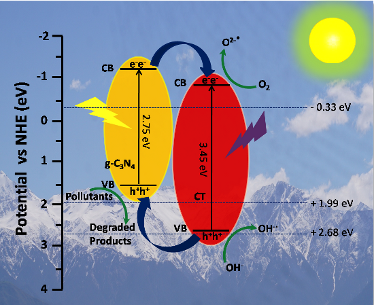
- specific surface area [24]. In this regard, various attempts have been made by researchers to eliminate these issues in recent times. Several strategies such as synthesis of mesoporous g-C3N4 [25], synthesis of 2D nanosheets [26], coupling with conductive materials [23], heterostructure formation with


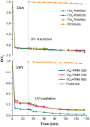
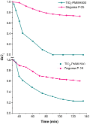
Photocatalytic and adsorption properties of TiO2-pillared montmorillonite obtained by hydrothermally activated intercalation of titanium polyhydroxo complexes
Beilstein J. Nanotechnol. 2018, 9, 364–378, doi:10.3762/bjnano.9.36
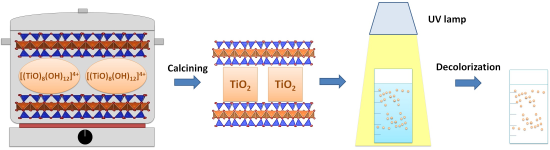
- samples are shown in Figure 6a. All the isotherms are characterized by the presence of capillary condensation hysteresis loops and belong to type IV according to IUPAC classification [39], which is typical for materials with mesoporous structure. Furthermore, the shape of the hysteresis loop for these






Sugarcane juice derived carbon dot–graphitic carbon nitride composites for bisphenol A degradation under sunlight irradiation
Beilstein J. Nanotechnol. 2018, 9, 353–363, doi:10.3762/bjnano.9.35
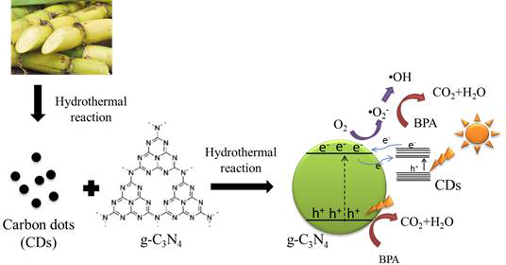
- [26][27], and degradation of pollutants [28][29][30]. However, the photocatalytic performance of bulk g-C3N4 remains unsatisfactory because of the fast recombination rate of electron pairs and narrower light absorption range over the entire solar spectrum. Turning g-C3N4 into a mesoporous nanorod


Synthesis and characterization of electrospun molybdenum dioxide–carbon nanofibers as sulfur matrix additives for rechargeable lithium–sulfur battery applications
Beilstein J. Nanotechnol. 2018, 9, 262–270, doi:10.3762/bjnano.9.28
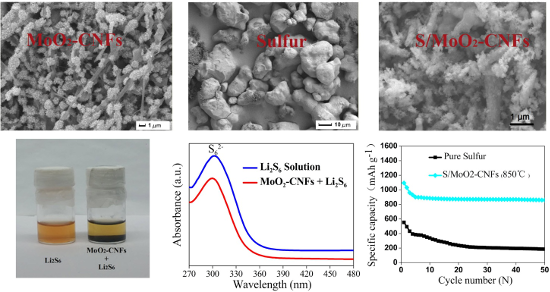
- new cell configuration [2]. Overall, it is critical to enhance the utilization of sulfur and stabilize the polysulfide within the cathodic region to yield Li–S batteries with improved electrochemical performance. For the past two decades, various carbon materials (e.g., mesoporous carbon [3


Review on optofluidic microreactors for artificial photosynthesis
Beilstein J. Nanotechnol. 2018, 9, 30–41, doi:10.3762/bjnano.9.5
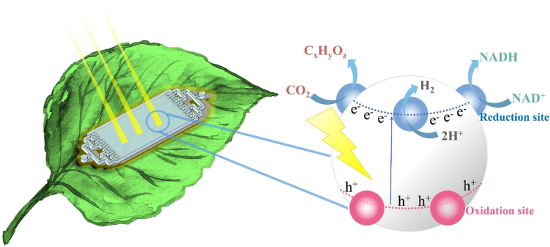
- membrane-based reactors were reported as well, for instance, mesoporous CdS/TiO2/SBA-15@carbon paper composite membranes [77] and copper-decorated TiO2 nanorod thin films [78]. In addition to the PDMS/PMMA-based microchannel reactors, bacterium has been shown to be a good microreactor as well. Yang et al


One-step chemical vapor deposition synthesis and supercapacitor performance of nitrogen-doped porous carbon–carbon nanotube hybrids
Beilstein J. Nanotechnol. 2017, 8, 2669–2679, doi:10.3762/bjnano.8.267
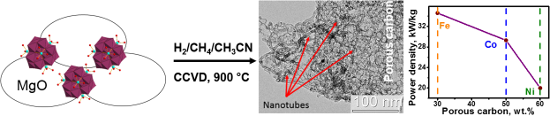
- works devoted to one-step formation of porous carbon–CNT hybrids for energy storage applications. Lei et al. have reported the CCVD synthesis of nitrogen-doped ordered mesoporous carbon and multiwalled CNTs (MWCNTs) with the use of a silica SBA-15 template impregnated by iron nitrate [14
- . The DTG temperature is dependent on the catalyst composition and for all components it grows in a sequence Fe < Co < Ni. The temperature of the maximal rate loss for porous carbon is 539–580 °С (component 1), which is characteristic for mesoporous carbon with a relatively low nitrogen content of 0.5


Synthesis of metal-fluoride nanoparticles supported on thermally reduced graphite oxide
Beilstein J. Nanotechnol. 2017, 8, 2474–2483, doi:10.3762/bjnano.8.247
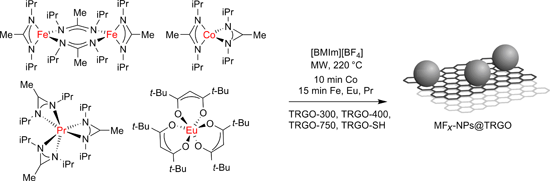
- ] yielded metal fluoride nanoparticles for Mn, Fe and Co [63]. The reaction of metal acetate (hydrate) precursors in ethylene glycol and an excess of [BMIm][BF4] gave fluoride nanoparticles [67]. Mesoporous carbon/iron carbide hybrids were synthesized using mesoporous silica as template and the ionic liquid


Fabrication of CeO2–MOx (M = Cu, Co, Ni) composite yolk–shell nanospheres with enhanced catalytic properties for CO oxidation
Beilstein J. Nanotechnol. 2017, 8, 2425–2437, doi:10.3762/bjnano.8.241
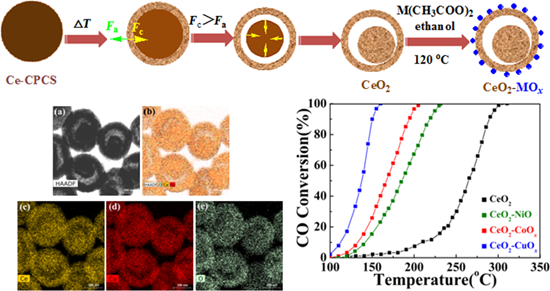
- CO oxidation [23]. Porous CeO2:Cu2+ materials with a tunable surface area were prepared through the thermolysis of a nanosized CeCu(BTC)(H2O)6 precursor [24]. Impressively, Ce2(SO4)3 was employed as the precursor to synthesize mesoporous CeO2–CuO bimetal oxide nanorods without the need for additional


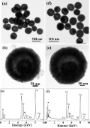

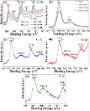


Fabrication of carbon nanospheres by the pyrolysis of polyacrylonitrile–poly(methyl methacrylate) core–shell composite nanoparticles
Beilstein J. Nanotechnol. 2017, 8, 1897–1908, doi:10.3762/bjnano.8.190

- nanomaterials, such as rattle-type magnetic carbon nanospheres (45.15 mg/g) [49], magnetic oxidized multiwalled carbon nanotube- κ-carrageenan-Fe3O4 nanocomposites (46.36 mg/g) [51], graphene (185.00 mg/g) [52], γ-Fe2O3 nanocrystal-anchored macro/mesoporous graphene (216.3 mg/g) [53], Fe3O4-graphene@mesoporous


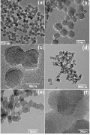

Two-dimensional carbon-based nanocomposites for photocatalytic energy generation and environmental remediation applications
Beilstein J. Nanotechnol. 2017, 8, 1571–1600, doi:10.3762/bjnano.8.159
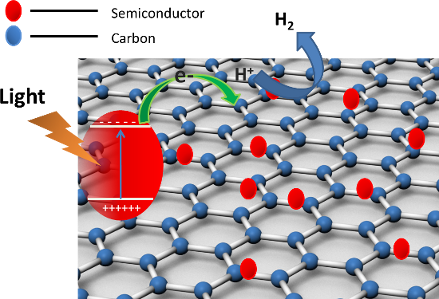


Oxidative chemical vapor deposition of polyaniline thin films
Beilstein J. Nanotechnol. 2017, 8, 1266–1276, doi:10.3762/bjnano.8.128
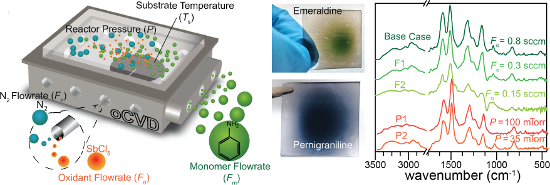
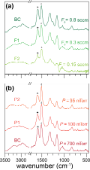
- aluminum oxide, mesoporous TiO2, and activated carbon; these oCVD PTh coatings resulted in enhanced charge storage due to preservation of the surface area and pore space within the nanostructures [32]. As a result, PTh-coated carbon electrodes showed a 50% increase in specific capacitance and excellent




Hierarchically structured nanoporous carbon tubes for high pressure carbon dioxide adsorption
Beilstein J. Nanotechnol. 2017, 8, 1135–1144, doi:10.3762/bjnano.8.115
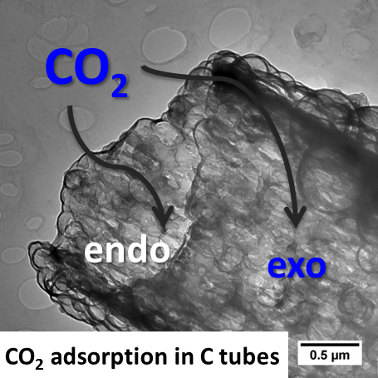
- tubes. Keywords: carbon dioxide adsorption; carbon tubes; gas adsorption; mesoporous carbon; Introduction Nanostructured carbon and silicon carbide materials have numerous potential applications. Structured carbons such as graphene, carbon nanotubes, carbon fibres or hierarchical porous carbons were
- mesoporous carbon [8], single-wall carbon nanotubes (CNTs) [9], multiwall CNTs [10], double-wall aligned CNTs [11] as well as graphene [12]. In the case of (ii), oxygen groups such as C–O and C=O were introduced on the carbon surface to enhance the adsorption of gases such as CO2 [11]. Silicon carbide is
- reduction at high temperatures (≈1300 °C) [22][23] or magnesio-thermic reduction at moderate temperatures (≈700 °C) [24]. Following these approaches, SiC nanotubes were successfully synthesized by reaction with CNTs [25][26], with porous aerogels [27], fibres [28], and ordered mesoporous SiC structures


Investigation of growth dynamics of carbon nanotubes
Beilstein J. Nanotechnol. 2017, 8, 826–856, doi:10.3762/bjnano.8.85
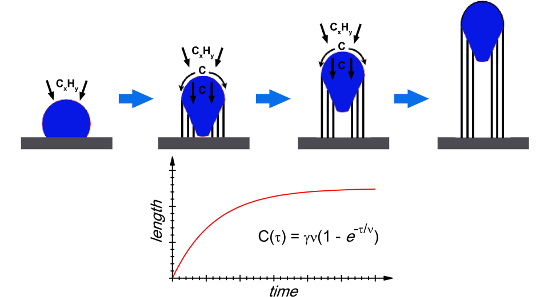
- -1 (mesoporous SiO2) support. 59.1% of semiconducting SWCNTs had the (9,8) chirality. It was suggested that strong metal-support interaction stabilized the Co clusters with a narrow diameter distribution around 1.2 nm, which were responsible for the selective growth of the (9,8) tubes. In [123], the


Recombinant DNA technology and click chemistry: a powerful combination for generating a hybrid elastin-like-statherin hydrogel to control calcium phosphate mineralization
Beilstein J. Nanotechnol. 2017, 8, 772–783, doi:10.3762/bjnano.8.80
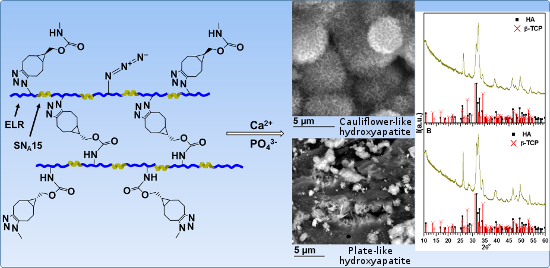
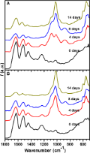
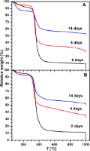
- in (composite) materials for bone regeneration [2][8]. Due to the correlation between the (crystal) structure and properties of CP, it is important to be able to control its nanostructures [9][10][11]. For example, hollow and mesoporous CP particles can be used for drug delivery due to their high



First examples of organosilica-based ionogels: synthesis and electrochemical behavior
Beilstein J. Nanotechnol. 2017, 8, 736–751, doi:10.3762/bjnano.8.77
- supercapacitor has a capacitance up to 90 F/g at room temperature [26]. Ameri et al. made IG transistors using graphene [27] for low voltage operation. Using a slightly different approach, Hesemann and coworkers and Néouze and coworkers incorporated IL-like functionalities into periodic mesoporous organosilicas
- box used for the experiments. Results Silica monoliths As stated in the introduction, mesoporous silica monoliths are often brittle and thus difficult to handle. The first goal of the current study is thus to provide a synthetic protocol towards more robust silica matrix materials suitable for IL
- ) pattern. All SAXS patterns show a strong scattering signal with a typical q−4 behavior indicating an amorphous, mesoporous system with strong phase boundaries and cylindrical pores, but without ordered mesopores [37]. This is confirmed by nitrogen sorption measurements, Figure 6. All monoliths show a type








Synthesis of graphene–transition metal oxide hybrid nanoparticles and their application in various fields
Beilstein J. Nanotechnol. 2017, 8, 688–714, doi:10.3762/bjnano.8.74
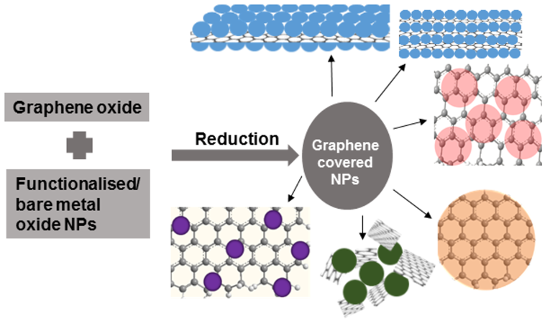
- higher than the efficiency of TiO2 nanospheres (65%) [97]. The graphene-based nanoarchitecture of TiO2 nanospindles [98], TiO2 nanorods [92] and TiO2 mesoporous [99] shows improved photocatalytic performance via structural optimisation of the architecture. Although most of the applications of graphene






Carbon nanotube-wrapped Fe2O3 anode with improved performance for lithium-ion batteries
Beilstein J. Nanotechnol. 2017, 8, 649–656, doi:10.3762/bjnano.8.69
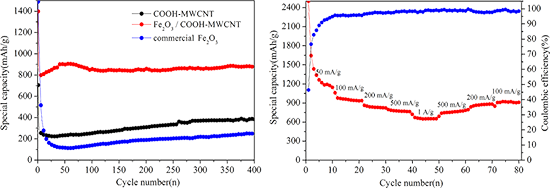
- . of composite materials. In this method, an Fe-based metal organic framework [MIL-88B (Fe)] was used as a precursor for the synthesis of spindle-like α-Fe2O3 nanoparticles with a mesoporous structure of less than 20 nm. When used as anode material for LIBs, these nanoparticles demonstrated a capacity


Fiber optic sensors based on hybrid phenyl-silica xerogel films to detect n-hexane: determination of the isosteric enthalpy of adsorption
Beilstein J. Nanotechnol. 2017, 8, 475–484, doi:10.3762/bjnano.8.51
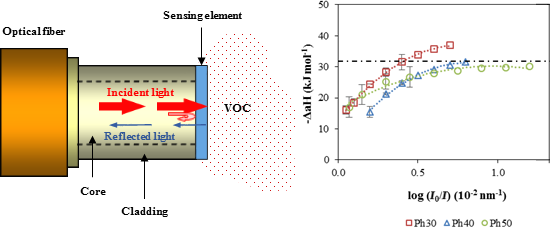
- hysteresis loops of type H-2, according to the International Union of Pure and Applied Chemistry classification [17]. The Type IV isotherms are characteristic of mesoporous materials common in many inorganic oxide gels having interconnected pore networks. The amount of adsorbed N2 decreased with an increase






The longstanding challenge of the nanocrystallization of 1,3,5-trinitroperhydro-1,3,5-triazine (RDX)
Beilstein J. Nanotechnol. 2017, 8, 452–466, doi:10.3762/bjnano.8.49
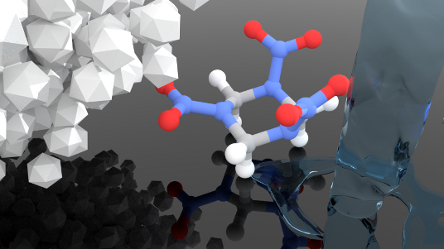
- . By drying with heating or at low pressure, a xerogel with higher density is obtained. If supercritical CO2 is used to extract the solvent, an aerogel with low density is formed. Therefore, the nanostructured nature of the explosive comes from the porous matrix: cavities of mesoporous gels are 2 to 50
- without RDX). Wuillaume et al. [28] trapped ammonium perchlorate (AP) and RDX in a mesoporous low-density energetic organogel. During the impact test, a negligible decrease of sensitivity was measured: 75 wt % RDX nanogels and macrogels had the same sensitivity and the 90 wt % nanogels are even more


Tailoring bifunctional hybrid organic–inorganic nanoadsorbents by the choice of functional layer composition probed by adsorption of Cu2+ ions
Beilstein J. Nanotechnol. 2017, 8, 334–347, doi:10.3762/bjnano.8.36
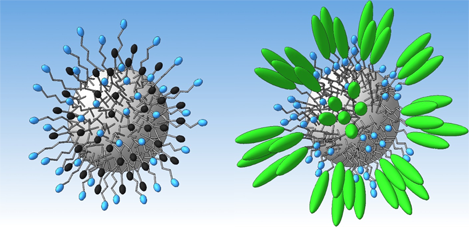
- opportunities, and in [20] the results dealing with the synthesis, structure, and properties of polysiloxane xerogels with bifunctional surface layers were summarized. In the beginning of the 21st century, the studies of synthesis of mesoporous silicas functionalized with various groups emerged, [21][22


Functionalized TiO2 nanoparticles by single-step hydrothermal synthesis: the role of the silane coupling agents
Beilstein J. Nanotechnol. 2017, 8, 304–312, doi:10.3762/bjnano.8.33
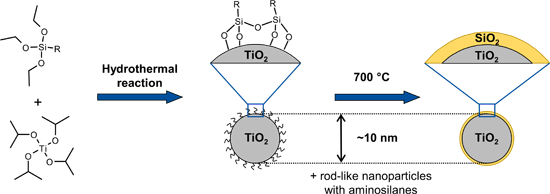
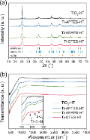
- the crystallite sizes determined by XRD, which suggest only weakly agglomeration in the powders after drying. The nitrogen adsorption and desorption isotherms of TiO2 and in situ surface-functionalized TiO2 nanoparticles demonstrate the hysteresis profile similar to mesoporous materials (Figure 4a



Performance of natural-dye-sensitized solar cells by ZnO nanorod and nanowall enhanced photoelectrodes
Beilstein J. Nanotechnol. 2017, 8, 287–295, doi:10.3762/bjnano.8.31
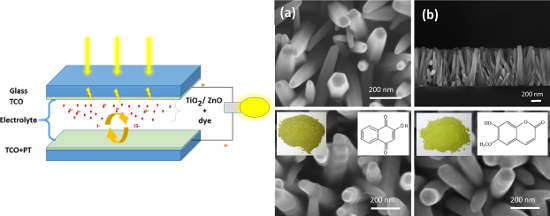
- represents the photoelectrode, composed of a wide band gap semiconductor thin layer coated on transparent conducting oxide (TCO) films. A mesoporous film layer is used as a semiconductor in the photoelectrode. Because of its stability and easy synthesis, titanium dioxide (TiO2) is mostly used as the
- ) has been studied as a mesoporous wide band gap semiconductor for use in DSSCs. It presents itself in the form of different morphological nanostructures, such as nanorods, nanocrystals, nanowires, nanotubes and nanowalls that can be exploited to optimize the dye loading [6][7][8][9]. The main purpose


Phosphorus-doped silicon nanorod anodes for high power lithium-ion batteries
Beilstein J. Nanotechnol. 2017, 8, 222–228, doi:10.3762/bjnano.8.24
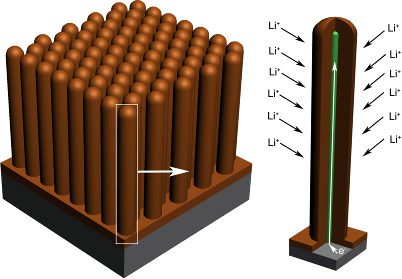
- with mesoporous carbon and crystalline TiO2 as the double shells. It delivered a high reversible capacity of 1726 mAh/g over 100 cycles [10]. Among various nanostructured Si anodes, the electrodes prepared by depositing Si layers directly on nanostructured current collectors always shows an improved


Effect of nanostructured carbon coatings on the electrochemical performance of Li1.4Ni0.5Mn0.5O2+x-based cathode materials
Beilstein J. Nanotechnol. 2016, 7, 1960–1970, doi:10.3762/bjnano.7.187
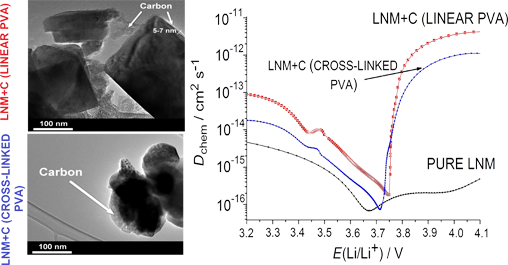
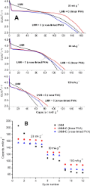
- observed, while for cross-linked PVA islands of mesoporous carbon are located on the boundaries of Li1.4Ni0.5Mn0.5O2+x particles. The presence of the carbon framework leads to a decrease of the polarization upon cycling and of the charge transfer resistance and to an increase in the apparent Li+ diffusion
- PVA, the polymer pyrolysis tentatively occurs without preliminary melting. The pyrolysis of PVA particles allocated in the voids between LNM crystallites results in forming mesoporous particulates of amorphous carbon in the interparticular space. Another difference between the pyrolysis products of
- of a carbon nanocoating and/or a mesoporous carbon framework does not alter the mechanism of lithium insertion–extraction into the Li1.4Ni0.5Mn0.5O2 structure but improves its kinetic and electrochemical properties. It is shown that even the nanosized layer of carbon complicates the transformation of



Chitosan-based nanoparticles for improved anticancer efficacy and bioavailability of mifepristone
Beilstein J. Nanotechnol. 2016, 7, 1861–1870, doi:10.3762/bjnano.7.178
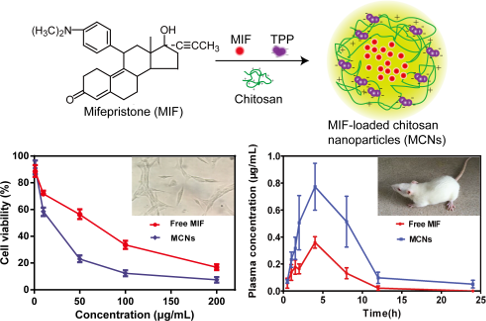
- could be another reason for the enhanced anti-proliferative efficiency of MCN. In our previous report, we loaded MIF into mesoporous silica nanoparticles (MSNs) coated with aEpCAM (aE-MSN-M) to target circulating tumor cells for cancer metastasis prevention, and also found that MIF entrapped in aE-MSN-M





