Search results
Search for "photon energy" in Full Text gives 137 result(s) in Beilstein Journal of Nanotechnology.
Photoresponse from single upright-standing ZnO nanorods explored by photoconductive AFM
Beilstein J. Nanotechnol. 2013, 4, 208–217, doi:10.3762/bjnano.4.21
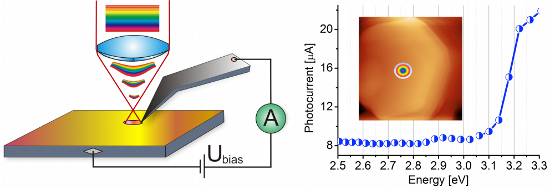
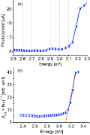
- ZnO NRs revealed that the minimum photon energy sufficient for photocurrent excitation is 3.1 eV. This value is at least 100 meV lower than the band-gap energy determined from the photoluminescence experiments. Conclusion: The obtained results suggest that the photoresponse in ZnO NRs under ambient
- 5b). The latter provides the energy corresponding to the transition involved in the photocarrier generation process. Interestingly, it has been found that the NRs are already sensitive to illumination with a wavelength of 400 nm, i.e., with a corresponding photon energy of 3.1 eV which is smaller
- by the dashed line in Figure 5b yields the transition energies involved in the photocarrier generation process. The obtained value Emin ≈ 3.1 eV is the minimum photon energy sufficient for the photoexcitation of mobile charge carriers. The value of 3.1 eV turned out to be at least 100 meV lower than



Towards atomic resolution in sodium titanate nanotubes using near-edge X-ray-absorption fine-structure spectromicroscopy combined with multichannel multiple-scattering calculations
Beilstein J. Nanotechnol. 2012, 3, 789–797, doi:10.3762/bjnano.3.88
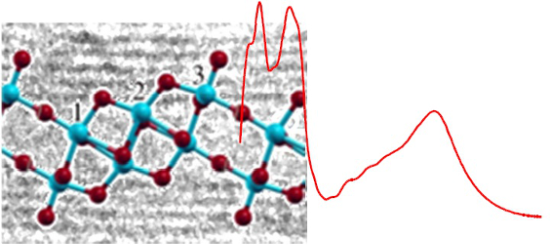
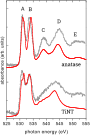
- measurements. NEXAFS spectra at the Ti L-edge recorded on (1) SrTiO3, (2) (Na,H)TiNTs and (3) anatase. The vertical lines indicate the photon energy of the first four X-ray images in Figure 2. The inset shows the pre-edge structures in the nanotube spectrum. (b) Ti L-edge spectra of (1) SrTiO3, (2) (Na,H)TiNTs



Ultraviolet photodetection of flexible ZnO nanowire sheets in polydimethylsiloxane polymer
Beilstein J. Nanotechnol. 2012, 3, 353–359, doi:10.3762/bjnano.3.41
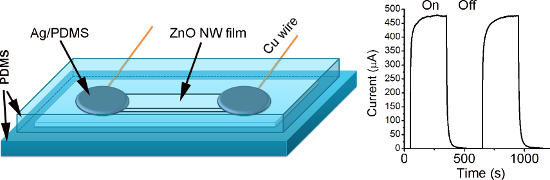
- photon energy higher than Eg generates electron–hole pairs in the ZnO. Holes migrate to the surface along the potential slope created by the band bending and recombine with O2-trapped electrons, thus releasing oxygen from the surface: O2–(ad) + h+ → O2(g). The heavily populated electrons in the


X-ray absorption spectroscopy by full-field X-ray microscopy of a thin graphite flake: Imaging and electronic structure via the carbon K-edge
Beilstein J. Nanotechnol. 2012, 3, 345–350, doi:10.3762/bjnano.3.39
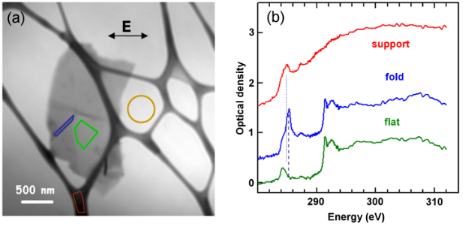
- ). During the data acquisition for a NEXAFS image stack, only the objective is moved, since the reflective condenser works largely independently of the photon energy of the illuminating X-rays. For the different photon energies there are slight changes in magnification, which are corrected by relocation of
- energy of this structure, indicating that the doping is rather uniform in the flake. In a recent theoretical study, spectral features appearing at 287–290 eV photon energy were associated with topological defects, such as monovacancies, divacancies and Stone–Wales defects [26]. In particular, a structure
- aXis2000 [27]. The NEXAFS spectra were normalized by using the signal intensity of the sample (the circled area in Figure 2) to correct for variations of the photon flux with photon energy (hν) and acquisition time. The sample was obtained from NanoIntegris (Illinois, USA) in the form of “PureSheets” (MONO



Junction formation of Cu3BiS3 investigated by Kelvin probe force microscopy and surface photovoltage measurements
Beilstein J. Nanotechnol. 2012, 3, 277–284, doi:10.3762/bjnano.3.31
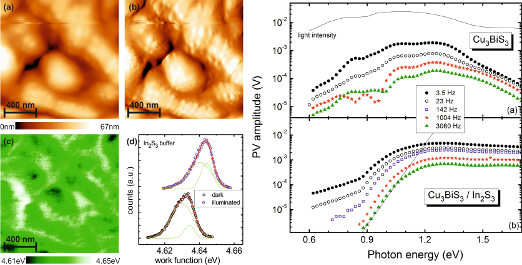
- ) and Cu3BiS3/In2S3 (b) samples. The x-signal begins at photon energies significantly below the optical band gap of Cu3BiS3. For Cu3BiS3 the in-phase PV signal is initially positive and increases to about 13 µV with increasing photon energy. Before a strong increase of the signal up to 114 µV at photon


X-ray spectroscopy characterization of self-assembled monolayers of nitrile-substituted oligo(phenylene ethynylene)s with variable chain length
Beilstein J. Nanotechnol. 2012, 3, 12–24, doi:10.3762/bjnano.3.2
- difference in attenuation of this signal in different films. Due to the quite close binding energies of the Au 4f and S 2p emissions, both signals are attenuated similarly, although not absolutely equally, as far as the primary excitation is performed at high photon energy. The S2p/Au4f intensity ratios for
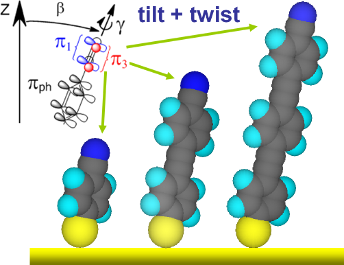
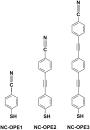
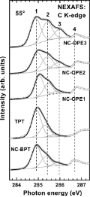
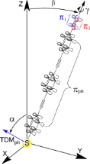
- monitored by plotting the difference between the NEXAFS spectra acquired at normal (90°) and grazing (20°) angles of X-ray incidence. The C K-edge NEXAFS spectra of the NC-OPEn SAMs acquired at an X-ray incidence angle of 55° are presented in Figure 3a, whereas the π*-resonance photon-energy range of these
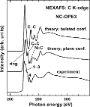
- higher photon energy. These spectra resemble that of benzonitrile [57][58] and are also typical of SAMs containing this moiety [29][30][33][59]. The appearance of the dominant double resonance is caused by the conjugation between the π* orbitals of the nitrile group and those of the adjacent phenyl ring



Investigation on structural, thermal, optical and sensing properties of meta-stable hexagonal MoO3 nanocrystals of one dimensional structure
Beilstein J. Nanotechnol. 2011, 2, 585–592, doi:10.3762/bjnano.2.62
- band gap is evaluated using K–M function as follows [27]: where F(R∞) is the K–M function or re-emission function, R∞ is the diffuse reflectance of an infinitely thick sample, K(λ) is the absorption coefficient, s(λ) is the scattering coefficient, hν is the photon energy and Eg is the band gap energy


Nanoscaled alloy formation from self-assembled elemental Co nanoparticles on top of Pt films
Beilstein J. Nanotechnol. 2011, 2, 473–485, doi:10.3762/bjnano.2.51
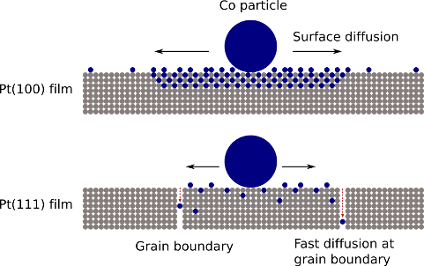
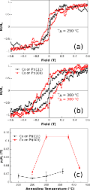
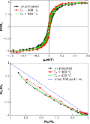
- recording the sample drain current (total electron yield, TEY) as a function of photon energy. External fields of up to µ0H = ± 3 T were available. Spectra and hysteresis loops were recorded and evaluated by methods described previously [11][28][29][30]. The insert to Figure 4a displays a typical pair of




Simple theoretical analysis of the photoemission from quantum confined effective mass superlattices of optoelectronic materials
Beilstein J. Nanotechnol. 2011, 2, 339–362, doi:10.3762/bjnano.2.40
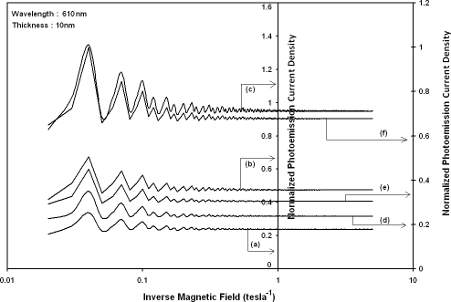
- superlattices, together with quantum well superlattices under magnetic quantization, has also been investigated in this regard. It appears, taking HgTe/Hg1−xCdxTe and InxGa1−xAs/InP effective mass superlattices, that the photoemission from these quantized structures is enhanced with increasing photon energy in
- photo-current density is [19] where e, m*, gv, kb, T, h, hν, are the electron charge, effective electron mass at the edge of the conduction band, valley degeneracy, the Boltzmann constant, temperature, the Planck constant, incident photon energy along the z-axis and work function respectively. It may
- be noted that the said equation is valid for both charge carriers and in this conventional form the photoemission changes with temperature, work function and the incident photon energy. This relation holds only under the condition of carrier non-degeneracy [20]. The following section gives the


Extended X-ray absorption fine structure of bimetallic nanoparticles
Beilstein J. Nanotechnol. 2011, 2, 237–251, doi:10.3762/bjnano.2.28
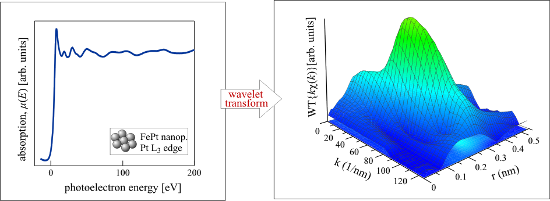
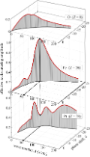
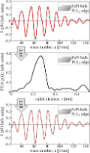
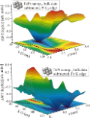
- particular element as a function of photon energy [36], partial FY [46][47] or total FY [48]. Also atomic EXAFS has been discussed assuming interstitial charges as scattering centres [49][50][51]. EXAFS analysis Nowadays, EXAFS analysis is usually carried out by the comparison of experimental data with




Structure, morphology, and magnetic properties of Fe nanoparticles deposited onto single-crystalline surfaces
Beilstein J. Nanotechnol. 2011, 2, 47–56, doi:10.3762/bjnano.2.6
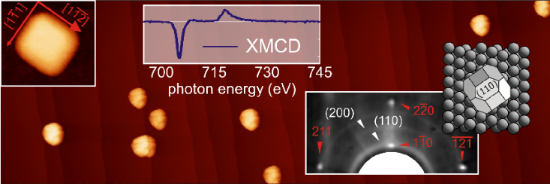
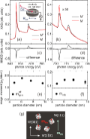
- electron yield at each photon energy and by switching the Ni film magnetization with a short external magnetic field pulse at each data point (a current of ≈100 A through two coils, 180 windings, magnetic field ≈1700 G). The photon helicity was kept fixed. Note that the nanoparticle data in Figure 2b are

Preparation and characterization of supported magnetic nanoparticles prepared by reverse micelles
Beilstein J. Nanotechnol. 2010, 1, 24–47, doi:10.3762/bjnano.1.5
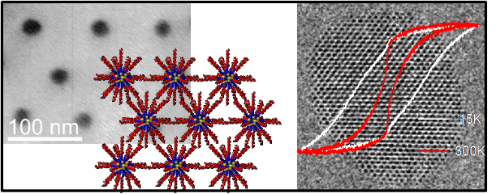
- total electron yield was recorded as function of photon energy in external fields up to 3 T and at variable temperatures between 11 K and 300 K [78]. Due to its surface sensitivity, it becomes possible to measure X-ray absorption spectra and hysteresis loops with high precision, even of NPs. Note that