Search results
Search for "texture" in Full Text gives 138 result(s) in Beilstein Journal of Nanotechnology.
Ferromagnetic behaviour of Fe-doped ZnO nanograined films
Beilstein J. Nanotechnol. 2013, 4, 361–369, doi:10.3762/bjnano.4.42
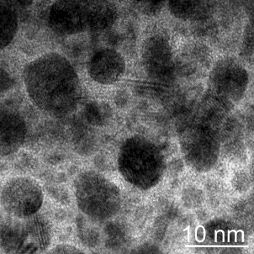
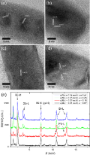
- with 31 and 40 atom % Fe. No visible texture can be observed in the deposited thin films, namely the diffraction rings shown in Figure 1b are uniform without any preferred orientations of ZnO grains. The observed FM behaviour in doped nanocrystalline as well as in dense ZnO films with 0.1 atom % Fe is
- previously that the texture or the amount of intergranular amorphous phase in the nanograined pure ZnO films drastically influences the FM properties even at the same grain size [68][69][70]. The GB structure also changes with increasing dopant content [71]. Moreover, by varying the synthesis conditions one
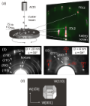
- structure; no texture is visible. Bright spots originate from the sapphire substrate. Magnetization (calibrated in units of Bohr magnetons per formula unit of ZnO) at RT for ZnO thin films doped with 0.1 atom % Fe deposited on the sapphire substrate. The curve was obtained after subtracting the magnetic


Characterization and properties of micro- and nanowires of controlled size, composition, and geometry fabricated by electrodeposition and ion-track technology
Beilstein J. Nanotechnol. 2012, 3, 860–883, doi:10.3762/bjnano.3.97
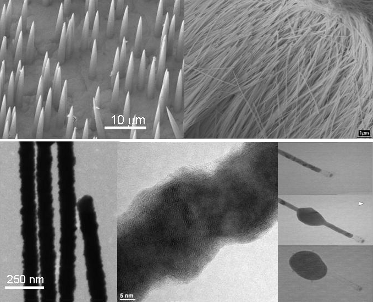
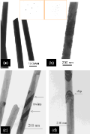
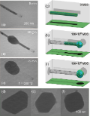
- anode. XRD and TEM revealed that the nanowires deposited potentiostatically are <110> textured. At higher temperatures and smaller overpotentials, the texture increases. At T = 60 °C and low overpotentials (e.g., Uc = −17 mV), single-crystalline wires are produced (Figure 9a). In contrast, wires
- deposited with reverse pulses exhibit a <100> texture and are polycrystalline with grain sizes of ca. 0.5 µm (Figure 9b). Bi nanowires with other preferred orientations have been synthesized by other techniques, such as low-temperature solvothermal process and high-pressure injection in alumina [89][90








Channeling in helium ion microscopy: Mapping of crystal orientation
Beilstein J. Nanotechnol. 2012, 3, 501–506, doi:10.3762/bjnano.3.57
- developed to obtain texture data or crystallographic information systematically in HIM. Especially the latter is an important issue in materials characterization. An important phenomenon that can be exploited in HIM for this purpose is channeling. This well-known process has been studied extensively in the
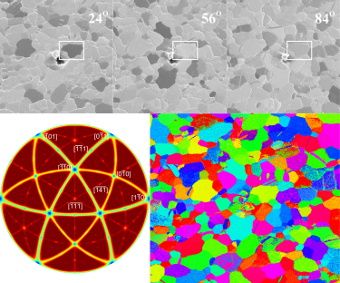
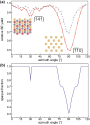
- microscopy In Figure 1 SE images of a polycrystalline gold film with a {111} texture are shown. The images with a field of view (FoV) of 10 µm were recorded by using a sample tilt (polar angle) of 35°, a PE of 15 keV and an ion dose of 4.9 × 1014 cm−2. In Figure 1a individual grains with an average size of 1
- which a <110> direction in this gold grain is parallel to the beam. For the marked grain the stage rotation angle for this condition is 24°. Conclusion We have demonstrated the importance of channeling in HIM using polycrystalline gold films with a <111> texture. To quantitatively explain the




Distribution of functional groups in periodic mesoporous organosilica materials studied by small-angle neutron scattering with in situ adsorption of nitrogen
Beilstein J. Nanotechnol. 2012, 3, 428–437, doi:10.3762/bjnano.3.49
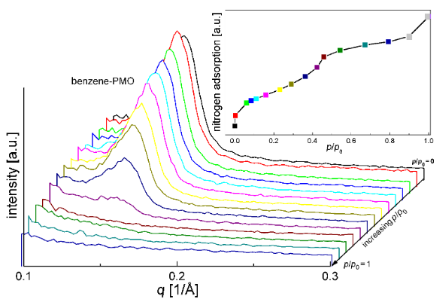
- . If grafting is performed at the silanol groups as well as the benzene rings, resulting in a total loading of 1.65 mmol SO3H per gram as determined by measuring the ion exchange capacity (IEC), the changes in the texture properties for modified benzene-PMO are even more pronounced, as documented by a


qPlus magnetic force microscopy in frequency-modulation mode with millihertz resolution
Beilstein J. Nanotechnol. 2012, 3, 174–178, doi:10.3762/bjnano.3.18
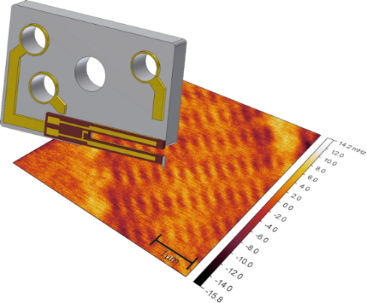
- this tip, and with an amplitude of 20 nm in both paths and a lift height of 45 nm, we imaged the bit structure of the hard-disc sample. The topographic image shows the typical surface texture of a hard disc (Figure 2a). The sizeable drift in both images is due to long measuring times, which were


Surface functionalization of aluminosilicate nanotubes with organic molecules
Beilstein J. Nanotechnol. 2012, 3, 82–100, doi:10.3762/bjnano.3.10
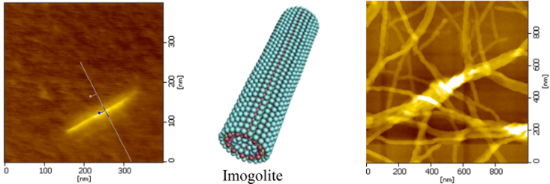
- organic molecules and determine both the individual morphology and the texture of the obtained nanohybrids [5][6]. Among various nanostructures with different shapes, nanotubes attract special research interest, not only because of their high mechanical strength, but also because of their large aspect


X-ray spectroscopy characterization of self-assembled monolayers of nitrile-substituted oligo(phenylene ethynylene)s with variable chain length
Beilstein J. Nanotechnol. 2012, 3, 12–24, doi:10.3762/bjnano.3.2
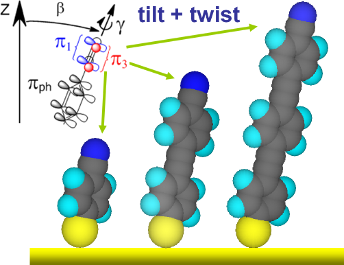
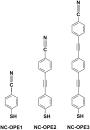
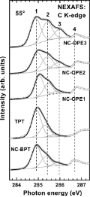
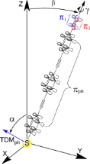
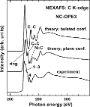
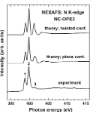
- evaporated films were polycrystalline, with a predominant (111) texture [40][70] and grain sizes of 20–50 nm. To prepare the SAMs, these substrates were immersed into a 1 mmol solution of the NC-OPEn compounds in toluene or in methylene chloride for 24 h at room temperature, with identical results in either



The effect of surface anisotropy in the slippery zone of Nepenthes alata pitchers on beetle attachment
Beilstein J. Nanotechnol. 2011, 2, 302–310, doi:10.3762/bjnano.2.35
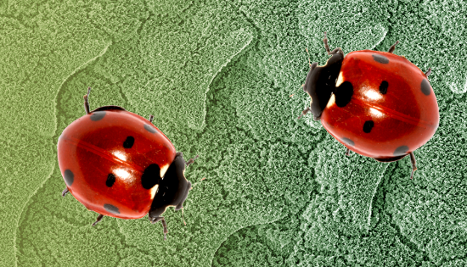
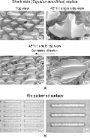
- pitchers (de-waxed pitcher upward versus replica upward: W = −116.000, T+ = 2.000, T− = −118.000, p < 0.001, Wilcoxon signed rank test; de-waxed pitcher downward versus replica downward: t = 4.966, p < 0.001, d.f. = 14, paired t-test). Discussion Texture of natural and artificial pitcher surfaces As in



Sorting of droplets by migration on structured surfaces
Beilstein J. Nanotechnol. 2011, 2, 215–221, doi:10.3762/bjnano.2.25
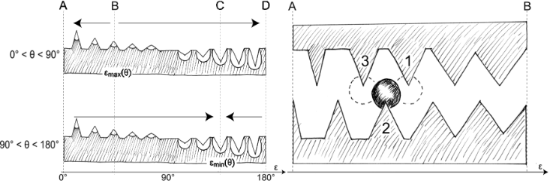
- about 60 mm/s. This effect can be obtained by varying 1) chemical contact angle, 2) surface texture, or 3) both parameters. In this contribution we describe how a controlled droplet movement can be achieved by a surface pattern consisting of cones and funnels whose length scales are comparable to the


Capillary origami: superhydrophobic ribbon surfaces and liquid marbles
Beilstein J. Nanotechnol. 2011, 2, 145–151, doi:10.3762/bjnano.2.18
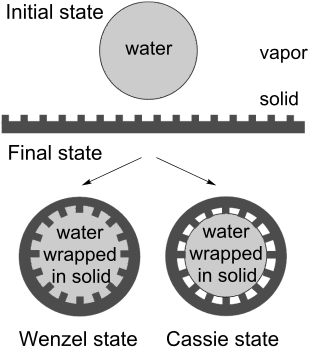
- anticipate that if the surface chemistry tends towards hydrophilic (i.e., θe < 90°) there might be a hemi-wicking effect with the liquid invading the surface texture, but wetting the asperities of the topographic features. A simple two-dimensional model consideration of the energy changes as a liquid invades



Biomimetics inspired surfaces for drag reduction and oleophobicity/philicity
Beilstein J. Nanotechnol. 2011, 2, 66–84, doi:10.3762/bjnano.2.9
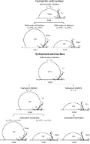
- et al. [54] showed that surface curvature, in conjunction with chemical composition and roughened texture, can be used for liquids with low surface tension, including alkanes such as decane and octane. Liu et al. [18] performed experiments in a solid-water-oil interface. They found that hydrophilic








Structure, morphology, and magnetic properties of Fe nanoparticles deposited onto single-crystalline surfaces
Beilstein J. Nanotechnol. 2011, 2, 47–56, doi:10.3762/bjnano.2.6
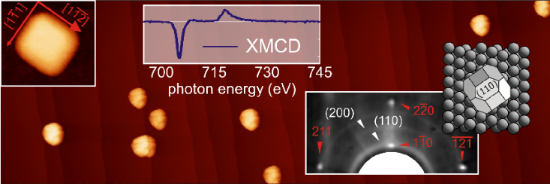
- , the particles possess a bulk-like Fe lattice. A texture in the (200) and (110) rings (marked by arrows in Figure 3b) also shows that the particles preferentially rest on their (001) and (110) surface facets, however, without any preferential azimuthal orientation. These data allow a major conclusion

Preparation and characterization of supported magnetic nanoparticles prepared by reverse micelles
Beilstein J. Nanotechnol. 2010, 1, 24–47, doi:10.3762/bjnano.1.5
- ArF laser was employed hitting a Pt target (purity 99.99%) at typical areal energy densities of 8 J/cm2. Details of the setup are described elsewhere [63][75]. The 50 nm polycrystalline Pt films exhibited a (111)-texture and a mean grain size of about 10 nm. Subsequent micelle deposition and plasma