


Search results
Search for "Ga" in Full Text gives 158 result(s) in Beilstein Journal of Nanotechnology.
Magnetic anisotropy of graphene quantum dots decorated with a ruthenium adatom
Beilstein J. Nanotechnol. 2013, 4, 441–445, doi:10.3762/bjnano.4.51
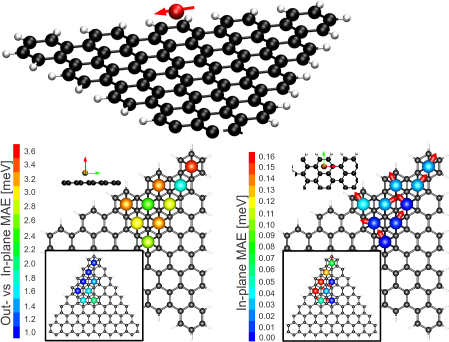
- 100 Å away from the flake plane. Acknowledgements We acknowledge financial support from EC FP7 e-infrastructures project MMM@HPC (GA 261594). KF thanks for support by the DFG-funded Transregional Collaborative Research Center SFB/TRR 88 “3 MET”. SS acknowledges the financial support of the


Synthesis and electrical characterization of intrinsic and in situ doped Si nanowires using a novel precursor
Beilstein J. Nanotechnol. 2012, 3, 564–569, doi:10.3762/bjnano.3.65
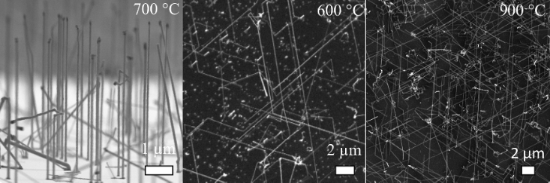
- adding HCl to the growth atmosphere [18]. For such VLS grown NW dopants can be introduced either through particular catalyst particles, such as In [19], Al [20] or Ga [21], which become partly incorporated into the NW during growth and thus work as p-type dopants themselves, or by adding a small amount


FTIR nanobiosensors for Escherichia coli detection
Beilstein J. Nanotechnol. 2012, 3, 485–492, doi:10.3762/bjnano.3.55
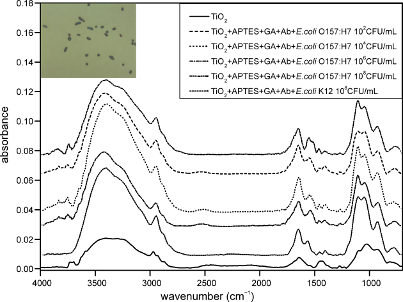
- necessary to improve the safety of our food supply chain. In this work we report on mesoporous titania thin-film substrates as sensors to detect E. coli O157:H7. Titania films treated with APTES ((3-aminopropyl)triethoxysilane) and GA (glutaraldehyde) were functionalized with specific antibodies and the
- %), glutaraldehyde (GA Grade I, 50% in H2O, specially purified for use as an electron microscopy fixative or other sophisticated use) were purchased from Sigma Aldrich (Germany). E. coli O157:H7 and E. coli K12 were obtained from the bacteria collection at Purdue University (Agricultural and Biological Engineering
- dried in air. The following functionalization of TiO2–APTES films with GA was obtained by immersing the films in GA 50% (v/v) in water for 24 h, washing with water and EtOH and drying at room temperature. Different experiments were realized, providing the immobilization of antibodies directly on titania


Junction formation of Cu3BiS3 investigated by Kelvin probe force microscopy and surface photovoltage measurements
Beilstein J. Nanotechnol. 2012, 3, 277–284, doi:10.3762/bjnano.3.31
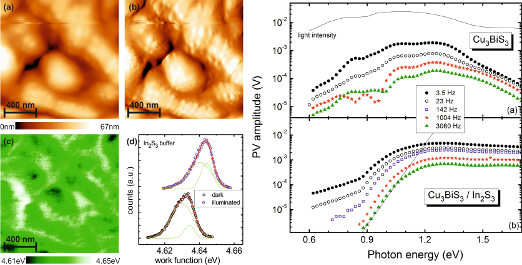
- charge-selective contact has to be increased. Keywords: buffer layer; Cu3BiS3; Kelvin probe force microscopy; solar cells; Introduction Thin-film solar cells based on absorbers made from Cu(In,Ga)Se2 [1] or CdTe [2] reach the highest efficiencies currently available. Both semiconductors are interesting
- photovoltaic active interface with a SPV of ~130 mV [7]. It is well known from the Cu(In,Ga)Se2 solar cells that a buffer layer is required between the n-ZnO window and the p-type absorber layer to reach high efficiency values [8]. Traditionally, CdS deposited by chemical bath deposition (CBD) has been used as
- , such as chemical bath deposition, atomic layer deposition, ion layer gas reaction (ILGAR) deposition, evaporation, and spray deposition [9]. One interesting aspect of the above mentioned solar cell materials CdTe and Cu(In,Ga)Se2 is their high efficiency despite the abundance of grain boundaries (GBs


Current-induced forces in mesoscopic systems: A scattering-matrix approach
Beilstein J. Nanotechnol. 2012, 3, 144–162, doi:10.3762/bjnano.3.15
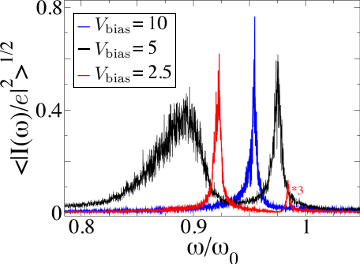
- order in , with G< = GR∑<GA. Current-induced forces in terms of Green’s functions We can now collect the results from the previous section and identify the current-induced forces appearing in the Langevin Equation 1. Except for the stochastic noise force, the current-induced forces are encoded in . In
- explicitly and using Equation 88 in Supporting Information File 1, Section A, we can express G< in terms of GR and GA and obtain where the second equality exploits the cyclic invariance of the trace. Noting that, by Equation 93 in Supporting Information File 1, Section A, Equation 37 can be expressed

![[Graphic 55]](/bjnano/content/inline/2190-4286-3-15-i141.png?max-width=637&scale=1.18182) can be tuned by the bias voltage. We consider...
can be tuned by the bias voltage. We consider...


When “small” terms matter: Coupled interference features in the transport properties of cross-conjugated molecules
Beilstein J. Nanotechnol. 2011, 2, 862–871, doi:10.3762/bjnano.2.95
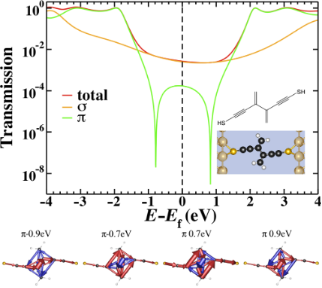
- transmission is generally calculated as [21] Gr(E) is the retarded Green’s function of the junction at energy E, Ga(E) is its conjugate transpose, and ΓL and ΓR are the broadening matrices describing the coupling to the left and right electrodes, respectively. In each of the three theoretical methods discussed




Dense lying self-organized GaAsSb quantum dots on GaAs for efficient lasers
Beilstein J. Nanotechnol. 2011, 2, 333–338, doi:10.3762/bjnano.2.39
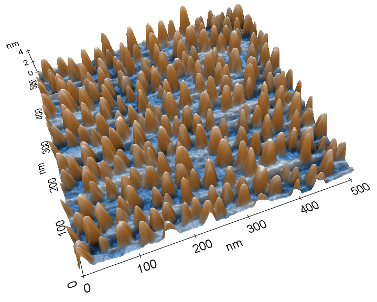
- –Krastanov (SK) epitaxial mode. Their characteristics were dependent on the Sb/Ga (V/III) flux ratio and the growth temperature. The samples were grown with a V/III ratio between 0.45/1 and 1.50/1 and a temperature between 445 and 580 °C, not commonly used by other research groups. These parameters enabled
- (SK) growth, depending on the precise control of the Sb/Ga V/III flux ratio, coverage, and growth temperature. Furthermore these parameters influence dot shape, size and density. The staggered (type-II) band alignment with a large valence band offset provides hole confinement. The electronic states
- lie in the GaAs conduction band continuum [1][2]. Bimberg et al. grew GaSb on GaAs with variable GaSb layer thickness [2][3][4][5]. Huffaker et al. achieved QDs by variation of the Sb/Ga flux ratio (V/III ratio) between 1.00/1 and 6.50/1 with a maximum dot density around 2.9 × 1010 cm−2 [1][6][7][8][9


On the reticular construction concept of covalent organic frameworks
Beilstein J. Nanotechnol. 2010, 1, 60–70, doi:10.3762/bjnano.1.8
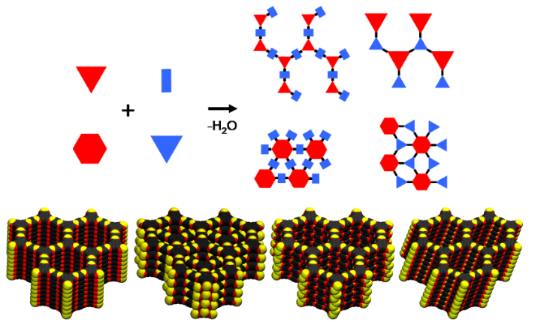
- calculated COF parameters. Supporting Information File 4: CIFs for selected structures. Acknowledgements Financial support by the European Union through the collaborative project FP7-NMP-2008-EU-India-2 GA 233482 and the German Research Council (DFG) is gratefully acknowledged.




Other Beilstein-Institut Open Science Activities



