


Search results
Search for "ammonia" in Full Text gives 153 result(s) in Beilstein Journal of Nanotechnology.
Investigation on structural, thermal, optical and sensing properties of meta-stable hexagonal MoO3 nanocrystals of one dimensional structure
Beilstein J. Nanotechnol. 2011, 2, 585–592, doi:10.3762/bjnano.2.62
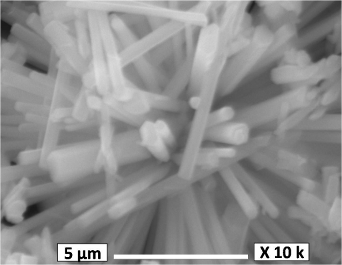
- nitrates and ammonia compounds from the material. The same observation is made from the DTA curve, which exhibits two broad exothermic peaks well below 270 °C. After dehydration and removal of ammonia compounds, a sharp exothermic peak at 430 °C with weight loss of 1.35 wt % is attributed to liberation of
- coordinated water and ammonia molecules from the internal structure of the MoO3 material, which promotes an irreversible phase transformation from the hexagonal to the orthorhombic structure [14][16]. The powder subjected to TGA measurements was subjected to XRD analysis, and the result confirmed that above


Schottky junction/ohmic contact behavior of a nanoporous TiO2 thin film photoanode in contact with redox electrolyte solutions
Beilstein J. Nanotechnol. 2011, 2, 127–134, doi:10.3762/bjnano.2.15
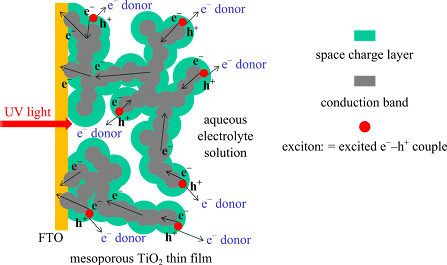
- ]. The present authors have reported a cell composed of a nanoporous semiconductor photoanode and an O2-reducing cathode that can efficiently photodecompose various bio-related compounds in water [11][12]. When ammonia was present in water in contact with a nanoporous TiO2 photoanode, the semiconductor
- formed a kind of Schottky junction, which induced efficient decomposition of ammonia with a high internal quantum efficiency (i.e., the number of decomposed molecules per photon activating an NH3 molecule) of over 100 (=104%) through auto-oxidative decomposition of the activated ammonia [12]. In




Magnetic nanoparticles for biomedical NMR-based diagnostics
Beilstein J. Nanotechnol. 2010, 1, 142–154, doi:10.3762/bjnano.1.17
- epichlorohydrin and activated by ammonia to provide primary amine group functionality. The amine groups can then be easily reacted with various agents containing anhydride, hydroxyl, carboxyl, thiol, or epoxide groups, to confer molecular specificity to the nanoparticle through bioconjugation [43]. Amine


Other Beilstein-Institut Open Science Activities



