


Search results
Search for "biosensors" in Full Text gives 151 result(s) in Beilstein Journal of Nanotechnology.
Electrochemical behavior of dye-linked L-proline dehydrogenase on glassy carbon electrodes modified by multi-walled carbon nanotubes
Beilstein J. Nanotechnol. 2010, 1, 135–141, doi:10.3762/bjnano.1.16
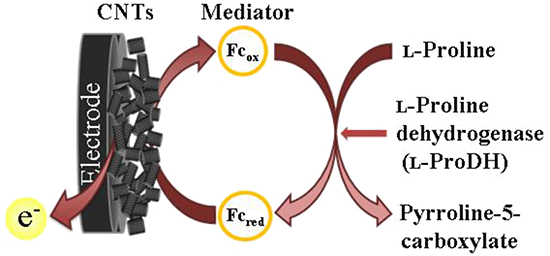
- require considerable time for analysis. In recent years, researchers have paid much more attention to the construction of electrochemical enzyme biosensors for the analysis of amino acids [5][6][7], and several electrochemical biosensing systems for L-proline and D-proline determination have been reported
- [8][9]. In the construction of enzyme biosensors, efficient communication between the active site of enzyme molecule and the electrode surface is one of the most important factors for sensor performance. As the protein shell always prevents the direct electron transfer from the active site of the
- enzyme, specific immobilization strategies, including electron mediators, should be considered [10][11][12]. In the last decade, the use of nano materials, especially carbon nanotubes (CNTs), in the construction of enzyme biosensors has received considerable attention. Because of their excellent


Other Beilstein-Institut Open Science Activities



