


Search results
Search for "current-voltage" in Full Text gives 161 result(s) in Beilstein Journal of Nanotechnology.
Current–voltage characteristics of single-molecule diarylethene junctions measured with adjustable gold electrodes in solution
Beilstein J. Nanotechnol. 2012, 3, 798–808, doi:10.3762/bjnano.3.89
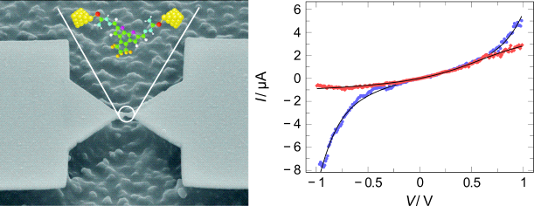
- current–voltage characteristics of these junctions are measured in a mechanically controlled break-junction system at room temperature and in liquid environment. We compare the transport properties of a series of molecules, labeled TSC, MN, and 4Py, with the same switching core but varying side-arms and
- [30][31]. Recently, low-temperature measurements of the current–voltage characteristics of single-molecule diarylethene junctions have been reported [32]. By applying the resonant-level model, the level alignment and the coupling strength of the dominant current-carrying molecular orbital (frontier
- several thousands of traces are used. A more detailed discussion about the histograms and the stability of individual junctions is given in Supporting Information File 1. For recording the current–voltage (I–V) characteristics the breaking procedure can be stopped at any position of the stretching or


The memory effect of nanoscale memristors investigated by conducting scanning probe microscopy methods
Beilstein J. Nanotechnol. 2012, 3, 722–730, doi:10.3762/bjnano.3.82
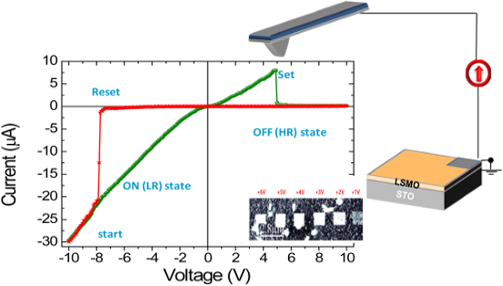
- ] and therefore the characterization of the local electrical properties becomes more and more important. In this work we have combined conductive scanning force microscopy imaging and single-point current–voltage spectroscopy, with more advanced spectroscopy measurements (3-D modes) to characterize the
- , interpretation of colour-coded current maps depends on the voltage sign as well as the absolute current magnitude. Thus higher currents appear darker in C-SFM images taken at negative Vtip, while brighter for positive Vtip. The current–voltage (I–V) characteristics of the contact were measured as a function of


Revealing thermal effects in the electronic transport through irradiated atomic metal point contacts
Beilstein J. Nanotechnol. 2012, 3, 703–711, doi:10.3762/bjnano.3.80
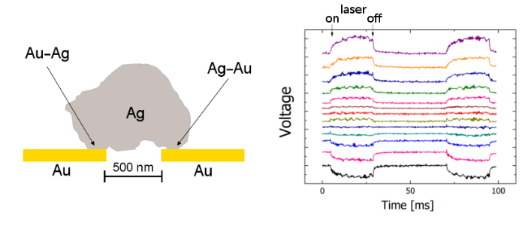
- electrode is controlled by the virtual ground technique implemented by the operational amplifier (OP2) in this current–voltage converter. The size of the atomic contact is controlled by applying the control potential Uec through amplifier OP1. The whole measurement is controlled by a home-written software





Low-temperature synthesis of carbon nanotubes on indium tin oxide electrodes for organic solar cells
Beilstein J. Nanotechnol. 2012, 3, 524–532, doi:10.3762/bjnano.3.60
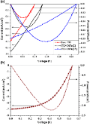
- with bare ITO-coated glass were also made for comparison with the same procedure. The current–voltage (I–V) characteristics under 1 sun (AM1.5G) were measured with an Agilent E5262A source meter. SEM images of MWCNTs grown on ITO-coated glass by CVD at: (a) 550 °C, (b) 525 °C, (c) 500 °C. Transmittance
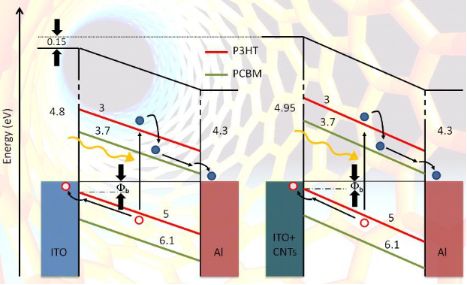
- 525 °C). WF levels for cells with ITO (left) and ITO–CNT (right) electrode. (All reported values are in eV and negative). Current–voltage characteristic and output power of P3HT:PCBM solar cells: (a) Cell C and cell C1, compared to a reference cell made with bare ITO-coated glass; (b) classic ITO




Structural, electronic and photovoltaic characterization of multiwalled carbon nanotubes grown directly on stainless steel
Beilstein J. Nanotechnol. 2012, 3, 360–367, doi:10.3762/bjnano.3.42
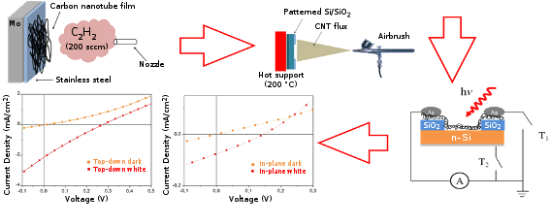
- compare the current–voltage curves collected. As reported in Figure 10a and Figure 10b, the open-circuit voltage (Voc) and the short-circuit density current (Jsc) in the in-plane configuration are markedly lower than those collected in the top-down geometry. The lower value of Jsc can be justified by the
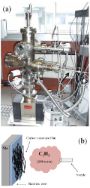


Ultraviolet photodetection of flexible ZnO nanowire sheets in polydimethylsiloxane polymer
Beilstein J. Nanotechnol. 2012, 3, 353–359, doi:10.3762/bjnano.3.41
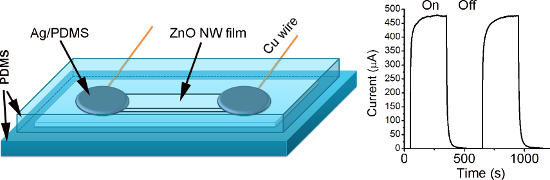
- PDMS would slowly spread out of the agglomeration of Ag nanoparticles and infiltrate the nanowire film due to capillarity. Figure 3a shows the current–voltage (I–V) curves of the device in PDMS, measured under UV-light illumination (312 nm, 30 mW·cm−2) and in the dark. The I–V curves of two other


Current-induced dynamics in carbon atomic contacts
Beilstein J. Nanotechnol. 2011, 2, 814–823, doi:10.3762/bjnano.2.90
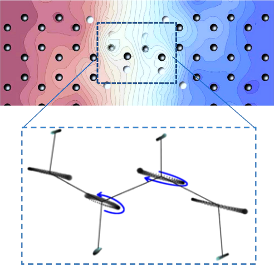
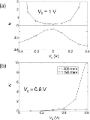
- applied between the two electrodes, Vb. We will show that this offers a convenient way to explore current-induced vibrational instabilities. We can already see the effect of the gate potential in the current–voltage (I − Vb) characteristics shown in Figure 2. The effect of the NC and BP forces is to
- perpendicular to the graphene surface. The center panel shows the calculated contour plot of the electrostatic-potential drop across the junction at Vg = 0 V, and Vb = 1 V. The equal drop at the left and right electrodes reflects the electron–hole symmetry for Vg = 0 V [40]. Current–Voltage (I−Vb) curves at



Nonconservative current-induced forces: A physical interpretation
Beilstein J. Nanotechnol. 2011, 2, 727–733, doi:10.3762/bjnano.2.79
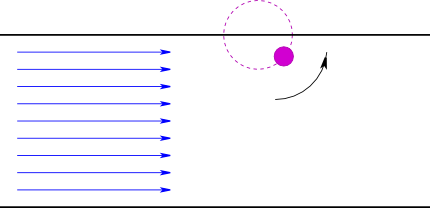
- –electron interactions, determine the current–voltage spectrum of the system. Allowing nuclei to respond to current-induced forces introduces two additional elements: Current-driven displacements and Joule heating. Current-induced forces arise, fundamentally, through momentum transfer from the electron flow

Charge transport in a zinc–porphyrin single-molecule junction
Beilstein J. Nanotechnol. 2011, 2, 714–719, doi:10.3762/bjnano.2.77
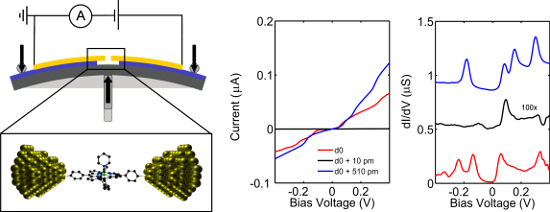
- allows us to characterize the transport in a molecular junction in detail. This complex molecule can form different junction configurations, having an observable effect on the trace histograms and the current–voltage (I(V)) measurements. Both methods show that multiple, stable single-molecule junction
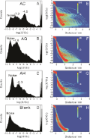
- (MCBJ) technique, we study the low-bias conductance as a function of the electrode displacement. In addition, we perform current–voltage measurements at different electrode spacings in order to gain spectroscopic information in the high-bias regime. The MCBJ technique is an elegant way to control the
- low-bias conductance of the molecule as a function of the electrode stretching. Second, we perform spectroscopy of the molecular energy levels by measuring current–voltage characteristics at fixed electrode spacings; this was done both at room temperature and cryogenic temperature (6 K). Results To


An MCBJ case study: The influence of π-conjugation on the single-molecule conductance at a solid/liquid interface
Beilstein J. Nanotechnol. 2011, 2, 699–713, doi:10.3762/bjnano.2.76
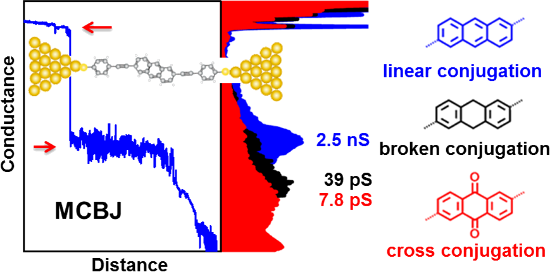
- current–distance and current–voltage measurements revealed details of the influence of π-conjugation on the single-molecule conductance. Keywords: anthraquinone; π-conjugation; mechanically controlled break junction; single-molecule conductance; Introduction Molecular electronics has expanded
- ), and a dihydroanthracene-based wire with a broken π-conjugation (AH) (Figure 1). The transport characteristics in single molecular junctions were investigated by conductance–distance as well as continuous current–voltage measurements in complementary MCBJ and STM-BJ experiments. In particular, a custom
- same analysis method to the blue traces did not lead to any clear feature between 10−1 G0 and 10−8 G0, which supports the assignment of the two types of traces. Continuous current–voltage (I–V) measurement I–V curves in the stretching process The high mechanical stability of the MCBJ setup provides a




Charge transfer through single molecule contacts: How reliable are rate descriptions?
Beilstein J. Nanotechnol. 2011, 2, 416–426, doi:10.3762/bjnano.2.47
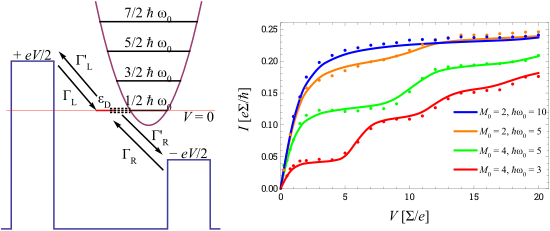
- molecule, i.e., with Single charge tunneling through the device can be formally and exactly captured under weak conditions (e.g., instantaneous equilibration in the leads during charge transfer) within the Meir–Wingreen formulation based on nonequilibrium Green’s functions [14][15]. For the current
- –voltage characteristics one finds with energy dependent lead self-energies ∑α(ε) = 2π∑k|Tk,α|2δ(ε – εk) and with the Fourier transforms of the time dependent Green’s functions and . Upon applying the polaron transformation (Equation 2), one has where all expectation values are calculated with the full


![[Graphic 38]](/bjnano/content/inline/2190-4286-2-47-i61.png?max-width=637&scale=1.18182) ω0 and versus the electron–phonon coupling m0.
ω0 and versus the electron–phonon coupling m0.





