Search results
Search for "disorder" in Full Text gives 199 result(s) in Beilstein Journal of Nanotechnology.
Metal hydrides: an innovative and challenging conversion reaction anode for lithium-ion batteries
Beilstein J. Nanotechnol. 2015, 6, 1821–1839, doi:10.3762/bjnano.6.186
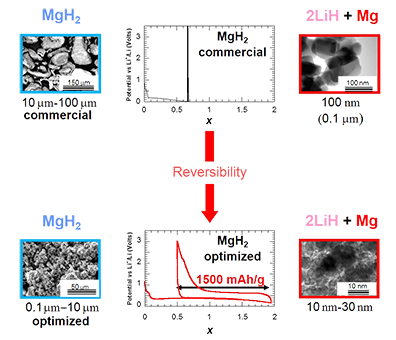
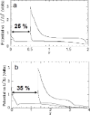
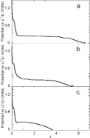
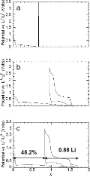
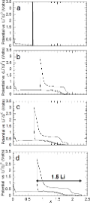
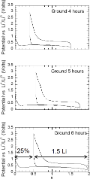
- fracture of the C–C covalent bonds, leading to the formation of very reactive edge carbon atoms and unstable particles which agglomerate together. The degree of disorder for carbonaceous materials increases with increased milling time and is proportional to the d(002) distance, as previously established










Possibilities and limitations of advanced transmission electron microscopy for carbon-based nanomaterials
Beilstein J. Nanotechnol. 2015, 6, 1541–1557, doi:10.3762/bjnano.6.158
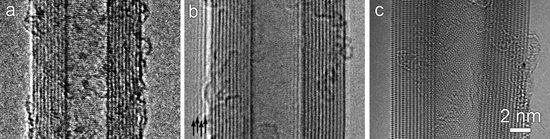
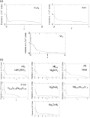
- , resulting in structural disorder. Severe continuous illumination may eventually lead to complete amorphization of the lattice at room temperature [36]. As demonstrated in Figure 4c–e, an ordered graphene lattice is transformed into a disordered two-dimensional (2D) carbon glass by continuous irradiation at


Current–voltage characteristics of manganite–titanite perovskite junctions
Beilstein J. Nanotechnol. 2015, 6, 1467–1484, doi:10.3762/bjnano.6.152
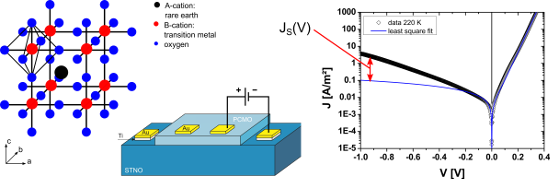
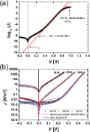
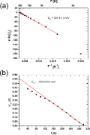
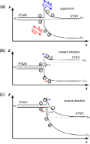
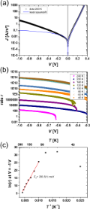
- direction, kppd approaches kppd,eq and Equation 15 reduces to the conventional Shockley equation with ideality factor n = 1. Disorder and polycrystalline structure have a strong impact on the electrical transport in organic junctions, since the polarons can be trapped at defects. Consequently, the absolute
- value and the temperature dependence of RS strongly depend on disorder. Since either the electron- or the hole-type polaron can be trapped, the resulting two different bimolecular recombination processes can be modelled as two different currents, which thus gives rise to an effective two diode Shockley





Nano-contact microscopy of supracrystals
Beilstein J. Nanotechnol. 2015, 6, 1229–1236, doi:10.3762/bjnano.6.126
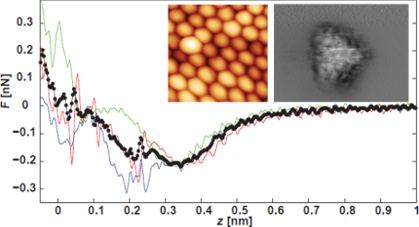
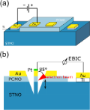
- depends both on the effective dimensionality and the amount of topological/charge disorder in the system. The distribution of nanocrystal connectivity due to this disorder plays an essential role in determining the topological “landscape” for charge transport, which can be affected at the nanoscopic

![[Graphic 1]](/bjnano/content/inline/2190-4286-6-126-i1.png?max-width=637&scale=1.18182) = 20 pA, ...
= 20 pA, ...


Charge carrier mobility and electronic properties of Al(Op)3: impact of excimer formation
Beilstein J. Nanotechnol. 2015, 6, 1107–1115, doi:10.3762/bjnano.6.112
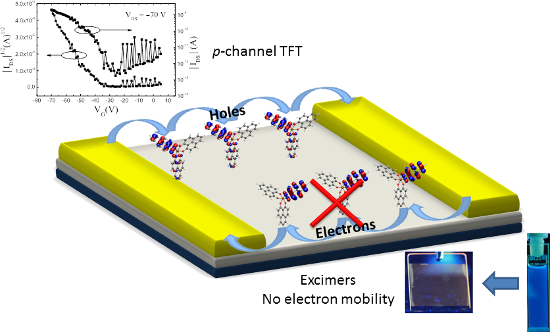
- deviations between the vacuum and matrix dipole moments arise from induction and polarization effects present only in the matrix, which influence the energy disorder. Furthermore, we calculated the width of the local density of states for additional charges (if a Gaussian shape is assumed, this is referred
- to as energy disorder, σ), the mean electronic coupling between molecules,
, the mean number of neighbors, M, and the reorganization energy, λ. These results are shown in Table 2. These microscopic parameters can be used to calculate the charge carrier mobility [41]: where e is the electric
- × 10−6 cm2·V−1·s−1 for electrons, which can be compared to Alq3 having a hole mobility of 3.3 × 10⁻⁸ cm2·V−1·s−1 and an electron mobility of 9.2 × 10⁻⁸ cm2·V−1·s−1. The differences between AlOp3 and Alq3 mainly arise from different dipole moments, which lead to a higher energy disorder, σ, for Alq3. Al


Electron-stimulated purification of platinum nanostructures grown via focused electron beam induced deposition
Beilstein J. Nanotechnol. 2015, 6, 907–918, doi:10.3762/bjnano.6.94
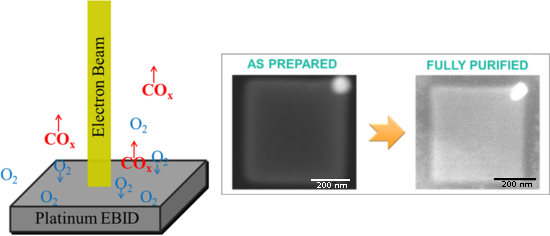
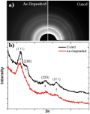
- -deposited diffraction pattern exhibits broad diffraction rings characteristic of small grain size and possibly disorder due to high carbon content. The diffraction peaks narrow as grain size increases after curing. Grain coarsening is commonly associated with an increase in electrical conductivity of the




Entropy effects in the collective dynamic behavior of alkyl monolayers tethered to Si(111)
Beilstein J. Nanotechnol. 2015, 6, 583–594, doi:10.3762/bjnano.6.60
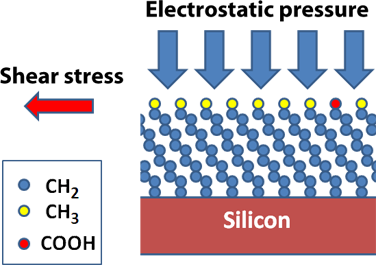
- , lateral (in-plane) inhomogeneity and transverse gradient of disorder [3]. As far as disorder is concerned, in model systems made of linear alkyl chains tethered in a densely packed array, experiments and simulations indicate that a quasi-perfect order can be obtained (at least locally) at low temperature
- chain segments located away from the head towards the molecular tail. The strain-induced formation of gauche defects, initiating at outer bonds (end-gauche) and proceeding inward (kinks and gauche–gauche conformers) [3][17][22] results into a disorder gradient. Another important issue related to energy
- dissipation mechanisms is the behavior of tethered OML under compressive and shear forces, as found in nano-tribology experiments, where external forces can cause conformational changes. Again, a disorder gradient results from the formation of gauche defects which can be reverted when the atomic force




Influence of grain size and composition, topology and excess free volume on the deformation behavior of Cu–Zr nanoglasses
Beilstein J. Nanotechnol. 2015, 6, 537–545, doi:10.3762/bjnano.6.56
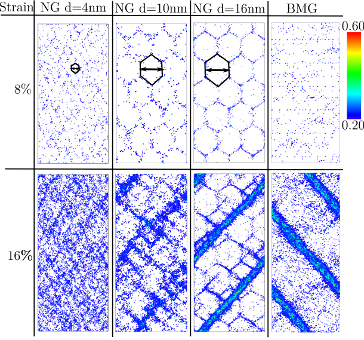
- interfaces don’t show topological disorder. Our results provide clear evidence that the mechanical properties of metallic NGs can be systematically tuned by controlling the size and the chemical composition of the glassy nanograins. Keywords: enhanced plasticity; metallic glasses; nanoglasses; shear bands
- deformation observed in the BMG. However, after a thermal annealing step, the excess free volume is equilibrating and only topological disorder can still be found in the glass–glass interfaces, which is having a minor influence on the formation of shear transformation zones. In the Zr-rich system (Cu36Zr64



In situ scanning tunneling microscopy study of Ca-modified rutile TiO2(110) in bulk water
Beilstein J. Nanotechnol. 2015, 6, 438–443, doi:10.3762/bjnano.6.44
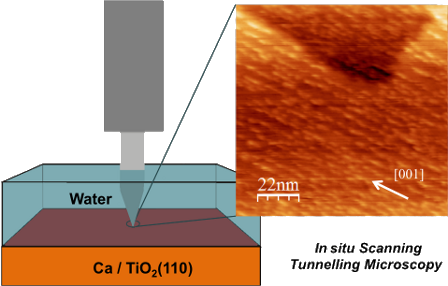
- (110) surface, and correspond to the 1 × 1 termination as shown in Figure 1a. Marked streaks appear along the columns of spots aligned in the direction, indicating the lack of in-phase correlation as a consequence of some degree of disorder in this direction. This is likely related to oxygen


Release behaviour and toxicity evaluation of levodopa from carboxylated single-walled carbon nanotubes
Beilstein J. Nanotechnol. 2015, 6, 243–253, doi:10.3762/bjnano.6.23
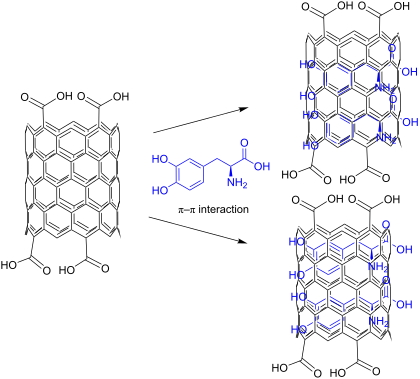
- Paralysis Agitans is a type of neurodegenerative disorder that affects one in every 100 persons above the average age of 65 years [10]. This disease, which affects the central nervous system, was first reported by Dr. James Parkinson in 1817 and was documented as “An Essay on the Shaking Palsy” [11]. A
- . All of the spectra revealed the presence of a radial breathing mode (RBM) and two characteristic bands of SWCNTs: the D-band (disorder-induced mode) was observed at 1342 cm−1 and the G-band (graphitic-like mode) was displayed at 1575 cm−1 for SWCNT–COOH and 1579 cm−1 for SWCNT–LD [18]. The RBM of the
- SWCNTs is a low frequency mode generated by the synchronous movement of the carbon atoms in the radial direction [19] and can be observed at 155 and 264 cm−1. The D-band is attributed to the non-crystalline quality of the carbon structures, due to defects or disorder content in the CNTs [20], whereas the




X-ray photoelectron spectroscopy of graphitic carbon nanomaterials doped with heteroatoms
Beilstein J. Nanotechnol. 2015, 6, 177–192, doi:10.3762/bjnano.6.17
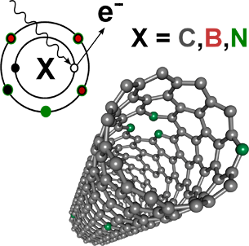
- preparation, the nanotubes can have a wide range of disorder, diameters, lengths, and degrees of bundling, factors which may all affect the measurement. The second difference, on the other hand, is the complication that samples of SWCNTs typically contain a mixture of semiconducting and metallic tubes, and
- measurements on multiwalled nanotubes as surveyed by Schiessling et al., who reported the same position of the C 1s line as for graphite but a larger FWHM at 0.63 eV [82]. However, they attributed this at least partly to remaining disorder or impurities even in the best samples, and cited a number of other


Bright photoluminescence from ordered arrays of SiGe nanowires grown on Si(111)
Beilstein J. Nanotechnol. 2014, 5, 2498–2504, doi:10.3762/bjnano.5.259
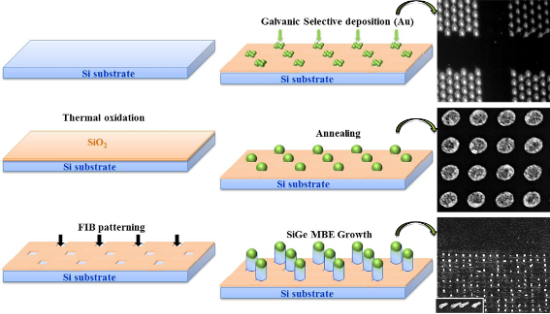
- opposed to the usual alloy disorder effect resulting in a breakdown in the wave vector selection rules. Using the results obtained from the fits to the sample with the strongest PL (sample (C)), the NW TA and TO phonon energies are found to be 15.7 (1.8) and 57.8 (0.6) meV, respectively, which agree very


Carbon nano-onions (multi-layer fullerenes): chemistry and applications
Beilstein J. Nanotechnol. 2014, 5, 1980–1998, doi:10.3762/bjnano.5.207
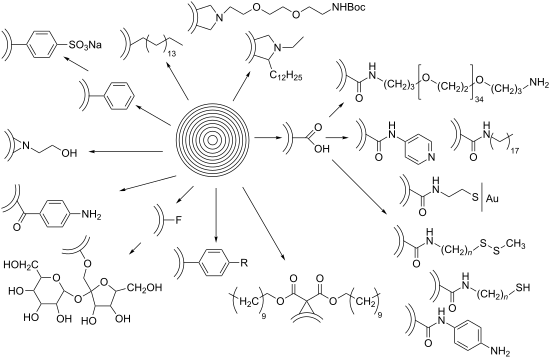
- structure of carbon nano-onions [10][12][20][21]. Typically, two broad Raman bands can be readily observed in the area between 1300 and 1600 cm−1 (Figure 2). The D-band at around 1350 cm−1 resembles structural disorder due to the presence of sp3 carbons, while the G-band at around 1580 cm−1 corresponds to


The influence of molecular mobility on the properties of networks of gold nanoparticles and organic ligands
Beilstein J. Nanotechnol. 2014, 5, 1664–1674, doi:10.3762/bjnano.5.177
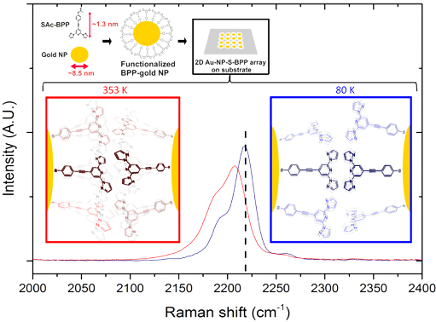
- Arrhenius plot for the S-BPP network in Figure 5b. One should point out that the transport measurements per se do not present a conclusive evidence of disorder-enhanced conductivity of nanoparticles networks. However, the combination of Raman spectroscopy and transport measurements favours such a model
- , proposing a new approach for understanding how disorder can impact the transport properties in molecular junctions. Additional calculations will be required to extend our hypothesis of fluctuations-enhanced transport between particles, taking into account the percolation character of transport in
- electrical properties of the S-BPP networks, which shows a clear deviation from Arrhenius behaviour above 220 K. Hence, our work suggests that the conductance behaviour of molecule–nanoparticle arrays can be tuned as an indicator of dynamical disorder in these structures, which can be a prerequisite to




On the structure of grain/interphase boundaries and interfaces
Beilstein J. Nanotechnol. 2014, 5, 1603–1615, doi:10.3762/bjnano.5.172
- developed [27]. Enormous efforts that will involve ab initio methods and take into account interatomic (including electronic) interactions will be necessary to improve the situation. Lower limit: the concept of representative volume (with a focus on the region of disorder) It was pointed out [27] that a


Donor–acceptor graphene-based hybrid materials facilitating photo-induced electron-transfer reactions
Beilstein J. Nanotechnol. 2014, 5, 1580–1589, doi:10.3762/bjnano.5.170
- graphite exhibits two characteristic Raman modes, namely the G-band, due to the presence of sp2-hybridized carbon atoms at 1585 cm−1 and the 2D band at a higher frequency of around 2725 cm−1. In addition, functionalized graphene sheets exhibit a new band, the so-called disorder D-band at around 1350 cm−1


Topology assisted self-organization of colloidal nanoparticles: application to 2D large-scale nanomastering
Beilstein J. Nanotechnol. 2014, 5, 1203–1209, doi:10.3762/bjnano.5.132
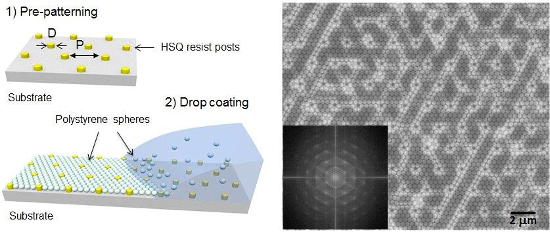
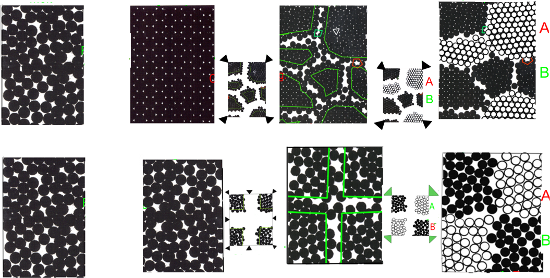
- with pitches higher than 7, i.e., for 10 pitches and 20 pitches, a disorder in the arrangement of the PS beads is observed as seen in Figure 3c and Figure 3d. The boundaries between the different grain orientations are clearly recognizable. This disorder increases with an increasing distance between


Manipulation of isolated brain nerve terminals by an external magnetic field using D-mannose-coated γ-Fe2O3 nano-sized particles and assessment of their effects on glutamate transport
Beilstein J. Nanotechnol. 2014, 5, 778–788, doi:10.3762/bjnano.5.90
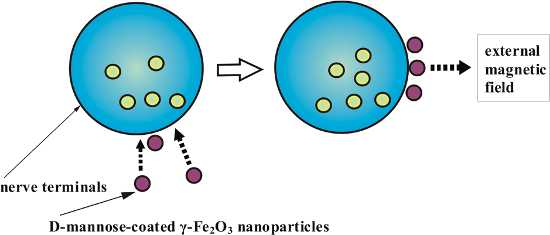
- methodological approaches for the manipulation of nerve cells by an external magnetic field can open new possibilities in disorder treatment. Methods based on the remote manipulation of magnetic nanoparticle-labeled cells by magnetic fields are receiving a great attention essentially because magnetic fields are



High activity of Ag-doped Cd0.1Zn0.9S photocatalyst prepared by the hydrothermal method for hydrogen production under visible-light irradiation
Beilstein J. Nanotechnol. 2014, 5, 587–595, doi:10.3762/bjnano.5.69
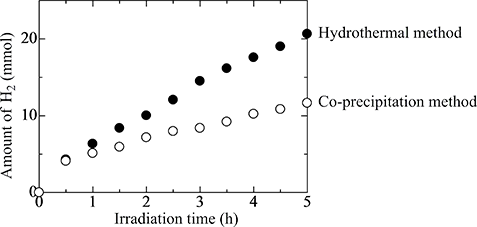
- increase the intensity of the diffraction peaks. With increasing amount of Ag dopant, the peaks became slightly broader (Figure 1b–d) since Ag might be clustered and in turn gave a slightly increased disorder. As the diffraction peaks were only slightly shifted to higher values of 2θ with increasing amount


Nanoscale patterning of a self-assembled monolayer by modification of the molecule–substrate bond
Beilstein J. Nanotechnol. 2014, 5, 258–267, doi:10.3762/bjnano.5.28
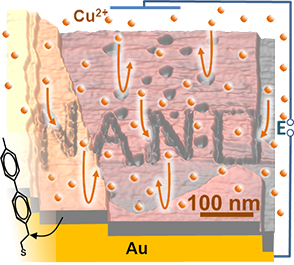
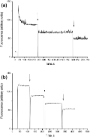
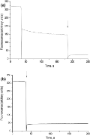
- during the UPD process. This further corroborates that, after removal of thiols by pulsing, thiols diffuse back into the defect from the surrounding area. Obviously, the SAM can bear a certain level of disorder/defects before the passivation against UPD breaks down. Even though it was not a focus of the


Some reflections on the understanding of the oxygen reduction reaction at Pt(111)
Beilstein J. Nanotechnol. 2013, 4, 956–967, doi:10.3762/bjnano.4.108
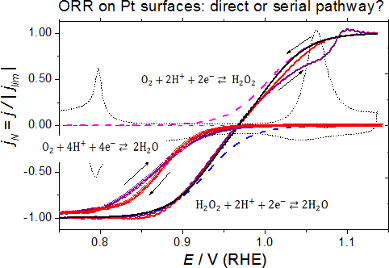
- coming from the solution that destroy these characteristic features. If both contamination and surface disorder appear, a fitting with theoretical models will be very difficult. In addition, if in this case both experimental measurements and theoretical calculations agree, one can consider that the
- higher PtO coverages that could further produce more oxidized forms. In these latter cases, however, the surface will start to disorder and would no longer be a flat, well-ordered Pt(111) surface. Oxygen reduction reaction (ORR) on Pt(111) The cyclic voltammetric profile (CV) for the ORR on Pt(111), in


A facile synthesis of a carbon-encapsulated Fe3O4 nanocomposite and its performance as anode in lithium-ion batteries
Beilstein J. Nanotechnol. 2013, 4, 699–704, doi:10.3762/bjnano.4.79
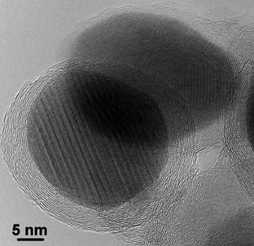
- characteristic of the D (disorder-induced phonon mode [17]) and G (graphitic lattice mode E2g [18]) bands of carbon, respectively. The intensity ratio IG/ID of 0.7 indicates that a significant quantity of disordered carbon is also present in the nanocomposite. In addition, the A1g vibration mode of the Fe3O4


Evolution of microstructure and related optical properties of ZnO grown by atomic layer deposition
Beilstein J. Nanotechnol. 2013, 4, 690–698, doi:10.3762/bjnano.4.78
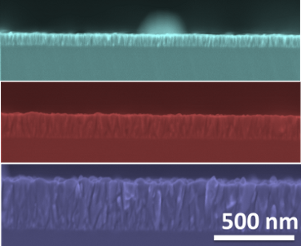
- . However, results obtained from 25 nm films do not show any significant increase of the band gap value. This hints at an absence of small crystallites in the amorphous structure of the films. Because of the disorder in amorphous and highly doped semiconductors, the absorption or the optical density D near


Nanoglasses: a new kind of noncrystalline materials
Beilstein J. Nanotechnol. 2013, 4, 517–533, doi:10.3762/bjnano.4.61
- al. [37]. These results are in line with observations on pre-induced shear bands produced by indentation [37] or cold rolling [54] where structural disorder was found to be retained even after annealing. The effect of the chemical composition of the glassy regions on the plastic deformation of






Characterization of electroforming-free titanium dioxide memristors
Beilstein J. Nanotechnol. 2013, 4, 467–473, doi:10.3762/bjnano.4.55
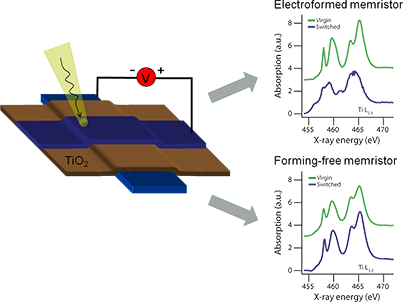
- the applied current, which serves to anneal the film during operation [29][35] and to reduce disorder. The overall lack of material changes in the forming-free compared to the electroformed devices shows a progress in reducing the device damage during operation and can thus improve the technological