


Search results
Search for "microstructures" in Full Text gives 157 result(s) in Beilstein Journal of Nanotechnology.
Self-organizing bioinspired oligothiophene–oligopeptide hybrids
Beilstein J. Nanotechnol. 2011, 2, 525–544, doi:10.3762/bjnano.2.57
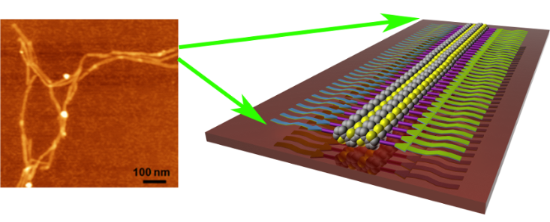
- segments in the peptide moieties were still intact [19][27]. The solution was spin-coated on the mica substrate and well-defined microstructures were visualized by means of AFM (Figure 3). The fibrillar structures exhibit single object widths of about 12 ± 1 nm (not tip corrected), with height maxima of 3
- respect to their geometry as well. They showed lengths of 100–200 nm, widths of 6–8 (±2) nm and heights of 0.4–0.7 (±0.2) nm. Compared to the fibers obtained in the kinked state of the molecule, 6' (Figure 6), the microstructures found for the fully stretched out peptide, 6, seem to be, by far, less self
- , differs profoundly. Whereas the kinked hybrids, 6', seem to self-assemble in such a way that the intermolecular noncovalent interacting forces are fully saturated, i.e., the formed microstructures do not make use of any unsaturated sites for, e.g., hydrogen bonding, the stretched out state of the peptide




Nanoscaled alloy formation from self-assembled elemental Co nanoparticles on top of Pt films
Beilstein J. Nanotechnol. 2011, 2, 473–485, doi:10.3762/bjnano.2.51
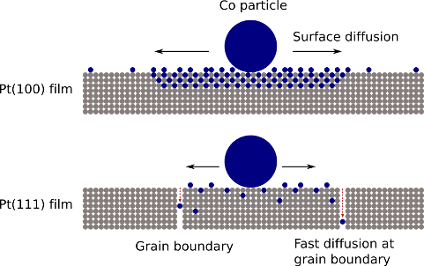
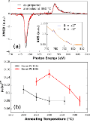
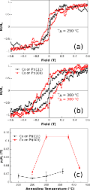
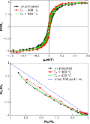
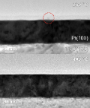
- under a H2 atmosphere, and the resulting variations of their structure, morphology and magnetic properties were characterized. We observed pronounced differences in the diffusion and alloying of Co nanoparticles on Pt films with different orientations and microstructures. On textured Pt(111) films




Simple theoretical analysis of the photoemission from quantum confined effective mass superlattices of optoelectronic materials
Beilstein J. Nanotechnol. 2011, 2, 339–362, doi:10.3762/bjnano.2.40
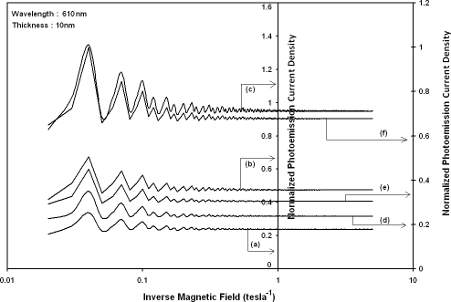
- have been investigated. The magneto-photoemission has been studied in subsection 4. The subsection 5 includes six different applications of this paper in the field of superlattices and microstructures in general. Theoretical Background 1 The formation of photoemission from effective mass quantum well


Hierarchically structured superhydrophobic flowers with low hysteresis of the wild pansy (Viola tricolor) – new design principles for biomimetic materials
Beilstein J. Nanotechnol. 2011, 2, 228–236, doi:10.3762/bjnano.2.27
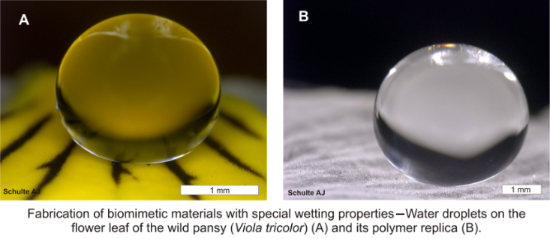
- such a surface architecture requires two production steps. Firstly, the microstructures must be produced by moulding, lithography or in-print-techniques. Secondly, the nanostructure production requires expensive lithographic techniques, or self-assembling materials, such as metal oxides [9][21]. Some
- microstructures. These surface microstructures cause optical signals [30][31] or function as a tactile cue for bees [32]. For us the “petal effect” or the repellence of petals seems to be a side effect and not the primary aim of the flower. A petal is a relatively short lived organ of plants, developed for
- surfaces, the micropapillae with wax crystals [6] and micropapillae with cuticle folds. Some remarkable differences exist between the surface architecture of the lotus leaf and Viola petals. In Viola petals microstructures are larger (average height of 40.2 µm) than those of lotus leaves, which have



Sorting of droplets by migration on structured surfaces
Beilstein J. Nanotechnol. 2011, 2, 215–221, doi:10.3762/bjnano.2.25
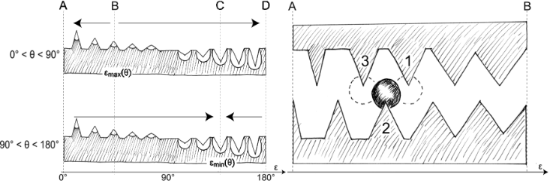
- ][7][8] that liquid droplets move towards areas of minimum contact angle if placed on a flat solid exhibiting a gradient of contact angle. Yang et al. [2] devised a hydrophobic micropatterned surface with a gradient in density of the microstructures that lead to droplet movement with maximum speeds of


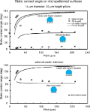
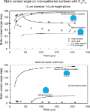
Biomimetics inspired surfaces for drag reduction and oleophobicity/philicity
Beilstein J. Nanotechnol. 2011, 2, 66–84, doi:10.3762/bjnano.2.9
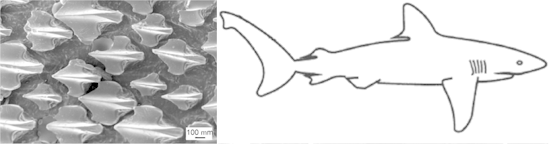
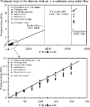
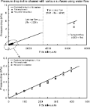
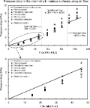
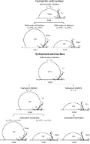
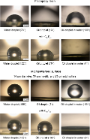
- , and 850 μm, respectively. The spacing between the ribs was 180 µm. To investigate drag reduction efficiency on the surfaces with superhydrophobicity, self-cleaning, and low adhesion described earlier, Jung and Bhushan [21] used nano-, micro-, and hierarchical structures [12][13]. Microstructures were
- ). Specimens with microstructures were immediately transferred into a vacuum chamber at 750 mTorr (100 Pa) pressure for 10 seconds to remove trapped air and to increase the resin infiltration through the structures. After hardening at room temperature (24 h at 22 °C), the positive replica was separated from
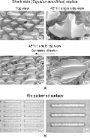
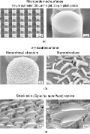
- rapid cooling of the specimen to 5 °C. Then the specimens were stored for seven days at 21 °C in a desiccator. The fast cooling of the wax prevents the formation of nanostructure roughness. Figure 5 shows the SEM micrographs of nanostructure on flat replica, microstructures, and hierarchical structure








Flash laser annealing for controlling size and shape of magnetic alloy nanoparticles
Beilstein J. Nanotechnol. 2010, 1, 55–59, doi:10.3762/bjnano.1.7
- Damien Alloyeau Christian Ricolleau Cyril Langlois Yann Le Bouar Annick Loiseau Matériaux et Phénomènes Quantiques, UMR 7162, Bâtiment Condorcet, Case 7021, Université Paris 7 / CNRS, 75205 Paris Cedex 13, France, Phone : +33 1 57 27 69 83 Laboratoire d’Etude des Microstructures – Unité mixte


Other Beilstein-Institut Open Science Activities



