Search results
Search for "binding energies" in Full Text gives 185 result(s) in Beilstein Journal of Nanotechnology.
Many-body effects in semiconducting single-wall silicon nanotubes
Beilstein J. Nanotechnol. 2014, 5, 19–25, doi:10.3762/bjnano.5.2
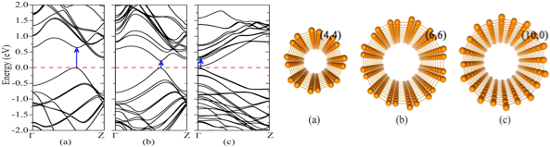
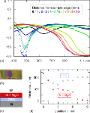
- SiNTs from 0.65, 0.28 and 0.05 eV at DFT level to 1.9, 1.22 and 0.79 eV at GW level. The Coulomb electron−hole (e−h) interactions significantly modify optical absorption properties obtained at noninteracting-particle level with the formation of bound excitons with considerable binding energies (of the
- order of 1 eV) assigned: the binding energies of the armchair (4,4), (6,6) and zigzag (10,0) SiNTs are 0.92, 1.1 and 0.6 eV, respectively. Results in this work are useful for understanding the physics and applications in silicon-based nanoscale device components. Keywords: Bethe–Salpeter equation
- screening leads to the formation of excitonic resonances or strongly bound excitons with considerable binding energies. Therefore, many-body effects [18][19][20][21][22][23][24][25][26][27][28][29][30][31] are required to understand this kind of systems sufficiently, especially their single-particle


Preparation of NiS/ZnIn2S4 as a superior photocatalyst for hydrogen evolution under visible light irradiation
Beilstein J. Nanotechnol. 2013, 4, 949–955, doi:10.3762/bjnano.4.107
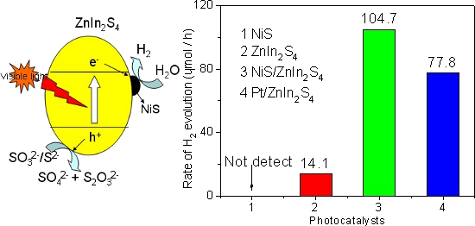
- . All of the binding energies were referred to the C 1s peak at 284.8 eV of the surface adventitious carbon. UV–visible diffraction spectra (UV–vis DRS) of the powders were obtained for the dry pressed disk samples using a UV–visible spectrophotometer (Cary 500 Scan Spectrophotometers, Varian). BaSO4


STM tip-assisted engineering of molecular nanostructures: PTCDA islands on Ge(001):H surfaces
Beilstein J. Nanotechnol. 2013, 4, 927–932, doi:10.3762/bjnano.4.104
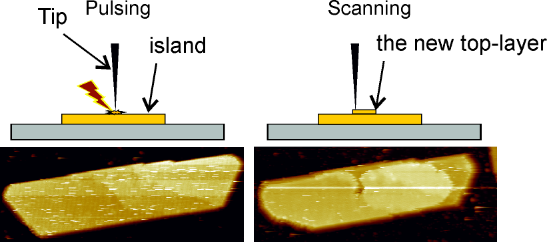
- layer is, the less strain it experiences [31]. Consequently, binding energies on the edges of lower lying layers are smaller than binding energies on the edges of higher lying layers. Therefore, molecules attached to the edges of lower lying layers prefer to ascend and attach to more favorable sites on
- higher laying layers. Due to the applied bias voltage pulses we created new edges on the top-most layer offering convenient adsorption sites with high binding energies. Thus, we expect that an ascending interlayer transport is responsible for the newly grown top-most layer. The presence of the scanning

Preparation of electrochemically active silicon nanotubes in highly ordered arrays
Beilstein J. Nanotechnol. 2013, 4, 655–664, doi:10.3762/bjnano.4.73
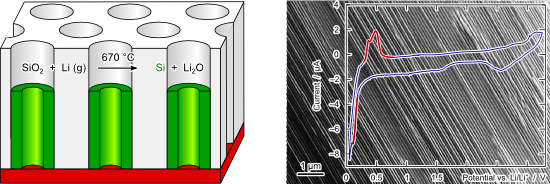
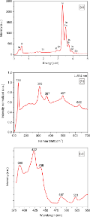
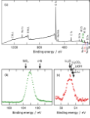
- (Figure 6c), which within the range from 51 eV to 59 eV displays an absolute maximum at 55.6 eV. For reference, the binding energies [27] of metallic Li (54.7 eV), LiOH (54.9 eV), Li2CO3 (55.2 eV), and Li2O (55.6 eV) are indicated in Figure 6. Some contribution of Li2CO3 (due to aerobic CO2 capture





Catalytic activity of nanostructured Au: Scale effects versus bimetallic/bifunctional effects in low-temperature CO oxidation on nanoporous Au
Beilstein J. Nanotechnol. 2013, 4, 111–128, doi:10.3762/bjnano.4.13
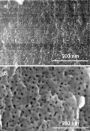
- for excitation. The binding energies of the Au(4f), Ag(3d) and Cu(2p) states were calibrated with respect to the C(1s) peak at 284.6 eV. The Au, Ag and Cu surface concentrations were calculated from the measured intensities of the Au(4f), Ag(3d) and Cu(2p) signals, respectively, by using tabulated


X-ray spectroscopy characterization of self-assembled monolayers of nitrile-substituted oligo(phenylene ethynylene)s with variable chain length
Beilstein J. Nanotechnol. 2012, 3, 12–24, doi:10.3762/bjnano.3.2
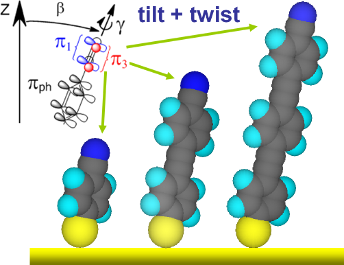
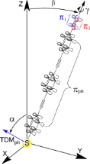
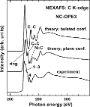
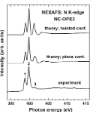
- difference in attenuation of this signal in different films. Due to the quite close binding energies of the Au 4f and S 2p emissions, both signals are attenuated similarly, although not absolutely equally, as far as the primary excitation is performed at high photon energy. The S2p/Au4f intensity ratios for



Towards a scalable and accurate quantum approach for describing vibrations of molecule–metal interfaces
Beilstein J. Nanotechnol. 2011, 2, 427–447, doi:10.3762/bjnano.2.48


Intermolecular vs molecule–substrate interactions: A combined STM and theoretical study of supramolecular phases on graphene/Ru(0001)
Beilstein J. Nanotechnol. 2011, 2, 365–373, doi:10.3762/bjnano.2.42
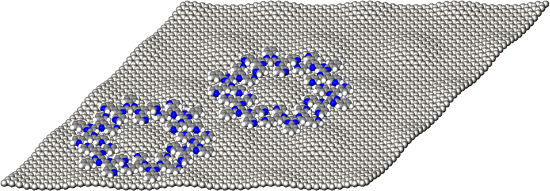
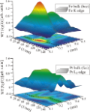
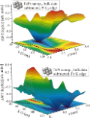
- of a “hill” site from that of a “valley” position. Table 1 and Table 2 show the differences between these sites for different force fields. Clearly, the calculated binding energies strongly depend on the force field used, as found before in force field calculations addressing 3,3'-BTP adsorption on
- graphite [38]. Nevertheless, although the absolute values may vary with the applied force field, the differences between binding energies at the two sites, reflecting the lateral corrugation of the potential energy of the substrate, are reasonably close, both for 3,3'-BTP and PTCDA. The corrugation of the


Extended X-ray absorption fine structure of bimetallic nanoparticles
Beilstein J. Nanotechnol. 2011, 2, 237–251, doi:10.3762/bjnano.2.28
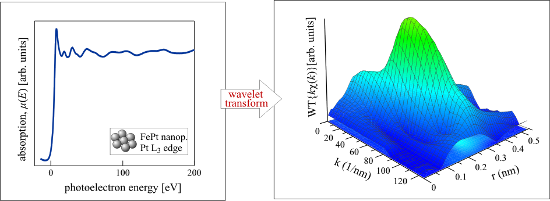
- on state-of-the-art X-ray absorption spectroscopy (XAS) on 3rd generation synchrotron sources such as the ESRF and BESSY II. In general, XAS deals with the excitation of core-level electrons, with their element-specific binding energies, by incident X-rays. After absorption of an X-ray photon, a core



Room temperature synthesis of indium tin oxide nanotubes with high precision wall thickness by electroless deposition
Beilstein J. Nanotechnol. 2011, 2, 119–126, doi:10.3762/bjnano.2.14
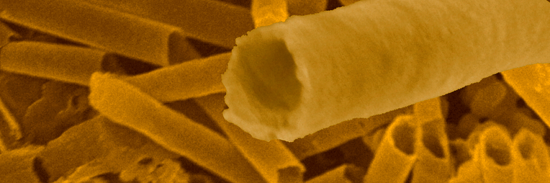
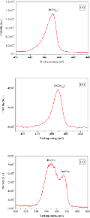
- peak with its maximum at 533,0 eV is for the In-O(1s). Comparing the binding energies shown in Figure 4a–c with literature values [28][29], the composition of the fabricated nanotubes was consistent with the stoichiometry of the ITO. Conclusion Bilateral open cylindrical ITO-NTs with controllable