Search results
Search for "current" in Full Text gives 1463 result(s) in Beilstein Journal of Nanotechnology. Showing first 200.
Local work function on graphene nanoribbons
Beilstein J. Nanotechnol. 2024, 15, 1125–1131, doi:10.3762/bjnano.15.91
- Daniel Rothhardt Amina Kimouche Tillmann Klamroth Regina Hoffmann-Vogel Institute of Physics and Astronomy, University of Potsdam, Karl-Liebknecht-Str. 24–25, 14476 Potsdam-Golm, Germany current address: Swiss Federal Laboratories for Materials Science and Technology, CH-8600 Dübendorf
- , Switzerland current address: Department of Physics, University of Basel, CH-4056 Basel, Switzerland Institute of Chemistry, University of Potsdam, Karl-Liebknecht-Str. 24–25, 14476 Potsdam-Golm, Germany 10.3762/bjnano.15.91 Abstract Graphene nanoribbons show exciting electronic properties related to the

![[Graphic 1]](/bjnano/content/inline/2190-4286-15-91-i4.svg?max-width=637&scale=1.18182)
Direct electron beam writing of silver using a β-diketonate precursor: first insights
Beilstein J. Nanotechnol. 2024, 15, 1117–1124, doi:10.3762/bjnano.15.90

- primary electron energy and about 0.5 nA beam current. Rectangular patterns of 10 × 10 µm2 were scanned in an inward spiraling beam path with a 3 nm point-to-point pitch, a dwell time of 1 μs per point, and different numbers of passes using the Xenos Patterning software. A typical workflow involved the
- used beam current of 0.5 nA corresponds to an electron flux of 6 × 10⁴ electrons per second and square nanometer, and an overall dose of 1.7 μC or 1 × 10¹⁷ electrons per square nanometer in the center part. There is a visible halo deposition region extending several micrometers beyond the area
- dwell time and a beam current of 246 pA. With 8 × 10⁷ electrons·s−1·nm−2 (assuming 5 nm FWHM of the beam), the local electron flux in this case was about three orders of magnitude larger than that of the thermal emitter. The resulting pillar height was more than 2 µm. Given the deposition time of 620 s


Unveiling the potential of alginate-based nanomaterials in sensing technology and smart delivery applications
Beilstein J. Nanotechnol. 2024, 15, 1077–1104, doi:10.3762/bjnano.15.88
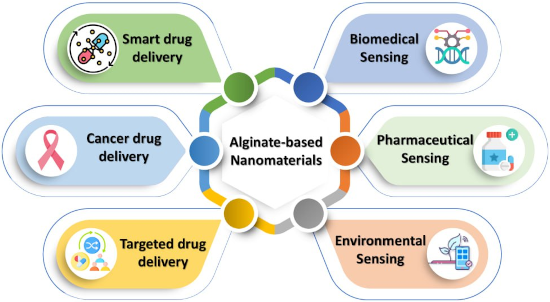
- . Current biomedical and pharmaceutical science has one focus on developing nanoparticle-based sensors, especially biopolymeric nanoparticles. Alginate is a widely used biopolymer in a variety of applications. The hydrogel-forming characteristic, the chemical structure with hydroxy and carboxylate moieties
- and pharmaceutical fields. Many review papers describe applications of alginate in the drug delivery field. The current study covers the structural and physicochemical properties of alginate-based nanoparticles. The prospective applications of alginate-based nanomaterials in various domains are
- discuss the current challenges in the drug delivery field and sensing techniques and the significant role of alginate-based nanoparticles in overcoming these problems. Background Drug delivery and sensing in healthcare: significance and impact Drug delivery refers to the process of administering


Interface properties of nanostructured carbon-coated biological implants: an overview
Beilstein J. Nanotechnol. 2024, 15, 1041–1053, doi:10.3762/bjnano.15.85
- , and they are classified according to the power sources used for the process (i.e., plasma-, direct current-, radiofrequency-, and ion beam-assisted coatings) [85]. All PVD processes are based on a vacuum chamber containing the material to be deposited, known as target, and the chosen substrate onto



Bolometric IR photoresponse based on a 3D micro-nano integrated CNT architecture
Beilstein J. Nanotechnol. 2024, 15, 1030–1040, doi:10.3762/bjnano.15.84
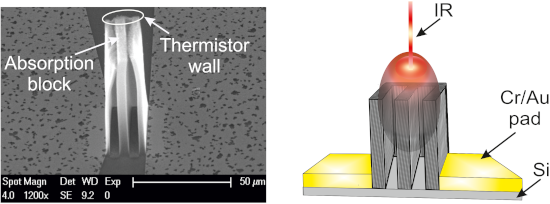
- resistance (TCR). These properties are advantageous for new bolometric sensors with high voltage responsivity and broadband absorption from the infrared (IR) to the terahertz spectrum. Preliminary performance evaluations have shown current and voltage responsivities of 2 mA/W and 30 V/W, respectively, in
- is the bias current, R is the resistance of the bolometer, α = (dR/dT)/R is the TCR, η is the absorption efficiency, G is the thermal conductance to the substrate, ω is the angular modulation frequency, τ = 1/(2πfcut−off) is the time constant of the detector, and fcut−off is the frequency at 70
- measurements. The true performance of the original M-shaped CNT block with higher TCR, higher voltage, and higher current responsivity could be demonstrated. In this work, new noise measurements were performed and compared for both configurations. The new configuration 2 is superior regarding the optimization


Entry of nanoparticles into cells and tissues: status and challenges
Beilstein J. Nanotechnol. 2024, 15, 1017–1029, doi:10.3762/bjnano.15.83
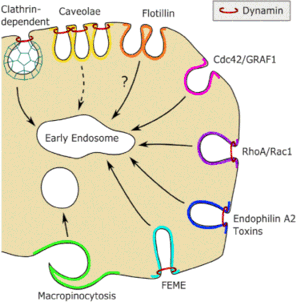
- scale bar is 100 nm. Figure 2 was reprinted from [29], Current Opinion in Cell Biology, vol. 23, by K. Sandvig; S. Pust; T. Skotland; B. van Deurs, “Clathrin-independent endocytosis: mechanisms and function“, pages 413-420, Copyright (2011), with permission from Elsevier. This content is not subject to


Atomistic insights into the morphological dynamics of gold and platinum nanoparticles: MD simulations in vacuum and aqueous media
Beilstein J. Nanotechnol. 2024, 15, 995–1009, doi:10.3762/bjnano.15.81
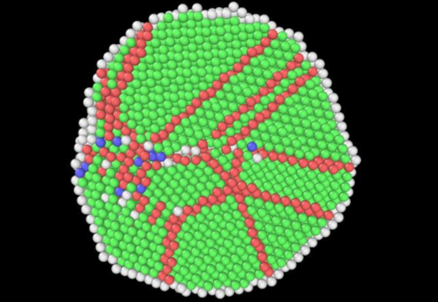
- can be traced back to the seminal works of Lindemann [29] and Pawlow [30]. Recent developments and the current state of the art have been summarized in the reviews of Mei and Lu [31] and Alcoutlabi and McKenna [32]. Emphasis has been placed on relating the melting temperature of a NP to its size by
- surfaces of the large NPs. This is in agreement with previous findings for Ag NPs with a similar diameter range [49]. It should be noted that the considered variations in the NP size are rather subtle and below detection for current analytical capabilities [85]. There are slight disparities between Au and


Recent progress on field-effect transistor-based biosensors: device perspective
Beilstein J. Nanotechnol. 2024, 15, 977–994, doi:10.3762/bjnano.15.80
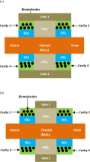
- bending between the carriers. However, when the gate bias that is supplied is greater than the threshold voltage of the device, the type of the channel is inverted which permits the current to flow and turns on the transistor [52]. The FET-based biosensors consist of two dissimilar transduction mechanisms
- concurrently shifts the threshold voltage and modifies the drain current via channel conductivity modulation. The difference between the current (threshold voltage) in the presence of biomolecules and the current without biomolecules is used to define the current sensitivity. The second transduction mechanism
- dielectric constant inside the cavity resulting in a gating effect modulation and subsequent alteration in channel conductivity. This leads to a change in both threshold voltage and drain current, manifesting the presence of target biomolecules in the cavity, and the corresponding sensitivity is defined




Beyond biomimicry – next generation applications of bioinspired adhesives from microfluidics to composites
Beilstein J. Nanotechnol. 2024, 15, 965–976, doi:10.3762/bjnano.15.79
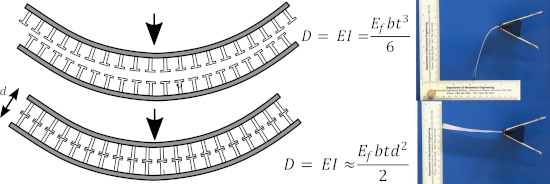
- ] and magnets are much better in terms of reliability and adhesion force than current biomimetic materials but need mating surfaces that are compatible. Traditional fasteners like screws, bolts, and nuts are available for assemblies that do not need to be disconnected frequently but are extremely strong


Identification of structural features of surface modifiers in engineered nanostructured metal oxides regarding cell uptake through ML-based classification
Beilstein J. Nanotechnol. 2024, 15, 909–924, doi:10.3762/bjnano.15.75
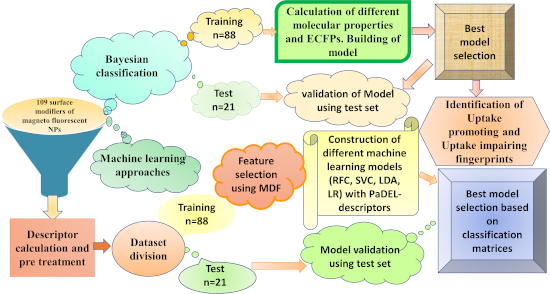
- , shape, and surface charge of NPs, as well as their surface functionalization. In the current study, classification-based ML models (i.e., Bayesian classification, random forest, support vector classifier, and linear discriminant analysis) have been developed to identify the features/fingerprints that
- uptake in the PaCa2 cell line [22][23][24][25][26][27]. In the current study, we have performed a distinctive approach by developing nano-QSAR machine learning-based classification models that encompass not only the cellular uptake data of the PaCa2 cell line but also the two additional cell lines HUVEC
- . This is particularly important for in vivo applications where non-specific uptake by the reticuloendothelial system (e.g., liver and spleen) can reduce the efficacy of the nanoparticles. The workflow of the current study is shown in Figure 1. The insights gained from this study hold significant


Water-assisted purification during electron beam-induced deposition of platinum and gold
Beilstein J. Nanotechnol. 2024, 15, 884–896, doi:10.3762/bjnano.15.73
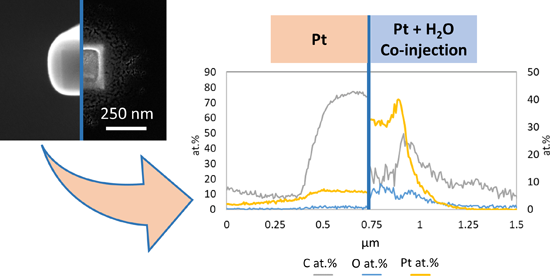
- the deposition are the precursor supply, the primary beam energy and current, and the patterning strategy. The deposits are built through consecutive electron beam spot exposures of the precursor molecules adsorbed on the substrate. The shape of the deposit is defined as an area containing an array of
- patterning parameters are the patterned area size, dwell time, primary beam energy and current, pitch, number of passes, and SEM chamber pressure during deposition or chamber pressure increase during deposition. The complete parameters for the deposits presented in this work are presented in Supporting
- varying the pressure increase in the SEM chamber upon the injection of the water precursor in the range of 0–4.7·10−5 mbar. Current variation series: A series of rectangular platinum deposits was deposited while varying the current of the primary beam (deposits indicated by 1b–1e) in the range of 0.13





A review on the structural characterization of nanomaterials for nano-QSAR models
Beilstein J. Nanotechnol. 2024, 15, 854–866, doi:10.3762/bjnano.15.71
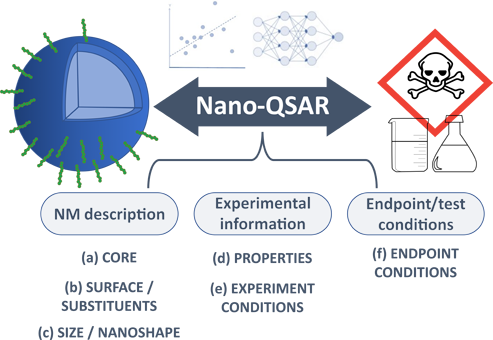
- ]. In other cases, a weighted-average can be used to transform the element-based descriptors to the current composition of compounds [18][19]. Most of the descriptors are based on the empirical formula (i.e., the proportion of elements in the substance), such as the molecular weight, which is calculated


Investigation on drag reduction on rotating blade surfaces with microtextures
Beilstein J. Nanotechnol. 2024, 15, 833–853, doi:10.3762/bjnano.15.70
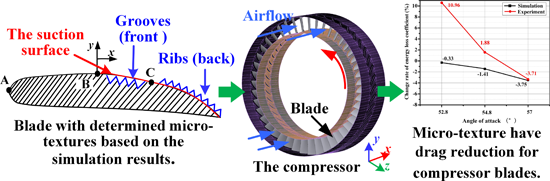
- ; Introduction In order to survive, organisms in nature have undergone billions of years of evolution; their body structures have been adapted to the current environment and exhibit special functions on biological surfaces [1]. For the purpose of drag reduction, valuable inspiration can be derived from rapidly


When nanomedicines meet tropical diseases
Beilstein J. Nanotechnol. 2024, 15, 830–832, doi:10.3762/bjnano.15.69

- oxide nanoparticles (SPIONs) for treating cutaneous lesions caused by Leishmania amazonensis. The selectivity index for intracellular amastigotes was more than 240 times higher compared to that of current prescribed drugs to treat the disease, making SPIONs strong candidates for a new therapeutic
Intermixing of MoS2 and WS2 photocatalysts toward methylene blue photodegradation
Beilstein J. Nanotechnol. 2024, 15, 817–829, doi:10.3762/bjnano.15.68
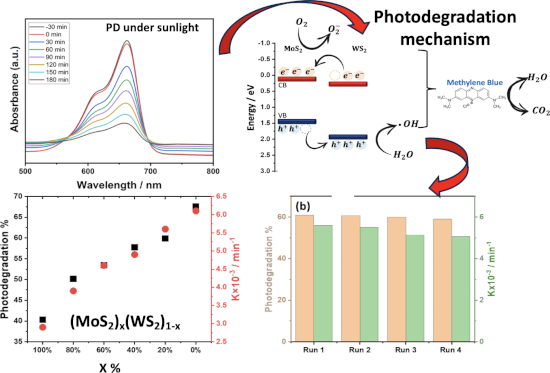
- . Those authors have used other mixed composites such as MoS2-GO and MoS2-ZnO prepared by the hydrothermal [22][23] method with photocatalyst loading of 10 to 100 mg, which is ten to hundredfold higher than the ones used for the current PD study. Furthermore, this study allowed higher stability of the


Electrospun polysuccinimide scaffolds containing different salts as potential wound dressing material
Beilstein J. Nanotechnol. 2024, 15, 781–796, doi:10.3762/bjnano.15.65
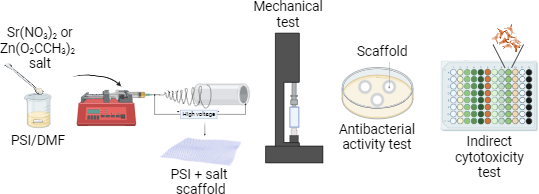
- , which was placed on a slow rotary drum (10 rpm). The distance between the needle of the syringe and the collector was 15 cm in all cases. The applied voltages (direct current power supply, ES 30 Model, Gamma High Voltage Inc., USA) and flow rates are in Table 1. Fourier-transform infrared spectroscopy
- PSI + 5 Zn(O2CCH3)2 scaffold was slightly cytotoxic to the 155BR fibroblasts after 72 hours. Based on previous data and on our current findings, we are confident that the PSI scaffolds with appropriate concentrations of Sr(NO3)2 and Zn(O2CCH3)2 could serve as potential wound dressings to perform local



Exploring surface charge dynamics: implications for AFM height measurements in 2D materials
Beilstein J. Nanotechnol. 2024, 15, 767–780, doi:10.3762/bjnano.15.64
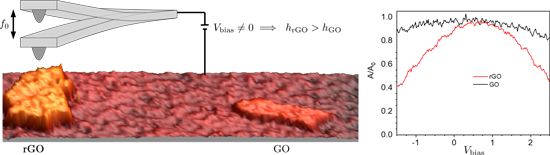
- an effective tip–sample voltage, the oscillating AFM tip generates a time-dependent electrical field, which induces a current and Joule dissipation due to the non-zero resistance of the material. These currents induce an oscillating charge movement. (ii) Simultaneously, these moving charges also
- -dependent when the tip is oscillating and/or an AC voltage is applied. After adding this contribution, we particularize to 2D materials on insulating supports, where the current through the bulk is minimal and the induced currents are confined to the surface. As shown in Figure 6, the sample is modelled as
- current density (J(x, y, z, t)) leaving the differential volume element (dV = dxdy a) has components parallel (J∥ = σ∥E∥) and perpendicular (Ji,z = σiEi,z, with i = 1,2 above and below the surface, respectively) to the surface. Supporting Information Supporting information includes: SI.1. Structure of GO


Effect of repeating hydrothermal growth processes and rapid thermal annealing on CuO thin film properties
Beilstein J. Nanotechnol. 2024, 15, 743–754, doi:10.3762/bjnano.15.62
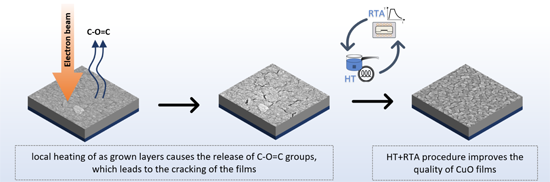
- literature. These encompass methods such as molecular beam epitaxy [17][18][19], direct current magnetron sputtering [4][20][21], and pulsed laser deposition [22][23][24]. Alternative approaches involve techniques such as chemical vapor deposition [25][26][27] and atomic layer deposition [28][29][30]. CuO
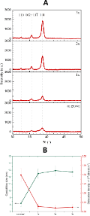
- , which disturbs the current flow. The most probable cause of such clear discrepancies may be a heterogeneous change in the chemical composition or distribution of defects as a result of thermal treatment. Capacitance differences between individual grains, which are observed to a small extent in the 1




Level set simulation of focused ion beam sputtering of a multilayer substrate
Beilstein J. Nanotechnol. 2024, 15, 733–742, doi:10.3762/bjnano.15.61
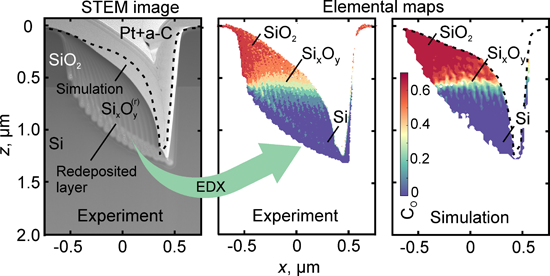
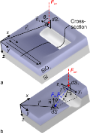
- beam workstation Helios Nanolab 650. Both types of test structures were fabricated using 30 kV accelerating voltage and an ion beam current of I = 900 pA. The chamber pressure was not higher then 10−6 mbar. A layer of platinum and amorphous carbon (Pt + a-C) was deposited onto the manufactured

![[Graphic 55]](/bjnano/content/inline/2190-4286-15-61-i68.svg?max-width=637&scale=1.18182)


Simultaneous electrochemical determination of uric acid and hypoxanthine at a TiO2/graphene quantum dot-modified electrode
Beilstein J. Nanotechnol. 2024, 15, 719–732, doi:10.3762/bjnano.15.60
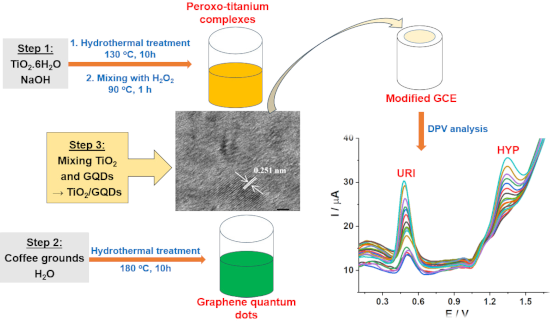
- electrochemistry, combining GQDs with semiconductors, especially TiO2, has been of interest. For example, GQDs have been successfully introduced into TiO2 [17] to enhance its photocatalytic activity. John Peter et al. reported TiO2/GQDs as anodes for enhancing the short-circuit current in solar cells [18]. The
- 0.45 V for URI and at 1.26 V for HYP at the TiO2/GQDs-GCE. It is notable that the electrochemical response is a function of the TiO2/GQDs composition (Figure 5b). The oxidation peak currents of URI and HYP increase with increasing amount of GQDs in TiO2/GQDs. However, the peak current of URI reaches
- its maximum when the GQDs reach 67% in mass (2:4)TiO2/GQDs and decreases at higher amounts of GQDs. Meanwhile, the HYP oxidation peak current is highest when the amount of GQDs reaches 80% in mass in (1:4)TiO2/GQDs. To balance between the peak currents of URI and HYP, the electrode modified by (1:4


Reduced subthreshold swing in a vertical tunnel FET using a low-work-function live metal strip and a low-k material at the drain
Beilstein J. Nanotechnol. 2024, 15, 713–718, doi:10.3762/bjnano.15.59
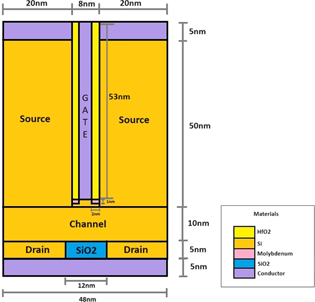
- minimum subthreshold slope and a good Ion/Ioff ratio. The low-k material at the drain reduces the gate-to-drain capacitance. Both the SiO2 layer and the live metal strip show excellent leakage current reduction to 1.4 × 10⁻¹⁷ A/μm. The design provides a subthreshold swing of 5 mV/decade, which is an
- excellent improvement in TFETs, an on-current of 1.00 × 10⁻⁵ A/μm, an Ion/Ioff ratio of 7.14 × 10¹¹, and a threshold voltage of 0.28 V. Keywords: dual low-work-function live strip (DLWLS); low-k dielectric spacer; low-work-function live strip (LWLS); Miller capacitance; molybdenum; subthreshold swing (SS
- ); tunnel field-effect transistor (TFET); Introduction Rapid miniaturization of electronic devices has led to an increase in leakage current. Leakage current is a big challenge in miniaturized circuits. Miniaturization, at the same time, increased the device performance and reduced the area occupied by the


Elastic modulus of β-Ga2O3 nanowires measured by resonance and three-point bending techniques
Beilstein J. Nanotechnol. 2024, 15, 704–712, doi:10.3762/bjnano.15.58
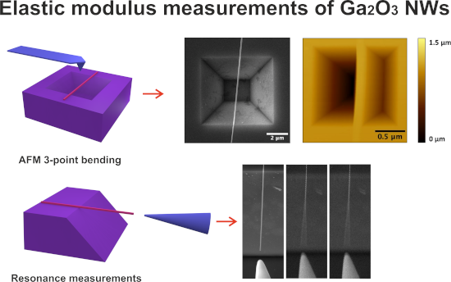
- ; Introduction Significant advancements in both material and device technologies related to monoclinic gallium oxide (β-Ga2O3) have been achieved in the current decade [1][2]. Recently, attention has been directed towards it due to its outstanding properties [3] such as ultrawide band gap (4.4–4.9 eV) and
- suitable for use on bendable and stretchable substrates in line with the current trends in electronic technologies focusing on flexible electronic device development [11][12]. Consequently, understanding the mechanical properties of β-Ga2O3 NWs becomes an important step. For instance, precise determination
- °C. Characterisation The morphology of as-grown NWs was examined using SEM (Helios 5 UX DualBeam). The measurements were carried out at an acceleration voltage of 5 keV and a beam current of 25 pA. Transmission electron microscopy (Tecnai GF20, FEI) at an accelerating voltage of 200 kV provided


Gold nanomakura: nanoarchitectonics and their photothermal response in association with carrageenan hydrogels
Beilstein J. Nanotechnol. 2024, 15, 678–693, doi:10.3762/bjnano.15.56

- , we chose one shorter and one longer nanorod to make the current study conclusive [29]. Interestingly, CTAB-AuNR and DTAB-AuNR showed a significant temperature rise of 16.7 and 20 °C, respectively, as shown in Figure 8b at colloidal state. The high temperature change in case of DTAB-AuNR clearly






Laser synthesis of nanoparticles in organic solvents – products, reactions, and perspectives
Beilstein J. Nanotechnol. 2024, 15, 638–663, doi:10.3762/bjnano.15.54
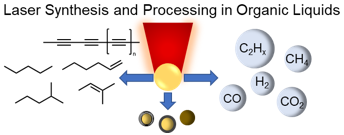
- mechanisms of organic liquid decomposition and carbon shell formation are highlighted and discussed regarding current challenges and future perspectives of LSPC using organic liquids instead of water. Keywords: alloy; photochemistry; pyrolysis; radicals; surface chemistry; Introduction Since the first
- stabilizing the nanoparticles’ glass structure [65]. While these reviews consider at least in part the chemical reactions occurring in organic liquids, they focus on specific topics. Thus, this perspective article aims to survey the current state of knowledge on the laser-based synthesis of colloidal





Stiffness calibration of qPlus sensors at low temperature through thermal noise measurements
Beilstein J. Nanotechnol. 2024, 15, 580–602, doi:10.3762/bjnano.15.50
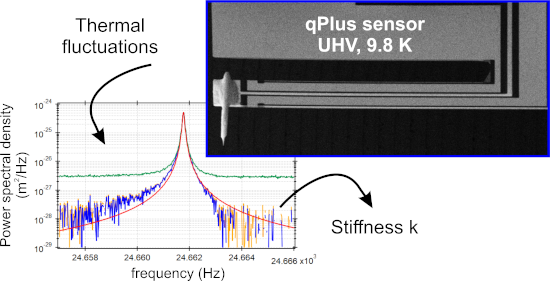
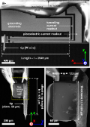
- , which forms the tip. The tip is electrically connected to an electrode that collects the tunneling current if scanning tunneling experiments are to be performed along with nc-AFM experiments. The qPlus sensors feature a resonance frequency of f1 ≃ 25 kHz and a most commonly reported stiffness of 1800 N
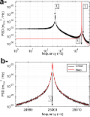
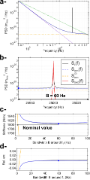
- stiffness. But this is not feasible in practice because of measurement noise, which usually exceeds thermal noise. There are several origins to measurement noise. For qPlus sensors, two main noise sources may be considered: the preamplifier, which converts the piezoelectric current of the QTF into a
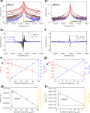
- to the calibration of the modal stiffness of QTFs used below 4.2 K and at 5 mbar [62][63]. The method is based on the measurement of the admittance of the piezoelectric current produced by the fork upon oscillation. The authors fitted that quantity with a Butterworth–Van Dyke-type electrical