Search results
Search for "density functional theory" in Full Text gives 249 result(s) in Beilstein Journal of Nanotechnology. Showing first 200.
Can molecular projected density of states (PDOS) be systematically used in electronic conductance analysis?
Beilstein J. Nanotechnol. 2015, 6, 1247–1259, doi:10.3762/bjnano.6.128
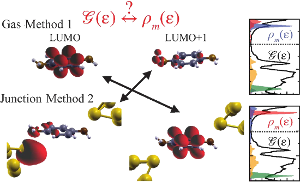
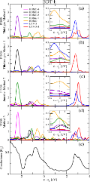
- established frameworks [5][6] like the Kubo–Greenwood [7][8] or the Landauer [9] formalisms, or the non-equilibrium Green’s function theory [10][11][12]. In the last two decades, the combination of these formalisms with density functional theory (DFT) or many-body perturbation (MBPT) theory allowed for the





Electronic interaction in composites of a conjugated polymer and carbon nanotubes: first-principles calculation and photophysical approaches
Beilstein J. Nanotechnol. 2015, 6, 1138–1144, doi:10.3762/bjnano.6.115
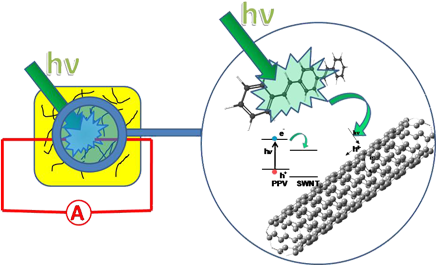
- photoexcitation techniques and density functional theory. Charge separation is confirmed experimentally by rapid quenching of PPV photoluminescence and changes in photocurrent starting at relatively low concentrations of SWNT. Calculations predict strong electronic interaction between the polymer and the SWNT
- density functional theory (DFT) calculations of coupling effects between the polymer and both species of SWNTs. Combined experimental results and first-principles calculations provide evidence that significant electronic interaction can take place between PPV chains and semiconducting SWNTs while metallic


Electrocatalysis on the nm scale
Beilstein J. Nanotechnol. 2015, 6, 1008–1009, doi:10.3762/bjnano.6.103

- developed to a stage where a reliable description of complex surface structures and surface processes (at the solid–gas interface) is possible based on first-principles electronic structure theory (in particular, (periodic) density functional theory (DFT)), but it is also increasingly developing new
Multiscale modeling of lithium ion batteries: thermal aspects
Beilstein J. Nanotechnol. 2015, 6, 987–1007, doi:10.3762/bjnano.6.102
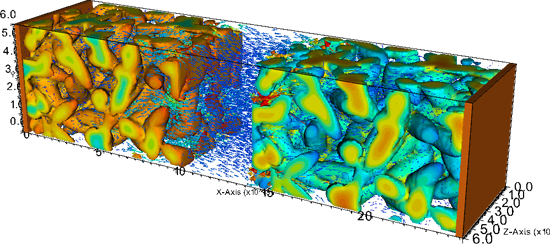
- dependency on composition or atomistic structure is the starting point for a rational design of energy storage materials [3]. Density functional theory with all its approximations [4][5] if combined with statistical mechanics methods is in this context the most successful method to simulate material
- . Even if information about energy barriers and reaction rates can be obtained from density functional theory for the system under investigation, additional modeling steps are necessary to obtain the relevant parameters for the kinetic models used in mesoscopic reaction–transport theories [53][54


Graphene on SiC(0001) inspected by dynamic atomic force microscopy at room temperature
Beilstein J. Nanotechnol. 2015, 6, 901–906, doi:10.3762/bjnano.6.93
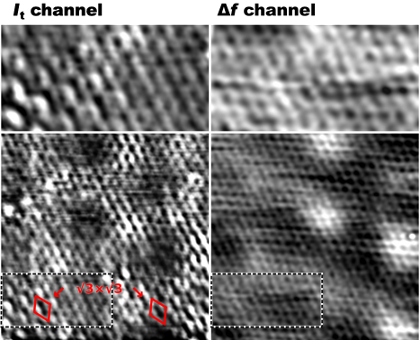
- sample. KPFM parabola was measured by sweeping the bias voltage and measuring the Δf value [24]. In order to estimate the SLG corrugation we carried out large scale total energy density functional theory (DFT) calculations. We used local-orbital FIREBALL code [25][26]. FIREBALL uses an optimized [27



![[Graphic 1]](/bjnano/content/inline/2190-4286-6-93-i1.png?max-width=637&scale=1.18182) × 6
× 6A simple approach to the synthesis of Cu1.8S dendrites with thiamine hydrochloride as a sulfur source and structure-directing agent
Beilstein J. Nanotechnol. 2015, 6, 881–885, doi:10.3762/bjnano.6.90
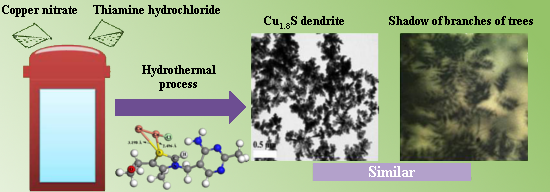
- high pressure, the complexes decompose and Cu1.8S nuclei are produced, as described by Equation 1: To give a detailed description of the complex, we performed density functional theory (DFT) calculations with a cluster model. In this cluster model, two Cu atoms were added to C12H17ClN4OS·HCl to


Statistics of work and orthogonality catastrophe in discrete level systems: an application to fullerene molecules and ultra-cold trapped Fermi gases
Beilstein J. Nanotechnol. 2015, 6, 755–766, doi:10.3762/bjnano.6.78
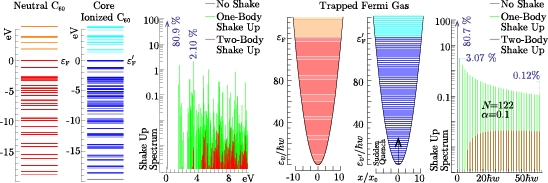
- to compute the work distribution (Section 1), based on the knowledge of the initial ground state and the low-lying final perturbed states of the systems (Section 2). To treat the fullerene molecule, we use density-functional theory (DFT) and simulate the sudden creation of a core state, by replacing

![[Graphic 22]](/bjnano/content/inline/2190-4286-6-78-i30.png?max-width=637&scale=1.18182) ) fullerene molecules, as com...
) fullerene molecules, as com...


Chains of carbon atoms: A vision or a new nanomaterial?
Beilstein J. Nanotechnol. 2015, 6, 559–569, doi:10.3762/bjnano.6.58
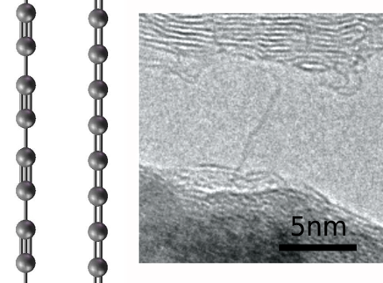
- density functional theory (DFT) occurred, leading to the application of more sophisticated and, accordingly, more computationally intensive techniques of simulation. While DFT gave correct calculations of lattice constants and energies, the bandgaps have been considerably underestimated. Many-body


In situ scanning tunneling microscopy study of Ca-modified rutile TiO2(110) in bulk water
Beilstein J. Nanotechnol. 2015, 6, 438–443, doi:10.3762/bjnano.6.44
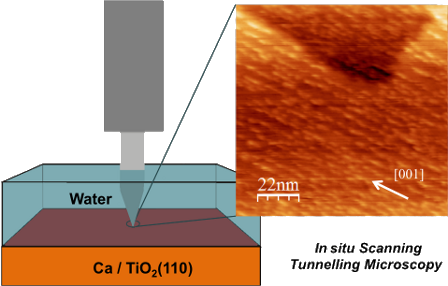
- ) surface. Recently, density functional theory (DFT) calculations have shown that, among the possible sites originally proposed on the basis of STM investigations [1], bridging oxygen (BO) atoms and in-plane oxygen (IO) atoms represent minima in the potential energy surface, thus providing more stable sites


Nanoparticle shapes by using Wulff constructions and first-principles calculations
Beilstein J. Nanotechnol. 2015, 6, 361–368, doi:10.3762/bjnano.6.35
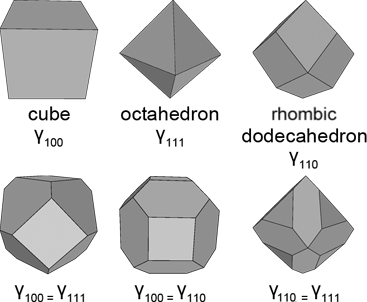
- -principles calculations, is a powerful tool for the analysis and prediction of the shapes of nanoparticles and tailor the properties of shape-inducing species. Keywords: density functional theory (DFT); hydrogen storage; multi-scale simulations; nanoparticles; surface energies; surfactants; Wulff




Carrier multiplication in silicon nanocrystals: ab initio results
Beilstein J. Nanotechnol. 2015, 6, 343–352, doi:10.3762/bjnano.6.33
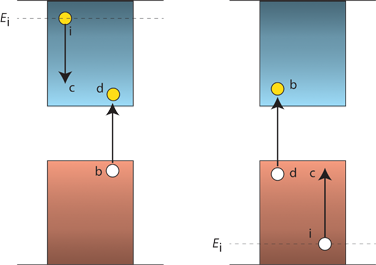
- CM effects in systems of isolated and interacting Si-NCs. Structural and electronic properties are calculated within the density functional theory (DFT) using the local density approximation, as implemented in the QuantumESPRESSO package [37]. Energy levels are determined by considering a


![[Graphic 31]](/bjnano/content/inline/2190-4286-6-33-i39.png?max-width=637&scale=1.18182) is given in the upper part of the figure. ...
is given in the upper part of the figure. ...
Synthesis of boron nitride nanotubes and their applications
Beilstein J. Nanotechnol. 2015, 6, 84–102, doi:10.3762/bjnano.6.9
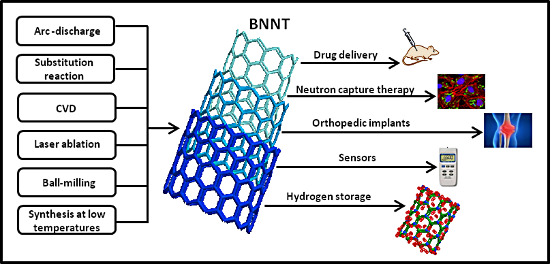
- atom. The Al atom induced a protrusion out of the plane of the BNNT and a distortion occurred at the doping site to relieve the stress. Density functional theory was performed to observe the absorption of cis-Pt and neda-Pt on pristine and Al-doped BNNTs. The results indicated that the chlorine atom of




SERS and DFT study of copper surfaces coated with corrosion inhibitor
Beilstein J. Nanotechnol. 2014, 5, 2489–2497, doi:10.3762/bjnano.5.258
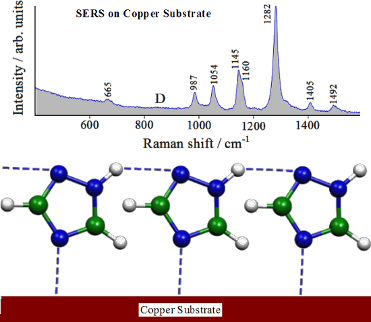
- anticorrosive thin film, the SERS spectra were interpreted with the aid of theoretical calculations based on the density functional theory (DFT) approach. Keywords: copper corrosion; DFT; inhibitor film; 1,2,4-triazole; SERS; Introduction Copper has a long history in a variety of industrial uses due to its
- surfaces are interpreted with the aid of density functional theory (DFT) calculations, which were able to provide useful information on the adsorption of different ligands on metal surfaces, including corrosion inhibitors [12][13][14][15]. Combining spectroscopic and theoretical results leads to the


Spectroscopic mapping and selective electronic tuning of molecular orbitals in phosphorescent organometallic complexes – a new strategy for OLED materials
Beilstein J. Nanotechnol. 2014, 5, 2248–2258, doi:10.3762/bjnano.5.234
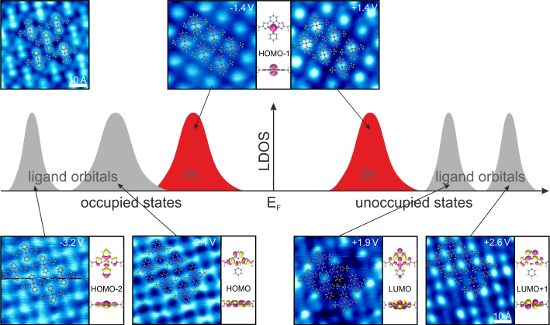
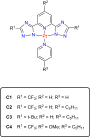
- transfer; density-functional theory; frontier orbitals; hybridization; OLED; Pt(II) complex; scanning tunneling microscopy; scanning tunneling spectroscopy; triplet emitters; Introduction Organic light emitting diodes (OLEDs) based on phosphorescent Ir(III) or Pt(II) complexes (also referred to as triplet
- (phosphorescent) triplet emitters both in monomeric and aggregated form [31][32]. We identified a number of occupied and unoccupied frontier orbitals. Comparison with density functional theory (DFT) calculations allows the unambiguous assignment of all MOs from the HOMO–2 to the LUMO+2. We found that the





Two-dimensional and tubular structures of misfit compounds: Structural and electronic properties
Beilstein J. Nanotechnol. 2014, 5, 2171–2178, doi:10.3762/bjnano.5.226

- electronic structure has been predicted by density functional theory calculations using the generalized gradient approximation. From the overlap of the empty bands in NbS2 with the filled valence band of PbSe, the authors concluded that “only a small fraction of an electron’s charge is transferred per atom


Nanomanipulation and environmental nanotechnology
Beilstein J. Nanotechnol. 2014, 5, 2079–2080, doi:10.3762/bjnano.5.216
- processes. For example, the photocatalytic degradation of pollutants can be interpreted using density functional theory. On a different scale, AFM measurements in liquid environments can be supported by advanced contact mechanics models including the squeeze-out of wetting fluids. Adhesion of fluorite
Electronic and electrochemical doping of graphene by surface adsorbates
Beilstein J. Nanotechnol. 2014, 5, 1842–1848, doi:10.3762/bjnano.5.195
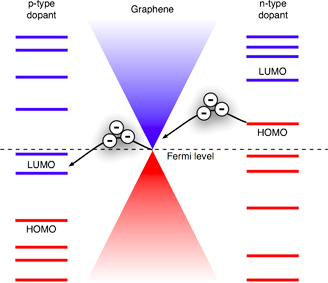
- demonstrated for various atomic and molecular adsorbates. Electropositive elements that easily donate their outer shell electrons are expected to be n-type dopants. Indeed, density functional theory (DFT) calculations predicted group I–III metals to be efficient electron donors for graphene [25][26][27][28
- calculations based on density functional theory demonstrated that a p-type graphene can be obtained through charge transfer between the TCNE molecule and graphene [38]. Electrochemical dopants It was observed that the exposure of graphene to a humid atmosphere causes p-type doping whereas exposure to toluene


Silicon and germanium nanocrystals: properties and characterization
Beilstein J. Nanotechnol. 2014, 5, 1787–1794, doi:10.3762/bjnano.5.189
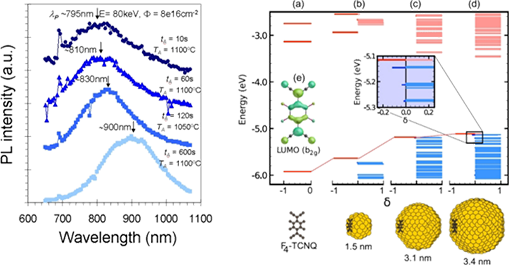
- understand the trends found by experimental and atomistic modeling studies. More recently, significant understanding of the relationships between structure, chemistry and electronic structure has been obtained from first-principles calculations based on density functional theory. From a theoretical
- even the smallest particles that were realized experimentally (about 1000 atoms for ca. 3 nm). Such sizes are close to the practical limits of present-day first-principles density functional theory implementations. Various full-DFT implementations by using localized basis sets such as Aimpro [17][44
- , are convenient in the case of free-standing nanocrystals, both because they can be combined with real-space boundary conditions and because they result in sparse Hamiltonian and overlap matrices that can be efficiently diagonalized. Notwithstanding, many implementations of density functional theory


Quasi-1D physics in metal-organic frameworks: MIL-47(V) from first principles
Beilstein J. Nanotechnol. 2014, 5, 1738–1748, doi:10.3762/bjnano.5.184
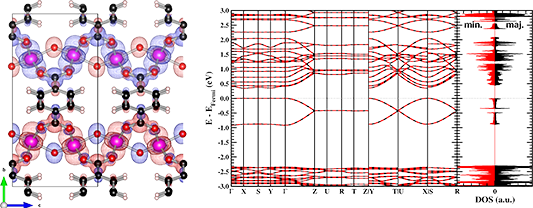
- framework (MOF) is investigated by using ab initio density functional theory (DFT) calculations. Special focus is placed on the relation between the spin configuration and the properties of the MOF. The ground state is found to be antiferromagnetic, with an equilibrium volume of 1554.70 Å3. The transition
- dispersion along the the direction of the VO6 chains, similar as for other quasi-1D materials. Keywords: band structure; density functional theory (DFT); low-dimensional electronics; metal-organic frameworks (MOFs); MIL-47; Introduction Metal-organic frameworks (MOFs) present a class of materials located
- Density functional theory calculations Density functional theory (DFT) calculations are performed within the projector augmented wave (PAW) method as implemented in the “Vienna ab initio Simulation Package” (VASP) while using the generalized gradient approximation (GGA) functional as constructed by Perdew


Restructuring of an Ir(210) electrode surface by potential cycling
Beilstein J. Nanotechnol. 2014, 5, 1349–1356, doi:10.3762/bjnano.5.148
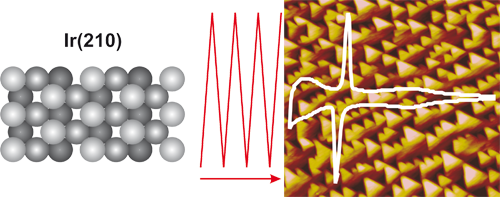
- for the different Ir surface orientations, the adsorption of more than 0.5 ML oxygen causes the formation of nano-pyramids exhibiting (110) and {311} faces to be thermodynamically more stable than the original Ir(210) substrate [19][23]. Based on density functional theory calculations it was predicted


Magnesium batteries: Current state of the art, issues and future perspectives
Beilstein J. Nanotechnol. 2014, 5, 1291–1311, doi:10.3762/bjnano.5.143
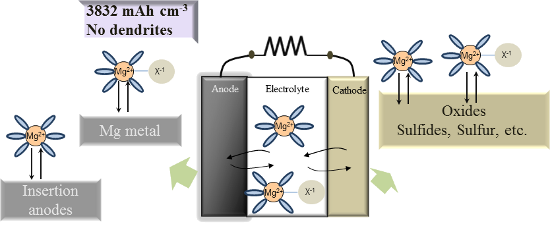
- study of borohydride-based solid state electrolytes was reported by Higashi et al. [37]. Guided by their first-principles calculations based on density functional theory (DFT), they experimentally investigated the conduction of magnesium ions in both Mg(BH4)2 and Mg(BH4)(NH2). The selection of these


Sublattice asymmetry of impurity doping in graphene: A review
Beilstein J. Nanotechnol. 2014, 5, 1210–1217, doi:10.3762/bjnano.5.133
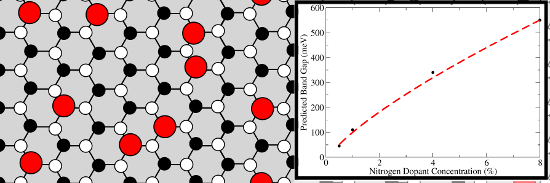
- leads to a same sublattice configuration for all impurities in a domain. Through density functional theory (DFT) calculations involving a graphene nanoribbon on a Cu(111) substrate, aiming to reproduce experimental conditions, a thorough investigation into the energetic favourable position of single


Fringe structures and tunable bandgap width of 2D boron nitride nanosheets
Beilstein J. Nanotechnol. 2014, 5, 1186–1192, doi:10.3762/bjnano.5.130
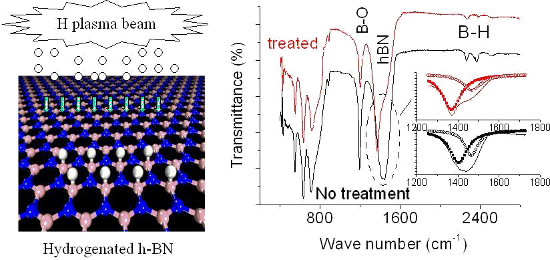
- -principles computations [13] and hybrid density functional theory calculations with van der Waals correction [14], Chen and Zhang show that polar boron nitride (BN) nanoribbons can be favorably aligned via substantial hydrogen bonding at the interfaces, which induces significant interface polarizations and


Organic and inorganic–organic thin film structures by molecular layer deposition: A review
Beilstein J. Nanotechnol. 2014, 5, 1104–1136, doi:10.3762/bjnano.5.123
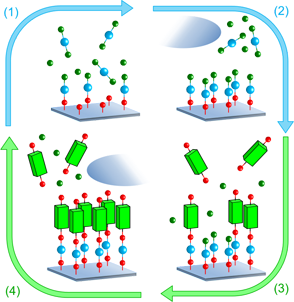
- +ED molecule length of 12.6 Å, and also below the somewhat lower GPC value of 6.5 Å per cycle expected based on the density functional theory calculations carried out by the group. The film growth was observed to be linear. The films were stable in ambient air and when annealed at least up to 250 °C




DFT study of binding and electron transfer from colorless aromatic pollutants to a TiO2 nanocluster: Application to photocatalytic degradation under visible light irradiation
Beilstein J. Nanotechnol. 2014, 5, 1016–1030, doi:10.3762/bjnano.5.115
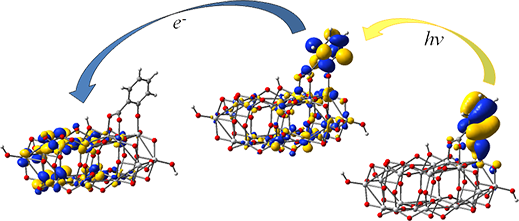
- Corneliu I. Oprea Petre Panait Mihai A. Girtu Department of Physics, Ovidius University of Constanţa, Constanţa 900527, Romania 10.3762/bjnano.5.115 Abstract We report results of density functional theory (DFT) calculations on some colorless aromatic systems adsorbed on a TiO2 nanocluster, in
- ; density functional theory; photocatalytic degradation; titanium dioxide; visible light irradiation; Introduction Titania, TiO2, has been widely used as photocatalyst for environmental applications [1][2][3][4][5][6], particularly for waste water purification. Due to its large band gap TiO2 absorbs only
- ]. Theoretically, density functional theory (DFT) calculations showed [21][22][23] that the binding of the carboxy group to titania is bidentate bridging, with the monodentate anchoring being less stable [24][25][26][27]. The higher performance of the dyes with both carboxy and hydroxy anchoring groups [28] has