Search results
Search for "hierarchical" in Full Text gives 190 result(s) in Beilstein Journal of Nanotechnology.
Reduced electron recombination of dye-sensitized solar cells based on TiO2 spheres consisting of ultrathin nanosheets with [001] facet exposed
Beilstein J. Nanotechnol. 2012, 3, 378–387, doi:10.3762/bjnano.3.44
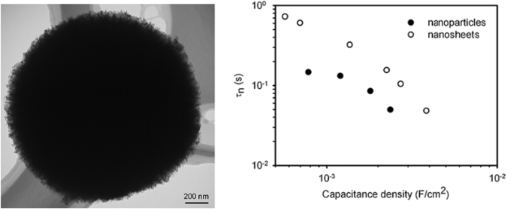
- transfer and back reaction has not been reported. A deep understanding of the role of the TiO2 [001] facet in these key processes of electron transport and recombination of DSCs is of great importance for both practical applications and basic research. In this work, anatase TiO2 spheres with a hierarchical


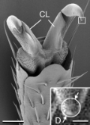
Impact of cell shape in hierarchically structured plant surfaces on the attachment of male Colorado potato beetles (Leptinotarsa decemlineata)
Beilstein J. Nanotechnol. 2012, 3, 57–64, doi:10.3762/bjnano.3.7
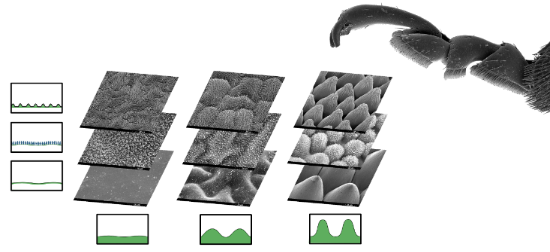
- Biomimetics, Schänzlestraße 1, 79104 Freiburg, Germany 10.3762/bjnano.3.7 Abstract Plant surfaces showing hierarchical structuring are frequently found in plant organs such as leaves, petals, fruits and stems. In our study we focus on the level of cell shape and on the level of superimposed microstructuring
- , leading to hierarchical surfaces if both levels are present. While it has been shown that epicuticular wax crystals and cuticular folds strongly reduce insect attachment, and that smooth papillate epidermal cells in petals improve the grip of pollinators, the impact of hierarchical surface structuring of
- optical properties of the plant surface, and can either improve or impede attachment of insects [1][2]. Structuring of epidermal surfaces such as leaves, petals and stems is manifold and occurs on different levels, leading to hierarchical organisation [3]. Both the shape and orientation of surface


Synthesis and catalytic applications of combined zeolitic/mesoporous materials
Beilstein J. Nanotechnol. 2011, 2, 785–801, doi:10.3762/bjnano.2.87
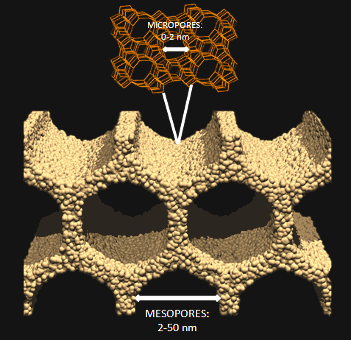
- ” hierarchical mesoporous zeolite, meaning a mesoporous material with zeolitic walls, wherein the micro- and mesopores are interconnected in order to form a hierarchical structure. Such mesoporous zeolites are expected to be superior materials since they will be able to catalyze the typical reactions in which
- standard zeolites are used, but instead of being limited by the microporous nature, they will be able to convert larger molecules as well [44]. Moreover, the presence of a hierarchical pore system is also considered to be beneficial, since the presence of two interconnected pore systems with different
- with only minor) “true” hierarchical ordering cannot be beneficial for certain reactions. In fact, often a uniform pore size distribution and a high level of porosity are much more relevant than a perfectly ordered nanoporous material. The disordered mesoporous material, KIT-1 [53], is the perfect




Template-assisted formation of microsized nanocrystalline CeO2 tubes and their catalytic performance in the carboxylation of methanol
Beilstein J. Nanotechnol. 2011, 2, 776–784, doi:10.3762/bjnano.2.86
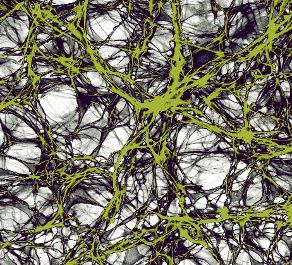
- and characterization of hierarchical microsized nanocrystalline ceria fibre mats Formation of ceria tubes without surfactant Ceria tubes were prepared by an exotemplating technique. After controlled ageing of a sol-precursor solution prepared from cerium ammonium nitrate (NH4)2Ce(NO3)6 in water and


Micro- and mesoporous solids: From science to application
Beilstein J. Nanotechnol. 2011, 2, 774–775, doi:10.3762/bjnano.2.85

- achieve a basic understanding of what happens inside the porous framework of such a solid on the molecular, and nano- and mesocopic level, in a hierarchical order, during adsorption, desorption and chemical reactions. Alongside the development of experimental methods to unravel the details of the

Approaches to nanostructure control and functionalizations of polymer@silica hybrid nanograss generated by biomimetic silica mineralization on a self-assembled polyamine layer
Beilstein J. Nanotechnol. 2011, 2, 760–773, doi:10.3762/bjnano.2.84
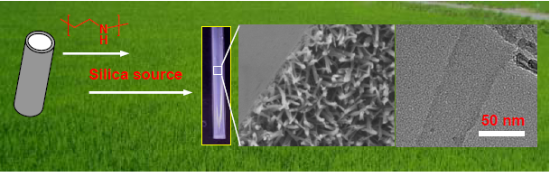
- after calcination [28]. Importantly, the attractive feature of this simple approach is that the nanosilicas can be created in a reliable and programmable way with a hierarchical nanostructure and complex morphology [29][30][31]. Very recently, we found that this crystalline LPEI is further capable of
- crystalline self-assembly on substrates, we also synthesized an ultrathin silica-nanowire-based surface, which demonstrated the feasible modulation of the hierarchical nanostructure and surface morphology [34]. In comparison, the modulation of the nanostructure and surface morphology of nanoribbon-based


Inorganic–organic hybrid materials through post-synthesis modification: Impact of the treatment with azides on the mesopore structure
Beilstein J. Nanotechnol. 2011, 2, 486–498, doi:10.3762/bjnano.2.52
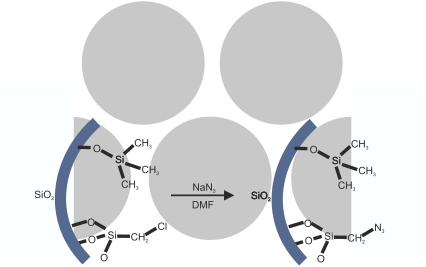
- the application of diol/polyol-modified silanes [1][2][3][14][15][16][17][18]. Nakanishi and Lindén relied on polymerization-induced phase separation during sol–gel processing to form monolithic bodies with a hierarchical organisation of the pore structure at the meso- and macroscopic length scale [16


Towards a scalable and accurate quantum approach for describing vibrations of molecule–metal interfaces
Beilstein J. Nanotechnol. 2011, 2, 427–447, doi:10.3762/bjnano.2.48
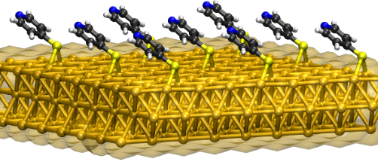
- systems and, as such, are able to account for resonance phenomena, combination bands and vibrational overtones in a hierarchical and consistent manner. While temperature effects can be included using a statistical mechanics framework, these are usually neglected, and thus the approach is better suited to
- desirable to use an approach that has a physical underpinning and whose accuracy can be improved systematically. Rabitz et al. [8][9] showed that a many-body decomposition leads to a convenient hierarchical representation of the PES. In their approach, the PES is expanded in a series of one-dimensional


Organic–inorganic nanosystems
Beilstein J. Nanotechnol. 2011, 2, 363–364, doi:10.3762/bjnano.2.41
- part funded by the German Science Foundation (DFG), many of them within the Collaborative Research Center (SFB) 569 dealing with the “Hierarchical Structure Formation and Function of Organic–Inorganic Nanosystems”. Thus, in addition to acknowledging the contributions of all authors and their teams, I
The effect of surface anisotropy in the slippery zone of Nepenthes alata pitchers on beetle attachment
Beilstein J. Nanotechnol. 2011, 2, 302–310, doi:10.3762/bjnano.2.35
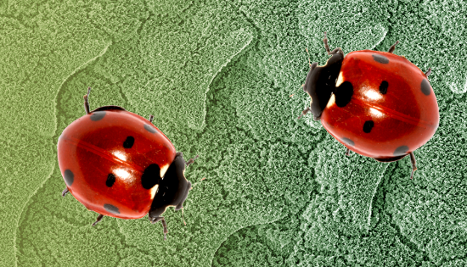
- joint project within the DFG priority program SPP 1420, whose members include the Department of Functional Morphology and Biomechanics at the University of Kiel and the Institute for Chemistry at the University of Osnabrück, the hierarchical structure of the slippery zone is currently being analysed at
- Materials Research: Functionality by Hierarchical Structuring of Materials’ (project GO 995 ⁄ 9-1) to SG.



Hierarchically structured superhydrophobic flowers with low hysteresis of the wild pansy (Viola tricolor) – new design principles for biomimetic materials
Beilstein J. Nanotechnol. 2011, 2, 228–236, doi:10.3762/bjnano.2.27
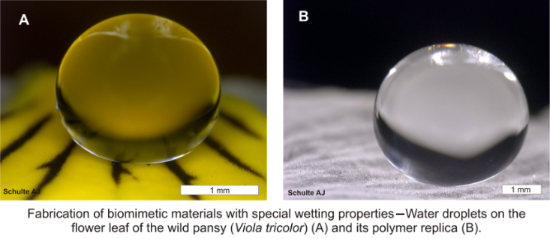
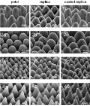
- superhydrophobic, low adhesive surface design, which combines the hierarchical structuring of petals with a wetting behavior similar to that of the lotus leaf. Keywords: anti-adhesive; petal effect; petal structures; polymer replication; superhydrophobic; Introduction Plant surfaces provide a large diversity of
- “petal effect” and are anti-adhesive for water droplets. It is well known that hierarchical surface architecture represents optimized structures for superhydrophobic surfaces [11][33][34][35][36]. Based on the data presented here, we can describe two main superhydrophobic surface architectures for plant



Functional morphology, biomechanics and biomimetic potential of stem–branch connections in Dracaena reflexa and Freycinetia insignis
Beilstein J. Nanotechnol. 2011, 2, 173–185, doi:10.3762/bjnano.2.21
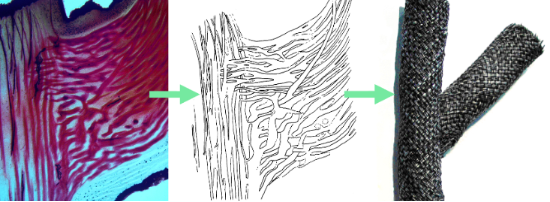
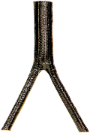
- occupied and trap solar energy in an efficient way (e.g., [5]). However, these benefits are coupled with disadvantages such as increased magnitude and complexity of mechanical loads. Therefore, structural and mechanical adaptation on different hierarchical levels can be observed both in main stems as well
- for Textile Technology and Process Engineering Denkendorf, the Institute of Lightweight Structures and Polymer Technology of the TU Dresden as well as the Botanical Garden of the TU Dresden [27][28][29][30][31]. In this project the hierarchical organisation of branch–stem-junctions of arborescent
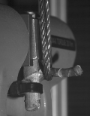
- monocotyledons and columnar cacti is analysed and different biomechanical tests are performed on these plants in order to determine the mechanical parameters of stems, branches, branch–stem-junctions and the different constituent tissues in different directions. This allows for simulation of hierarchical




Superhydrophobicity in perfection: the outstanding properties of the lotus leaf
Beilstein J. Nanotechnol. 2011, 2, 152–161, doi:10.3762/bjnano.2.19
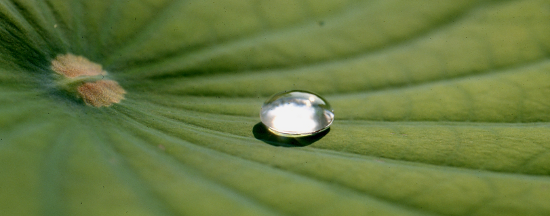
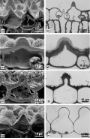
- the aquatic environment – some of the leaves float occasionally on the water surface – the stomata are located in the upper epidermis. The lower epidermis consists of convex cells covered with wax tubules and contains only few stomata. The upper epidermis features the distinctive hierarchical
- structure consisting of papillae with a dense coating of agglomerated wax tubules, which is the basis for the famous superhydrophobicity (Figure 1). However, a hierarchical surface structure which induces strong water repellency and contact angles above 150° is not a special feature of lotus leaves. It has
- regenerate damaged or lost waxes. Conclusion It is true that lotus exhibits outstanding water repellency on the upper side of its leaves. The basis of this behaviour is the hierarchical surface structure. In comparison to other species with a hierarchical surface structure composed of papillae and wax







Superhydrophobic surfaces of the water bug Notonecta glauca: a model for friction reduction and air retention
Beilstein J. Nanotechnol. 2011, 2, 137–144, doi:10.3762/bjnano.2.17
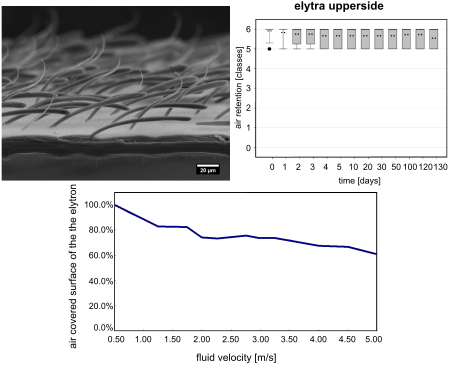
- through water, but most of the time it supports itself from underneath against the water surface with both pairs of fore legs and the tip of the abdomen [26]. The surface of the elytra is covered by a hierarchical structure of larger setae and very small microtrichia. Balmert et al. hypothesized that the
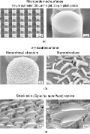
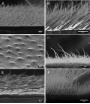
- , a pure microtrichia structure and a hierarchical structure with setae and microtrichia (Figure 2). On the abdominal sternites a pure setae structure can be observed. About 2,300 setae per mm2 cover the surface up to a height of approximately 30 µm. The basis of these setae points in the caudal
- in the living animal, the upper side stays in direct contact with the water. It therefore may have developed further adaptations to stabilize the air film. Obviously, the hierarchical double structure of the upper side of the elytra with a dense microtrichia cover and two different kinds of setae is



Biomimetics inspired surfaces for drag reduction and oleophobicity/philicity
Beilstein J. Nanotechnol. 2011, 2, 66–84, doi:10.3762/bjnano.2.9
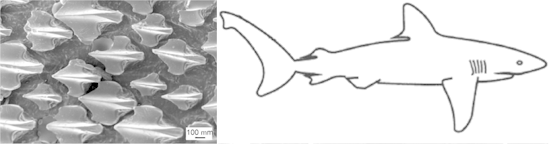
- , nanodevices, and processes which provide desirable properties. Hierarchical structures with dimensions of features ranging from the macroscale to the nanoscale are extremely common in nature and possess properties of interest. There are a large number of objects including bacteria, plants, land and aquatic
- animals, and seashells with properties of commercial interest. Certain plant leaves, such as lotus (Nelumbo nucifera) leaves, are known to be superhydrophobic and self-cleaning due to the hierarchical surface roughness and presence of a wax layer. In addition to a self-cleaning effect, these surfaces with
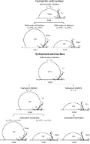
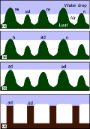
- waxes on lotus leaves exist as tubules [10][11]. Water droplets on these hierarchical structured surfaces readily sit on the apex of the nanostructures because air bubbles fill the valleys of the structure under the droplet (Figure 1a). Therefore, these leaves exhibit considerable superhydrophobicity