Search results
Search for "material properties" in Full Text gives 196 result(s) in Beilstein Journal of Nanotechnology.
In situ monitoring magnetism and resistance of nanophase platinum upon electrochemical oxidation
Beilstein J. Nanotechnol. 2013, 4, 394–399, doi:10.3762/bjnano.4.46
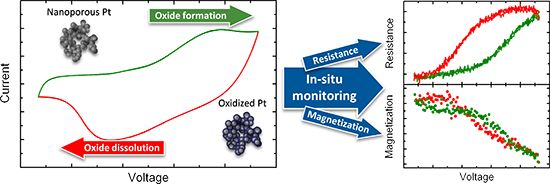
- Institute of Physics, University of Graz, Universitätsplatz 5, 8010 Graz, Austria 10.3762/bjnano.4.46 Abstract Controlled tuning of material properties by external stimuli represents one of the major topics of current research in the field of functional materials. Electrochemically induced property tuning
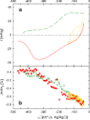
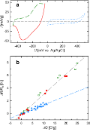
- –electrolyte interface of nanophase materials, the physical material properties may also be changed by electrochemical surface reactions, as for instance documented for nanoporous Au [6]. Based on tunability studies of the electrical resistance of porous nanocrystalline Pt [5] or nanoporous Pt [7] and of the

Multiple regimes of operation in bimodal AFM: understanding the energy of cantilever eigenmodes
Beilstein J. Nanotechnol. 2013, 4, 385–393, doi:10.3762/bjnano.4.45
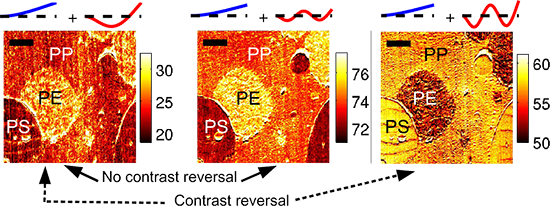
- property contrast with high resolution. Bimodal AFM, where two eigenmodes are simultaneously excited, confers significant advantages over conventional single-frequency tapping mode AFM due to its ability to provide contrast between regions with different material properties under gentle imaging conditions
- ) image and the so-called “phase” image. The latter is related to material properties and is frequently used to distinguish different domains or different blend components from one another. While phase imaging often provides good contrast between different materials, it is difficult to determine the exact


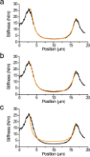
![[Graphic 3]](/bjnano/content/inline/2190-4286-4-45-i5.png?max-width=637&scale=1.18182) . In the top row (a, b) the first eigen...
. In the top row (a, b) the first eigen...



Polynomial force approximations and multifrequency atomic force microscopy
Beilstein J. Nanotechnol. 2013, 4, 352–360, doi:10.3762/bjnano.4.41
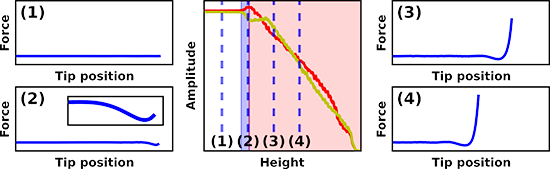
- account for adhesive forces in the contact regime, which we try to circumvent by using tips with small radii. While the DMT model provides sufficient insight into material properties, the extracted numerical values of the DMT parameters should not be expected to agree with values for the bulk material. In

![[Graphic 19]](/bjnano/content/inline/2190-4286-4-41-i45.png?max-width=637&scale=1.18182) matrix (a) and its pseudo-inverse (b). Only rows with non-zero elements are d...
matrix (a) and its pseudo-inverse (b). Only rows with non-zero elements are d...


Grating-assisted coupling to nanophotonic circuits in microcrystalline diamond thin films
Beilstein J. Nanotechnol. 2013, 4, 300–305, doi:10.3762/bjnano.4.33
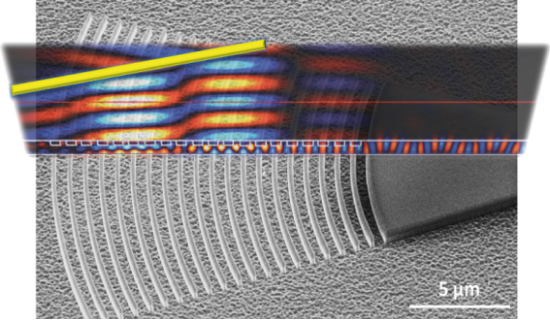
- diamond has found a wealth of applications for the fabrication of windows that permit transmission in the long-IR or microwave regions [14]. In addition, diamond provides attractive material properties, such as biocompatibility, chemical inertness, high thermal conductivity, and mechanical hardness [15


High-resolution nanomechanical analysis of suspended electrospun silk fibers with the torsional harmonic atomic force microscope
Beilstein J. Nanotechnol. 2013, 4, 243–248, doi:10.3762/bjnano.4.25
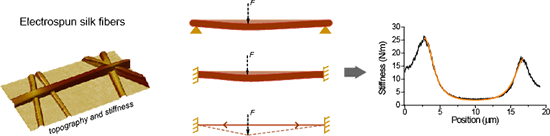
- force–distance curves to parameters representing the material properties. Although contact-mechanics models can be used for a wide variety of polymer composites, block-copolymers, and biomaterials [27][28][29][30][31][32][33][34], these models are not applicable to materials with complex geometries. For


Bimodal atomic force microscopy driving the higher eigenmode in frequency-modulation mode: Implementation, advantages, disadvantages and comparison to the open-loop case
Beilstein J. Nanotechnol. 2013, 4, 198–207, doi:10.3762/bjnano.4.20
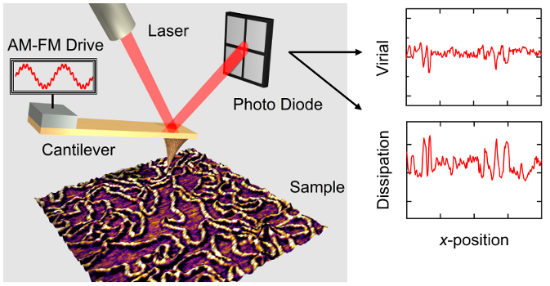
- of the second phase contrast to material properties in the small-amplitude regime. This method, which was later implemented experimentally [3] and studied further theoretically and computationally [4][5], gave birth to a new host of multifrequency AFM techniques, which nowadays include a wide variety


Plasticity of Cu nanoparticles: Dislocation-dendrite-induced strain hardening and a limit for displacive plasticity
Beilstein J. Nanotechnol. 2013, 4, 173–179, doi:10.3762/bjnano.4.17
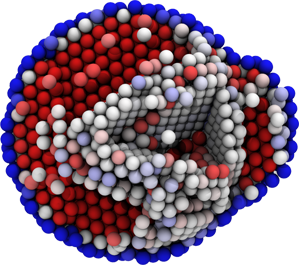
- threshold pressure, depending on the material properties, is reached. In their pioneering work, Sun et al. [7] studied the extrusion of Ag nanoparticles experimentally and attributed the plastic flow to dislocation activity, based on a combination of simulation results on Pt showing traces of dislocation


Towards 4-dimensional atomic force spectroscopy using the spectral inversion method
Beilstein J. Nanotechnol. 2013, 4, 87–93, doi:10.3762/bjnano.4.10
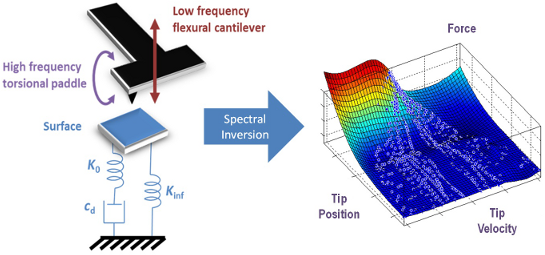
- a single 2-dimensional (2D) surface scan. Although signal-to-noise ratio limitations can currently prevent the accurate experimental implementation of the 4D method, and the extraction of rate-dependent material properties from the force maps is a formidable challenge, the spectral inversion method


Thermal noise limit for ultra-high vacuum noncontact atomic force microscopy
Beilstein J. Nanotechnol. 2013, 4, 32–44, doi:10.3762/bjnano.4.4
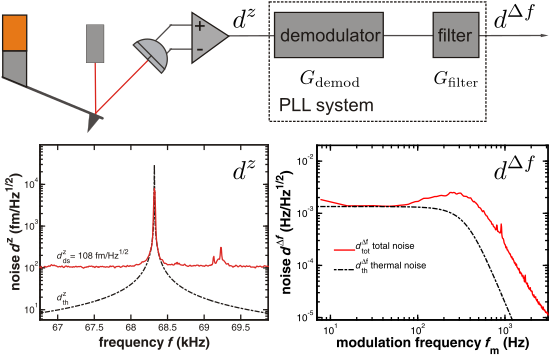
- first and second harmonic mode are determined by measuring resonance curves and fitting the amplitude response function to the data as described in [9]. This procedure also yields quality factors Qn, while the stiffness kdim is calculated from cantilever dimensions and material properties [10] and used


![[Graphic 53]](/bjnano/content/inline/2190-4286-4-4-i64.png?max-width=637&scale=1.18182) =
= ![[Graphic 32]](/bjnano/content/inline/2190-4286-4-4-i43.png?max-width=637&scale=1.18182) f...
f...


![[Graphic 56]](/bjnano/content/inline/2190-4286-4-4-i67.png?max-width=637&scale=1.18182) using three diff...
using three diff...

Growth behaviour and mechanical properties of PLL/HA multilayer films studied by AFM
Beilstein J. Nanotechnol. 2012, 3, 778–788, doi:10.3762/bjnano.3.87
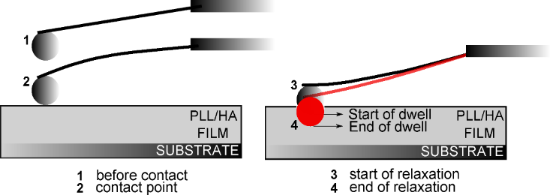
- [21][37][38][40]. Another source of error in mechanical measurements of thin films is the substrate effect [37]. Although film stiffening due to the hard substrate is a real effect, it should be eliminated in the calculations since it does not reflect the material properties of the coating and may not


Controlled positioning of nanoparticles on a micrometer scale
Beilstein J. Nanotechnol. 2012, 3, 773–777, doi:10.3762/bjnano.3.86
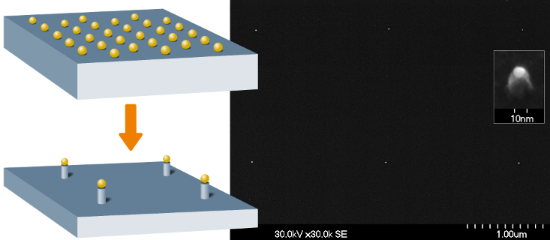
- ; Introduction Nanoparticles (NPs) still play a major role in nanoscience from both an application and a fundamental point of view. Common to both aspects is the interest in possible new properties when reducing the sample size of a material down to the nanoscale. Quite generally, all material properties display


Plasmonics-based detection of H2 and CO: discrimination between reducing gases facilitated by material control
Beilstein J. Nanotechnol. 2012, 3, 712–721, doi:10.3762/bjnano.3.81
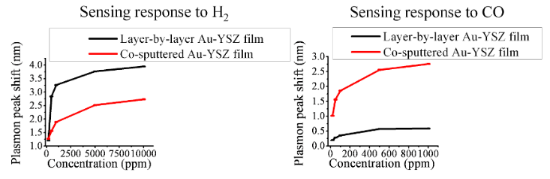
- films to the gases at temperatures of 500 °C in a background of dry air. Characterization of the samples by XRD and SEM enabled the correlation of material properties with the differences in the CO- and H2-induced LSPR peak shifts, including the relative desensitization towards NO2. Sensing
- has been performed for the first time. The resulting material properties of these films have produced a unique sensing dependence, which has enabled an enhanced detection of H2 by a factor of 4 in comparison to CO. Such a strong difference in the detection of these two reducing gases is significant
- selective detection of CO and H2 for many types of metal-oxide-based sensing applications is problematic since they both react readily with the oxygen anion species and produce a similar response on the transducer of interest [1]. The results from this current study show that by tuning the material





Assessing the plasmonics of gold nano-triangles with higher order laser modes
Beilstein J. Nanotechnol. 2012, 3, 674–683, doi:10.3762/bjnano.3.77
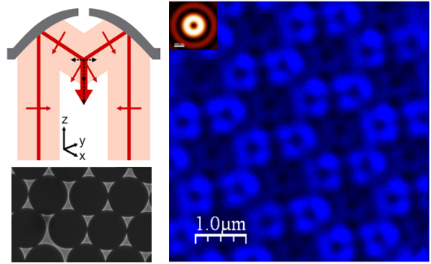
- dielectric materials such as the glass and silicon is inevitably missing. 2) The foci at the air/silicon and air/glass interfaces are different due to the different material properties. 3) This simple convolution approach accurately describes the scattering at single nanostructures but completely neglects


Wavelet cross-correlation and phase analysis of a free cantilever subjected to band excitation
Beilstein J. Nanotechnol. 2012, 3, 294–300, doi:10.3762/bjnano.3.33
- ; Introduction Atomic force microscopy (AFM) has made important progresses towards the characterization of material properties at the nanoscale (elastic constants, force interactions, friction, molecular interactions, to name only a few) by means of dynamic techniques that extended the microscope capabilities
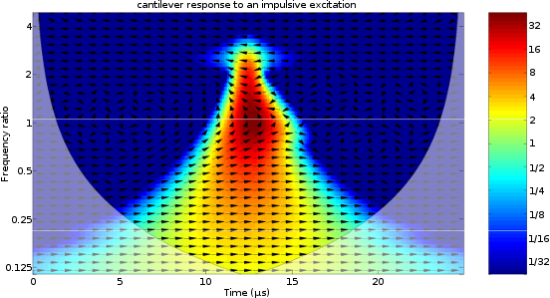
- spectral distribution upon impact, captured with wavelet amplitude and phase analysis, is thus a fingerprint of the material properties. This information can be used, at the very least, to determine compositional contrast. A final remark is due concerning the effect of noise (thermal and environmental
- characterization of material properties on the nanoscale. The wavelet correlation technique allows one to measure the phase relationship between driver force and cantilever response in complex excitation schemes. The complete time–frequency picture of the phase evolution can be exploited as an important tool to


Simultaneous current, force and dissipation measurements on the Si(111) 7×7 surface with an optimized qPlus AFM/STM technique
Beilstein J. Nanotechnol. 2012, 3, 249–259, doi:10.3762/bjnano.3.28
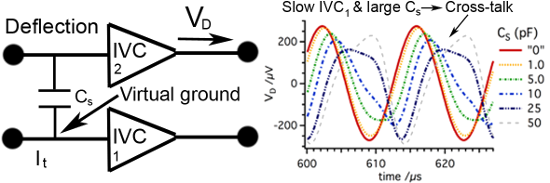
- physical, chemical and material properties of surfaces and nanostructures at the atomic scale. STM is based on the detection of the tunneling current between a probe and a sample, and it turned quickly into a standard technique widely used to characterize conductive surfaces and to modify objects at the
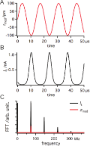

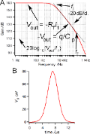
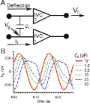

![[Graphic 7]](/bjnano/content/inline/2190-4286-3-28-i11.png?max-width=637&scale=1.18182) can...
can...


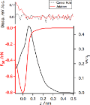
Theoretical study of the frequency shift in bimodal FM-AFM by fractional calculus
Beilstein J. Nanotechnol. 2012, 3, 198–206, doi:10.3762/bjnano.3.22
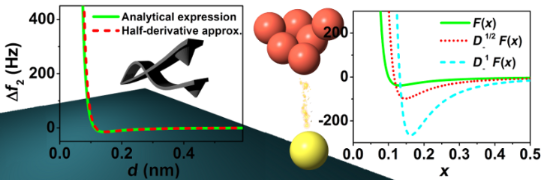
- method enables the simultaneous recording of several material properties and, at the same time, it also increases the sensitivity of the microscope. Here we apply fractional calculus to express the frequency shift of the second eigenmode in terms of the fractional derivative of the interaction force. We
- or integration is dictated by the difference between the amplitude of oscillation and the length scale of the interaction. Successful approaches to reconstruct material properties in a quantitative way came along with the development of novel AFM techniques, such as scanning probe accelerometer


Moisture harvesting and water transport through specialized micro-structures on the integument of lizards
Beilstein J. Nanotechnol. 2011, 2, 204–214, doi:10.3762/bjnano.2.24
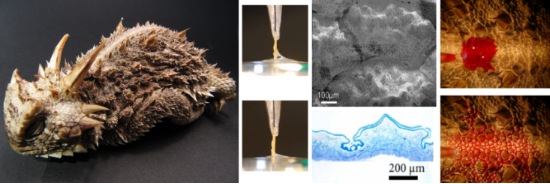
- and any macroscopic geometric parameter of the scales in the three investigated species (data not shown). Thus, either material properties or the micro ornamentation of the scales induce the high wettability. Contact angle and microscopic morphology To quantify the wetting properties we attempted to


Infrared receptors in pyrophilous (“fire loving”) insects as model for new un-cooled infrared sensors
Beilstein J. Nanotechnol. 2011, 2, 186–197, doi:10.3762/bjnano.2.22
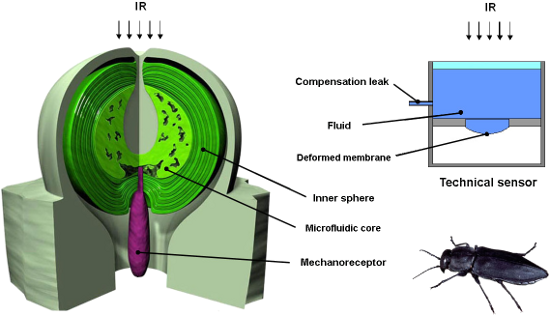
- beetles and bugs Structure and material properties of photomechanic IR receptors Structure and function of photomechanic insect IR sensillae have been most studied in Melanophila beetles. As a special behavioural feature, beetles of both sexes approach forest fires because their brood depends on burnt
- coefficient, water is not an optimal liquid. Hydrocarbons such as n-pentane and toluene, as well as methanol, which are also used as fluids in thermometers, are more appropriate. Table 1 shows the material properties of different hydrocarbons and carbon dioxide in comparison to water. The thermal expansion
- Golay sensors yields different results due to the different material properties, in particular density ρ, heat capacity cp and the coefficients β, κ, α in Equation 7. For a better comparison with the water-filled cavity, it is also assumed that a thin zone due to a thin absorbing film on the inner glass


Switching adhesion forces by crossing the metal–insulator transition in Magnéli-type vanadium oxide crystals
Beilstein J. Nanotechnol. 2011, 2, 59–65, doi:10.3762/bjnano.2.8
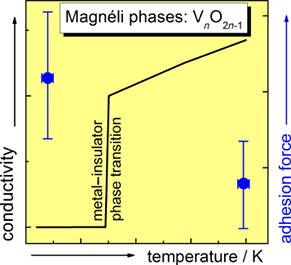
- integrity, allows for relating frictional and electronic material properties at the nano scale. This behavior makes the vanadium Magnéli phases interesting candidates for technology, e.g., as intelligent devices or coatings where switching of adhesion or friction is desired. Keywords: adhesion force
- Johnson–Kendall–Roberts (JKR) model [19]. These two models improved the Hertzian theory [18] by including the effect of adhesion and present the limiting cases of more general contact theories by Maugis [32]. Both models have in common that the pull-off-force is independent of the elastic material
- properties but is essentially a linear function not only of the sphere radius but also of the surface energy of the sample. At the MIT the crystal structure of the Magnéli phases is distorted resulting in a slightly higher density in the metallic phase [33] and an increase of the atomic density at the



Magnetic nanoparticles for biomedical NMR-based diagnostics
Beilstein J. Nanotechnol. 2010, 1, 142–154, doi:10.3762/bjnano.1.17
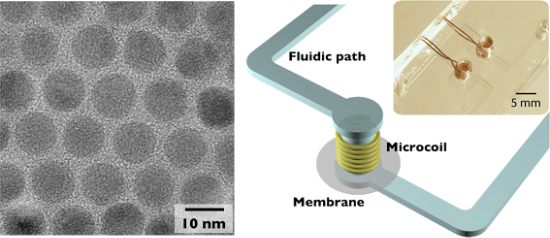
- [20]. The upper limit for a single domain [~(A/2K)1/2] is determined by the material properties: the exchange stiffness (A) and the anisotropy constant (K). For most magnetic materials (e.g., ferrite and iron), MNPs with a diameter <20 nm will have a single domain with magnetic moments aligned in a


Review and outlook: from single nanoparticles to self-assembled monolayers and granular GMR sensors
Beilstein J. Nanotechnol. 2010, 1, 75–93, doi:10.3762/bjnano.1.10
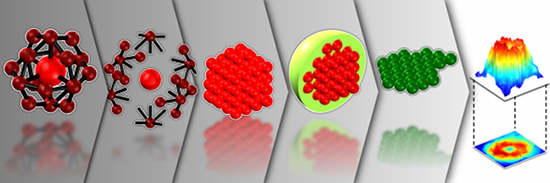
- , interface effects gain importance until below a critical diameter dc, the formation of domains is energetically less favorable. For spherical particles, this critical diameter dc depends on various material properties such as the exchange constant A, the effective anisotropy constant Keff and the saturation