


Search results
Search for "patterning" in Full Text gives 191 result(s) in Beilstein Journal of Nanotechnology.
Electron-beam patterned self-assembled monolayers as templates for Cu electrodeposition and lift-off
Beilstein J. Nanotechnol. 2012, 3, 101–113, doi:10.3762/bjnano.3.11
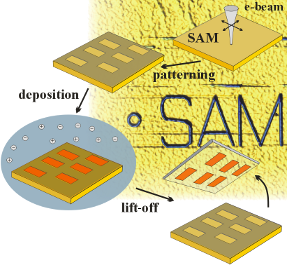
- patterned SAM layer does not deteriorate during the lift-off process it may serve as a master that can be straightforwardly reused [15]. This is of particular advantage for small-scaled structures in which patterning becomes increasingly time-consuming and expensive. The feasibility of this SAM based
- hexadecane thiol (CH3(CH2)15SH, MC16) as a blocking thiol [15]. The present paper is an investigation of a scheme for creating surface features with smaller dimensions by using e-beam patterning of a single-component SAM of ω-(4'-methylbiphenyl-4-yl)thiol (CH3–C6H4–C6H4–SH, MBP0). While selective deposition
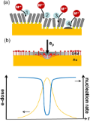
- rate becomes very small. These two points together are very important as they are the key to high-resolution patterning. A double-pulse-polarisation scheme is applied in which an initial nucleation phase at an overpotential that is significantly larger than ηcrit is followed by further growth at lower





Substrate-mediated effects in photothermal patterning of alkanethiol self-assembled monolayers with microfocused continuous-wave lasers
Beilstein J. Nanotechnol. 2012, 3, 65–74, doi:10.3762/bjnano.3.8
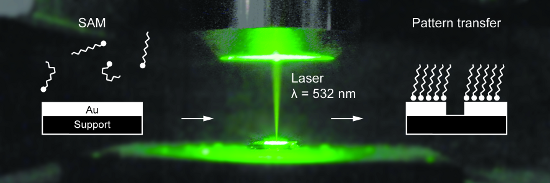
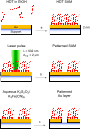
- locally heat the substrate surface and initiate desorption or decomposition of the coating. Because of the strongly temperature-dependent desorption kinetics, the overall process is highly nonlinear in the applied laser power. For this reason, subwavelength patterning is feasible employing ordinary
- continuous-wave lasers. The lateral resolution, generally, depends on both the type of the organic monolayer and the nature of the substrate. In previous studies we reported on photothermal patterning of distinct types of SAMs on Si supports. In this contribution, a systematic study on the impact of the
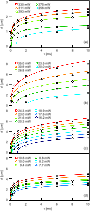
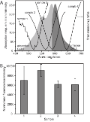
- patterning technique. Because of the strongly temperature-dependent thermal conductivity of Si, surface-temperature profiles on Au/Si substrates are very narrow ensuring a particularly high lateral resolution. At a 1/e spot diameter of 2 µm, fabrication of subwavelength structures with diameters of 300–400




Direct-write polymer nanolithography in ultra-high vacuum
Beilstein J. Nanotechnol. 2012, 3, 52–56, doi:10.3762/bjnano.3.6
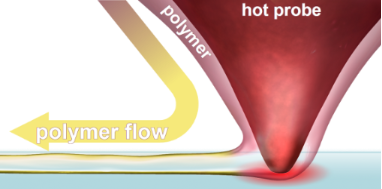
- decrease as the inverse square root of the scan speed. The widths of the deposited structures decrease monotonically with the scan speed but do not show a clear power law relationship. When patterning under ambient conditions, dimensional control may be achieved by varying the tip temperature; however, the


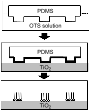
Self-assembled monolayers and titanium dioxide: From surface patterning to potential applications
Beilstein J. Nanotechnol. 2011, 2, 845–861, doi:10.3762/bjnano.2.94
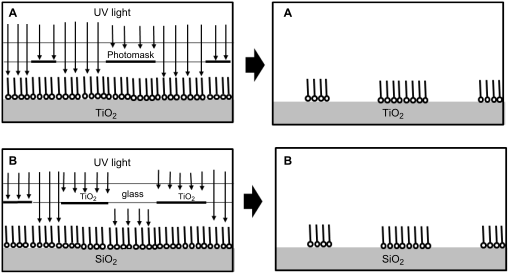
- TiO2 is described. Photocatalytic phenomena that are of specific relevance to SAMs, such as remote degradation, and cases where SAMs were used to study photocatalytic phenomena, are discussed as well. Mastering of micro-patterning is a key issue en route to a successful assimilation of a variety of
- titanium dioxide based devices. Accordingly, particular attention is given to the description of a variety of methods and techniques aimed at utilizing the photocatalytic properties of titanium dioxide for patterning. Reports on a variety of applications are discussed. These examples, representing the
- many ways, from the study of fundamental issues in TiO2 photocatalysis to the growth of supramolecular structures; from serving as a tool for patterning to suggesting means to obtain the selective photocatalytic degradation of highly toxic contaminants. This potential for synergism between self



Self-assembly at solid surfaces
Beilstein J. Nanotechnol. 2011, 2, 824–825, doi:10.3762/bjnano.2.91

- advent of relatively recent technologies for small-scale patterning, interest in self-assembled films has seen a surge of activity throughout a wide range of areas ranging from biointerfaces to data storage and devices. This Thematic Series presents a small, but significant sampling of these exciting
Approaches to nanostructure control and functionalizations of polymer@silica hybrid nanograss generated by biomimetic silica mineralization on a self-assembled polyamine layer
Beilstein J. Nanotechnol. 2011, 2, 760–773, doi:10.3762/bjnano.2.84
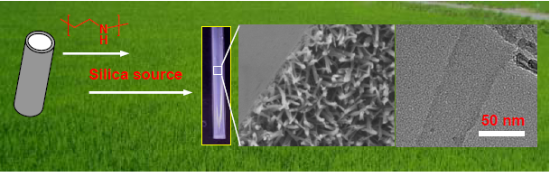
- achieved by first patterning silicification-active polymer solutions onto the substrates and subsequently performing silica deposition [24][25]. Cha and coworkers [26] reported using block copolymer thin film for the biomimetic formation of two-dimensional silica nanopatterned arrays. However, the


The atomic force microscope as a mechano–electrochemical pen
Beilstein J. Nanotechnol. 2011, 2, 659–664, doi:10.3762/bjnano.2.70
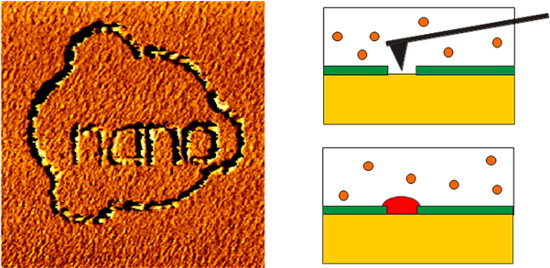
- numerous applications including in the fields of microelectronics, nanoscale electronics and nano-electromechanical systems (NEMS). Considerable progress was achieved recently in the field of self-organized electrochemical patterning of nanowires. In thin-film electrolytes, regular arrays of nanowires were
- techniques also include the use of elaborate voltage-pulse sequences [24][25]. While much work was performed using the STM as a tool for electrochemical patterning, only a few attempts exist utilizing the AFM as a tool for controlled site-selective electrochemical deposition of metals on surfaces. Initial


Tip-enhanced Raman spectroscopic imaging of patterned thiol monolayers
Beilstein J. Nanotechnol. 2011, 2, 509–515, doi:10.3762/bjnano.2.55
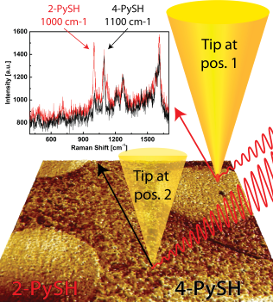
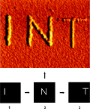
- likely that a very small fraction of molecules diffusing on the Ag surface during production of the samples dominated the spectra, preventing a localization of the molecules. Another possible explanation is that the roughness of the SERS substrate interfered with the patterning process used (compare

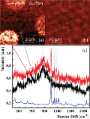

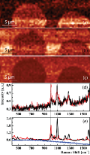


Towards multiple readout application of plasmonic arrays
Beilstein J. Nanotechnol. 2011, 2, 501–508, doi:10.3762/bjnano.2.54
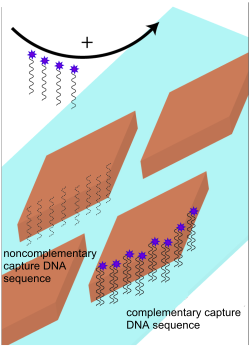
- enhancement across a large area [22]. By virtue of the patterning process, the optical parameters are tunable by varying both the size of the nanoparticles and the period of the array [23], which leads to design and fabrication strategies of SERS arrays developed to gain a maximum SERS enhancement [24


Plasmonic nanostructures fabricated using nanosphere-lithography, soft-lithography and plasma etching
Beilstein J. Nanotechnol. 2011, 2, 448–458, doi:10.3762/bjnano.2.49

- this kind require large area nanostructured surfaces. Thus only methods allowing large scale lithography/patterning are appropriate for this purpose. E-beam lithography and FIB based nanofabrication would be prohibitively expensive. The most common fabrication technique using arrays of polystyrene (PS
- nm. Nanoimprint lithography [55][56] is another alternative technique in which a pattern is formed on top of a substrate by pressing a mold against a thin resist film, followed by reactive ion etching (RIE) of the patterned substrate. This allows patterning of reproducible structures up to a few tens


Formation of precise 2D Au particle arrays via thermally induced dewetting on pre-patterned substrates
Beilstein J. Nanotechnol. 2011, 2, 318–326, doi:10.3762/bjnano.2.37
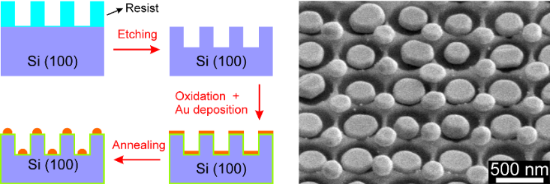
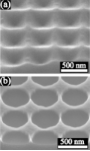
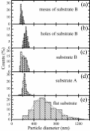
- Garching, Germany 10.3762/bjnano.2.37 Abstract The fabrication of precise 2D Au nanoparticle arrays over a large area is presented. The technique was based on pre-patterning of the substrate before the deposition of a thin Au film, and the creation of periodic particle arrays by subsequent dewetting
- was observed on a thin metal film that had been patterned using focused ion beam (FIB) before the dewetting process [34]. However, the FIB patterning is a time-consuming process. Giermann and Thompson reported the formation of a 2D ordered Au nanoparticle array, with uniform size and aligned
- technique, which was developed by Philips Research and SUSS MicroTec, combines the advantages of both UV nanoimprint lithography techniques with rigid stamp for the best resolution and with soft stamp for the large-area (6 inch area) patterning. Thermal oxide several nanometers thick was grown on the pre





Sorting of droplets by migration on structured surfaces
Beilstein J. Nanotechnol. 2011, 2, 215–221, doi:10.3762/bjnano.2.25
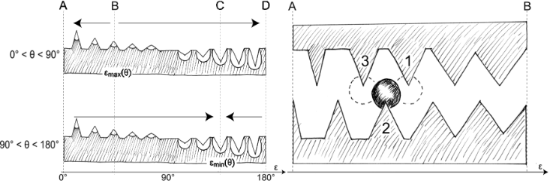
- centre whereas lyophobic droplets would migrate away from it. A reverse migration order should result if the roles of A and B are interchanged or if point C is chosen as the centre and point D as the periphery. Discussion The specific surface patterning is not only able to initiate a spontaneous and


Manipulation of gold colloidal nanoparticles with atomic force microscopy in dynamic mode: influence of particle–substrate chemistry and morphology, and of operating conditions
Beilstein J. Nanotechnol. 2011, 2, 85–98, doi:10.3762/bjnano.2.10
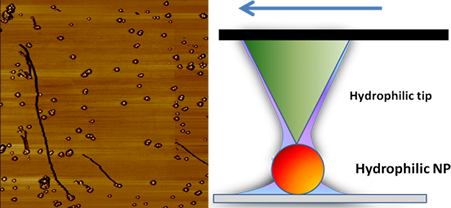
- . the shape, size and grafting of the NPs, as well as the surface chemistry and the patterning of the substrate, and finally the operating conditions (temperature, humidity and scan velocity). Whereas the operating conditions and substrate structure are shown to have a strong effect on the mobility of


A collisional model for AFM manipulation of rigid nanoparticles
Beilstein J. Nanotechnol. 2010, 1, 158–162, doi:10.3762/bjnano.1.19
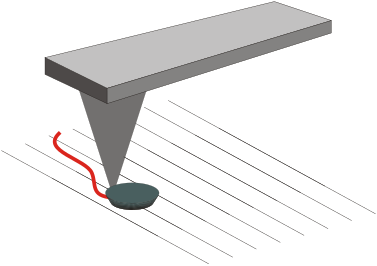
- direction of motion of arbitrarily shaped nanoparticles is important for the guided formation of nanostructures. An interesting analogy is found with AFM nanolithography. In a recent paper we have shown that the patterning of amorphous polymers can be ‘tuned’ by varying the scan path of an AFM tip which


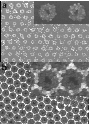
Aerosol assisted fabrication of two dimensional ZnO island arrays and honeycomb patterns with identical lattice structures
Beilstein J. Nanotechnol. 2010, 1, 71–74, doi:10.3762/bjnano.1.9
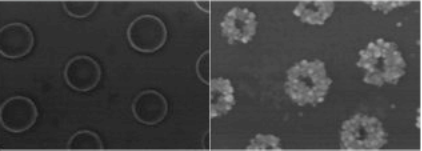
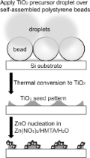
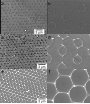
- -dimensional photonic crystals (PhCs) [7][8][9]. To this end, a number of techniques, including an atomic layer epitaxy [10], chemical vapor deposition [11], and photoresist patterning [12][13], have been used to deposit various morphologies of ZnO patterns on substrates. There is intense current interest in

Flash laser annealing for controlling size and shape of magnetic alloy nanoparticles
Beilstein J. Nanotechnol. 2010, 1, 55–59, doi:10.3762/bjnano.1.7
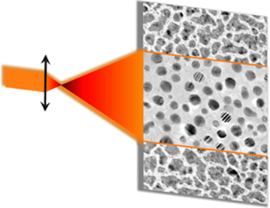
- produce organized CoPt or any bimetallic NPs on a substrate, by using an accurate patterning of the light field intensity designed by masks or gratings lithography [14][31]. Schematic representation of the experimental setup: the sample is placed behind the back focal plane of a convergent lens. The





