Search results
Search for "trapping" in Full Text gives 185 result(s) in Beilstein Journal of Nanotechnology.
Influence of diffusion on space-charge-limited current measurements in organic semiconductors
Beilstein J. Nanotechnol. 2013, 4, 180–188, doi:10.3762/bjnano.4.18
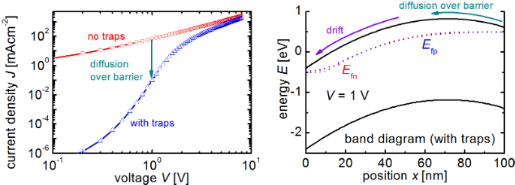
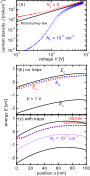
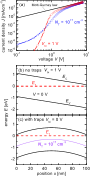
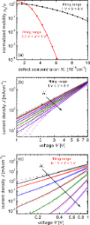
- are generally disordered materials, it is important to investigate the effects of energetic disorder on the results of our simulations. In order to take the effect of disorder into account, a multiple trapping model together with exponential band tails is used in some simulations (Figure 3 and Figure


Reduced electron recombination of dye-sensitized solar cells based on TiO2 spheres consisting of ultrathin nanosheets with [001] facet exposed
Beilstein J. Nanotechnol. 2012, 3, 378–387, doi:10.3762/bjnano.3.44
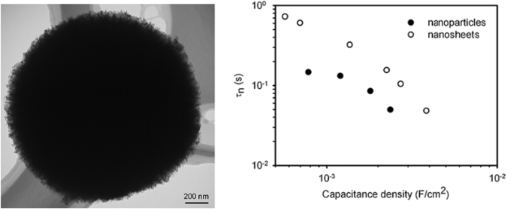
- dye molecule) excites an electron from the ground state of the dye molecule to its excited state. The electron is then injected to the conduction band of the adjacent TiO2 material, owing to a favorable alignment of the energetics. The electron goes through a series of trapping/detrapping process in
- that mimics the physical process in the device. The equivalent circuit that depicts the process of electron trapping/detrapping in DSCs is shown in Figure 3a. It contains a series resistance, Rs, a capacitance at the Pt electrode/electrolyte interface, CPt, and a resistance for the charge-transfer


Electron-beam patterned self-assembled monolayers as templates for Cu electrodeposition and lift-off
Beilstein J. Nanotechnol. 2012, 3, 101–113, doi:10.3762/bjnano.3.11
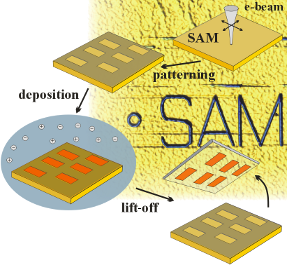
- the same. The depth between the Cu surface and the copper-free area was 30 nm after lift-off, revealing an incomplete filling of the trench by the glue, which is again likely due to trapping of air. On comparison of the friction images of the Cu structure as deposited and after lift-off (Figures 9b

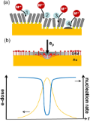


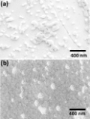


Femtosecond time-resolved photodissociation dynamics of methyl halide molecules on ultrathin gold films
Beilstein J. Nanotechnol. 2011, 2, 618–627, doi:10.3762/bjnano.2.65
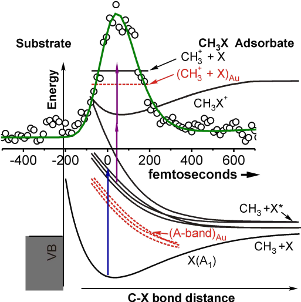
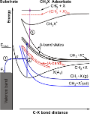
- photodissociation when the molecules are in contact with the metal substrate [33][34]. In contrast to CH3I, however, the photodissociation of the first monolayer of CH3Br and CH3Cl is easily promoted on the Pt(111) surface through UV irradiation [24][31][35][36]. Trapping of iodine atoms at the surface subsequent
- trapping of the iodine atoms at the surface subsequent to CD3I photodissociation. Consequently, during the laser irradiation of the sample an iodine film (or a gold–iodine layer) might be formed between the Au surface and the subsequently adsorbed CD3I molecules. On this iodine film, the photodissociation


The effect of surface anisotropy in the slippery zone of Nepenthes alata pitchers on beetle attachment
Beilstein J. Nanotechnol. 2011, 2, 302–310, doi:10.3762/bjnano.2.35
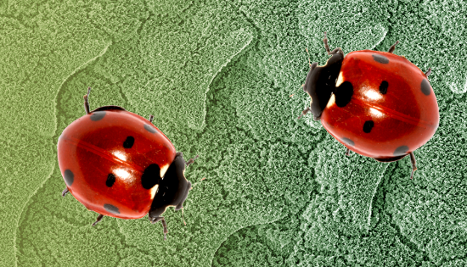
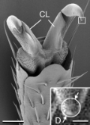
- downward pitcher direction, since, in this direction, they could interlock with overhanging edges of lunate cells. Keywords: adhesive pads; claws; Coccinella septempunctata; insect–plant interactions; traction force; Introduction Pitcher-shaped trapping organs produced at the tips of tendrils are
- decades, different aspects of Nepenthes biology, among them the structure and functions of pitchers, especially with respect to their trapping efficiency, have been the focus of numerous structural and experimental studies and field observations (review in [7]). For example, the importance of the pitcher
- highly viscous thus preventing trapped insects from escaping [12][13]. Although the slippery zone, situated inside the pitcher just below the peristome in the majority of Nepenthes species, was recognised long ago as an important structure for insect trapping and retention, due to its particular downward



Manipulation of gold colloidal nanoparticles with atomic force microscopy in dynamic mode: influence of particle–substrate chemistry and morphology, and of operating conditions
Beilstein J. Nanotechnol. 2011, 2, 85–98, doi:10.3762/bjnano.2.10
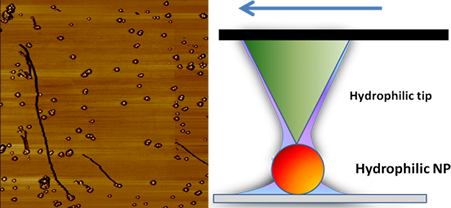
- manipulation systems. In the former, laser trapping (optical tweezers) or electrostatic or magnetic field forces are utilized. Thus, Yamomoto et al. [4] cut DNA using restriction enzymes on a laser trapped bead, Vonna et al. used magnetic tweezers and beads to stretch cell membranes [5] and Stroscio et al. [6


Oriented growth of porphyrin-based molecular wires on ionic crystals analysed by nc-AFM
Beilstein J. Nanotechnol. 2011, 2, 34–39, doi:10.3762/bjnano.2.4
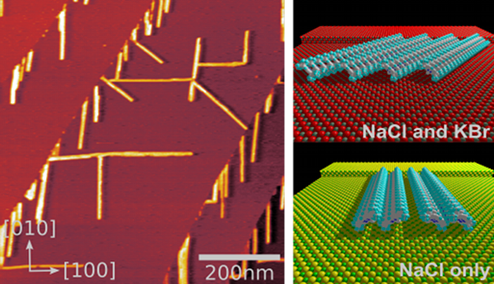
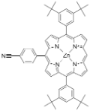
- kinks of the alkali halide crystals act as trapping points for the polar molecules, preventing them from diffusing freely over the surface. Simultaneously, intermolecular interactions force the cyano-porphyrins to form π–π stacks. These wires grow along the edges, forming long one-dimensional molecular


Defects in oxide surfaces studied by atomic force and scanning tunneling microscopy
Beilstein J. Nanotechnol. 2011, 2, 1–14, doi:10.3762/bjnano.2.1
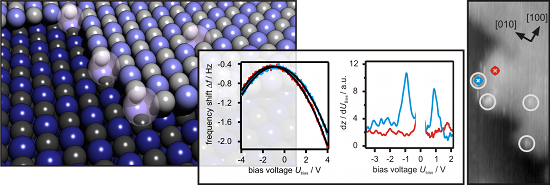
- single point defects or single adsorbates, instead of integrating over a square millimeter range. However, absolute values of the work function cannot be measured directly, only work function differences. Point defects Oxygen vacancies, also known as color centers, are electron trapping point defects and


Ultrafine metallic Fe nanoparticles: synthesis, structure and magnetism
Beilstein J. Nanotechnol. 2010, 1, 108–118, doi:10.3762/bjnano.1.13
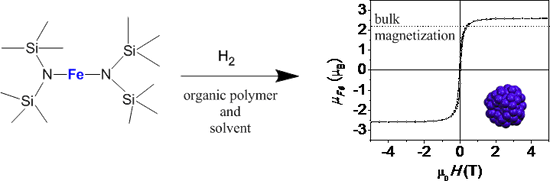
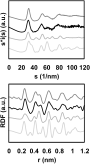
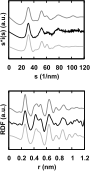
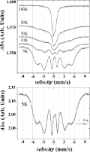
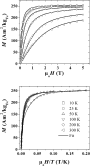
- process involving the coalescence of small clusters. This emphasises the importance of the solution phase synthesis for the trapping of unstable intermediates and the growth of metastable structures often kinetically favoured. Magnetic properties A. Mössbauer spectra The Mössbauer spectra, recorded at





Enhanced visible light photocatalysis through fast crystallization of zinc oxide nanorods
Beilstein J. Nanotechnol. 2010, 1, 14–20, doi:10.3762/bjnano.1.3
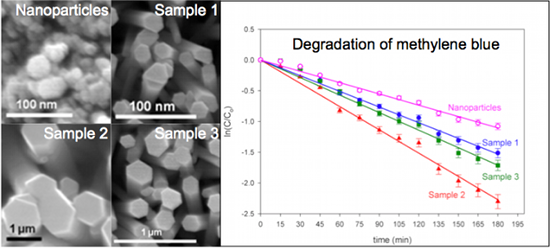
- within the band gap (surface defects) [16], thereby affecting the optical and electronic properties [17]. Increased electron trapping due to higher defect sites leads to enhancement in the photocatalytic efficiency. This increase in photocatalytic efficiency is possible provided the electron-hole pair