


Search results
Search for "wetting" in Full Text gives 182 result(s) in Beilstein Journal of Nanotechnology.
Superhydrophobicity in perfection: the outstanding properties of the lotus leaf
Beilstein J. Nanotechnol. 2011, 2, 152–161, doi:10.3762/bjnano.2.19
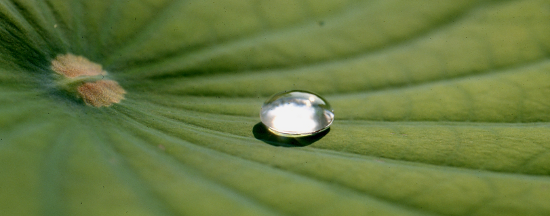
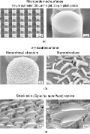
- drops touch only the highest papillae [12]. At higher pressures, e.g., at the impact of raindrops, the water intrudes deeper between the papillae (Figure 4a) and forms a meniscus at the still superhydrophobic wax tubules coating. The deformation of the non-wetting droplet surface due to surface tension





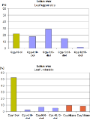


Capillary origami: superhydrophobic ribbon surfaces and liquid marbles
Beilstein J. Nanotechnol. 2011, 2, 145–151, doi:10.3762/bjnano.2.18
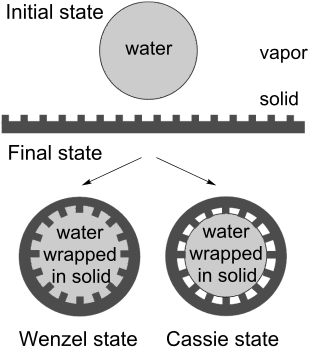
- Glen McHale Michael I. Newton Neil J. Shirtcliffe Nicasio R. Geraldi School of Science and Technology, Nottingham Trent University, Clifton Lane, Nottingham NG11 8NS, UK 10.3762/bjnano.2.18 Abstract In the wetting of a solid by a liquid it is often assumed that the substrate is rigid. However
- ; superhydrophobic; Wenzel; Introduction In wetting, the usual implicit assumption is that a solid substrate is sufficiently thick or rigid, that it does not deform or change shape due to the interfacial forces that arise when it contacts a droplet of a liquid, however, in many natural systems this is not the case
- , in an absolute sense, be considered hydrophilic [11]. That work also discussed why for a partially wetting droplet to be observed there is necessarily an assumption of some rigidity of the substrate, so that the usual definition of relative hydrophobicity (and relative hydrophilicity) through contact



Manipulation of gold colloidal nanoparticles with atomic force microscopy in dynamic mode: influence of particle–substrate chemistry and morphology, and of operating conditions
Beilstein J. Nanotechnol. 2011, 2, 85–98, doi:10.3762/bjnano.2.10
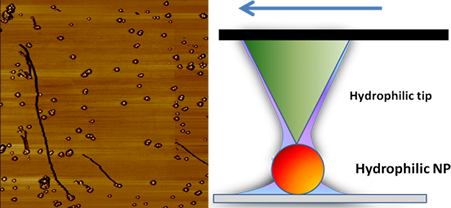
- , the magnitude of friction and adhesion forces is strongly dependent on the capillary force that is related to the intrinsic wetting properties of the interfacial system. As a consequence, the resulting water meniscus (or layer) can either increase friction through increased adhesion in the contact
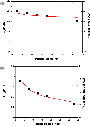


Biomimetics inspired surfaces for drag reduction and oleophobicity/philicity
Beilstein J. Nanotechnol. 2011, 2, 66–84, doi:10.3762/bjnano.2.9
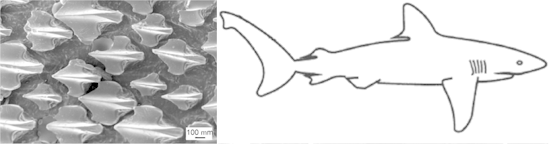
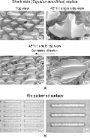
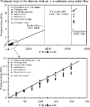
- created, and in this article the influence of structure on drag reduction efficiency is reviewed. Biomimetic-inspired oleophobic surfaces can be used to prevent contamination of the underwater parts of ships by biological and organic contaminants, including oil. The article also reviews the wetting
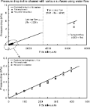
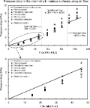
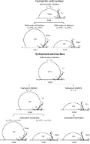
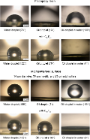
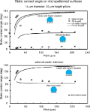
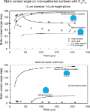
- that can be used against marine ship fouling [17]. Jung and Bhushan [20] proposed a model for predicting the oleophobic/philic nature of surfaces and showed how the water and oil droplets in three phase interfaces influence the wetting behavior on micropatterned surfaces with varying pitch values as
- applications. In this section, we discuss a model for predicting the oleophobic/philic nature and experimental measurements of the wetting properties of the surfaces. Modeling of contact angle for various interfaces If a water droplet is placed on a solid surface in air, the solid–air and water–air interfaces








Kinetic lattice Monte-Carlo simulations on the ordering kinetics of free and supported FePt L10-nanoparticles
Beilstein J. Nanotechnol. 2011, 2, 40–46, doi:10.3762/bjnano.2.5
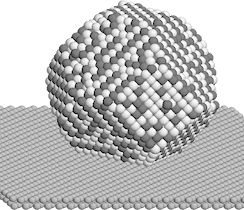
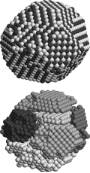
- species to the interface. In cases where wetting of the substrate or surface facetting occurs, we find that diffusional atomic motion on the surface goes along with an enhanced long-range order. Keywords: FePt; Monte-Carlo simulations; nanoparticles; ordering kinetics; Introduction Nanoparticles in
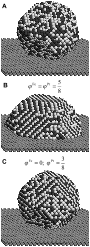
- cases are considered: First, the relative strength of the interactions of the substrate is assumed to be identical for both elements. In this case, the parameters determine the wetting angle of the particle in equilibrium with the substrate. Second, it is assumed that only Pt has a significant binding
- energy to the substrate, with and . In addition to wetting, the parameters then provide a driving force for segregation of Pt at the interface to the substrate which prefers a c-axis orientation of the L10 structure perpendicular to the substrate. For generating the initial configuration for kinetic




Single-pass Kelvin force microscopy and dC/dZ measurements in the intermittent contact: applications to polymer materials
Beilstein J. Nanotechnol. 2011, 2, 15–27, doi:10.3762/bjnano.2.2
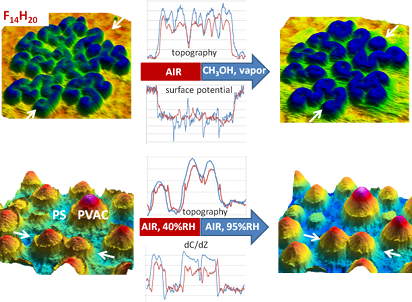
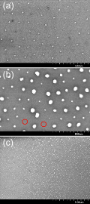
- hydrophobic surface of PS-enriched domains. The droplets are characterized by a relatively large wetting angle that indicates hydrophobicity of the underlying locations. Compared to surface potential studies the use of dC/dZ measurements was relatively limited by studies of organic layers [23] and water



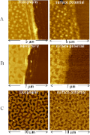


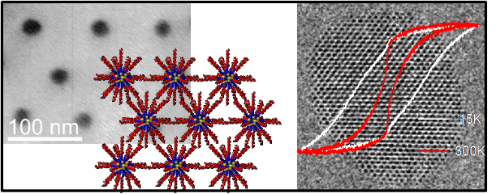
Preparation and characterization of supported magnetic nanoparticles prepared by reverse micelles
Beilstein J. Nanotechnol. 2010, 1, 24–47, doi:10.3762/bjnano.1.5






Other Beilstein-Institut Open Science Activities



