


Search results
Search for "Aedes aegypti" in Full Text gives 7 result(s) in Beilstein Journal of Nanotechnology.
Advances in nanotechnology applied to natural products
Beilstein J. Nanotechnol. 2026, 17, 555–558, doi:10.3762/bjnano.17.36

- compared with nonformulated oils. The issue also includes research illustrating the potential of nanoemulsions for vector control. This subject particularly highlights the potential of the high oil interface area of nanoemulsions in enhancing penetration through the cuticle of Aedes aegypti larvae [10] and
Targeting the vector of arboviruses Aedes aegypti with nanoemulsions based on essential oils: a review with focus on larvicidal and repellent properties
Beilstein J. Nanotechnol. 2025, 16, 1894–1913, doi:10.3762/bjnano.16.132
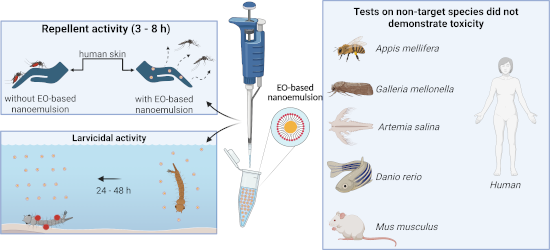
- arises. In this context, natural produts such as essential oils (EOs) have been studied for their larvicidal and repellent properties against Aedes aegypti, due to the presence of compounds such as terpenoids and phenols. However, the usage of EOs is limited due to some properties such as poor water
- solubility, high volatility, and intrinsic oxidation sensitivity. Thus, the development of novel formulations to efficiently deliver bioactives represents an innovative approach for Aedes aegypti control. In this context, nanothecnology provides smart formulations with improved drug solubility, controlled
- nanoemulsions are discussed. In addition, this review highlights challenges and perspectives on pharmaceutical nanotechnology towards nanoemulsions as safe, effective, and eco-friendly tools for controlling Ae. Aegypti. Keywords: Aedes aegypti; arboviruses; mosquito vector; nanoemulsion; nanotechnology


Chitosan nanocomposite containing rotenoids: an alternative bioinsecticidal approach for the management of Aedes aegypti
Beilstein J. Nanotechnol. 2025, 16, 1197–1208, doi:10.3762/bjnano.16.88
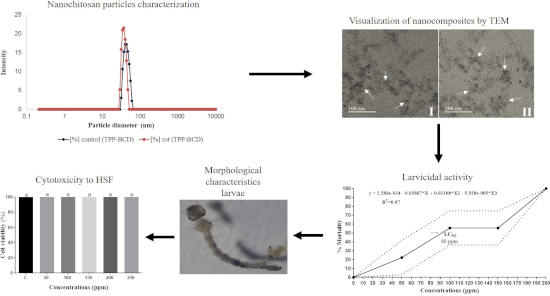
- Darcy Ribeiro, Campos dos Goytacazes/RJ, Brazil 10.3762/bjnano.16.88 Abstract Climate change has intensified the proliferation of disease vectors, such as Aedes aegypti, the primary transmitter of dengue, chikungunya, and zika viruses. Although the two recently licensed dengue vaccines represent a
- for vector control. Keywords: dengue; nanoparticle; pest management; phytochemicals; Introduction Climate change has significantly impacted public health, intensifying the proliferation of disease vectors such as those transmitted by the mosquito Aedes aegypti. Environmental conditions exacerbated
- studies have reported similar improvements in larvicidal activity through nanocarrier systems based on botanical insecticides. For instance, silver nanoparticles (AgNPs) synthesized using aqueous leaf extract of Ambrasia arborescens demonstrated markedly higher toxicity against Aedes aegypti larvae (LC50



Green synthesis of silver nanoparticles derived from algae and their larvicidal properties to control Aedes aegypti
Beilstein J. Nanotechnol. 2024, 15, 1566–1575, doi:10.3762/bjnano.15.123
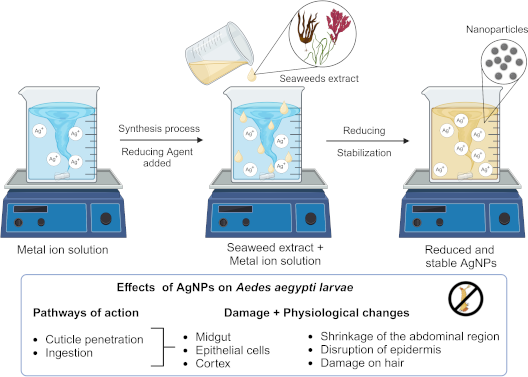
- . These compounds act by reducing Ag+ ions to Ag0 and stabilize nanoparticles by capping [58] (Figure 2). Larvicidal activity of AgNPs against Aedes aegypti Aedes aegypti, also known as the dengue mosquito, is a vector of important arboviruses, including Dengue, Zika, Chikungunya and Yellow Fever [6][59
- ), 26 µg/mL (L3), and 29 µg/mL (4). The treatment exposure time was not described by the authors. Gopu, et al. synthesized and investigated the larvicidal potential of AgNPs from the seaweed extract Amphiroa rigida [54]. Aedes aegypti larvae at stages L3 and L4 were treated with A. rigida AgNPs (5–80 μg
- economical, energy efficient, and environmentally friendly. The use of AgNPs synthesized from extracts of seaweed species against Aedes aegypti may be a viable option for replacing commercially available synthetic chemical insecticides, being able to surpass them in terms of larvicidal activity with lower


When nanomedicines meet tropical diseases
Beilstein J. Nanotechnol. 2024, 15, 830–832, doi:10.3762/bjnano.15.69
- , York Biomedical Research Institute, University of York, York YO10 5DD, UK Aggeu Magalhães Institute, Oswaldo Cruz Foundation (FIOCRUZ), 50670-420, Recife, PE, Brazil Faculty of Medical Sciences, University of Pernambuco (UPE), 52171-011, Recife, PE, Brazil 10.3762/bjnano.15.69 Keywords: Aedes aegypti
- Aedes aegypti larvae [7]. This warrants further investigation on eco-friendly insecticides to fight Aedes aegypti, the primary vector of dengue, zika, and chikungunya. Overall, this article collection was conceived to be an original literature resource converging nanomedicine and NTDs. All high-quality
Development and characterization of potential larvicidal nanoemulsions against Aedes aegypti
Beilstein J. Nanotechnol. 2024, 15, 104–114, doi:10.3762/bjnano.15.10
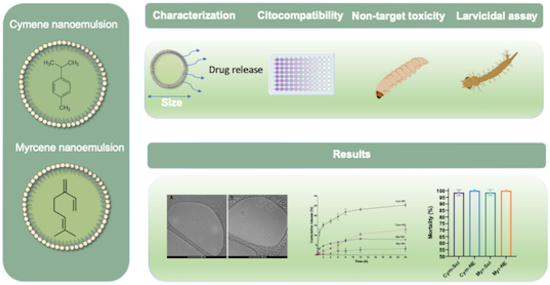
- involving Galleria mellonella larvae. Additionally, we investigated the insecticidal efficacy of monoterpenes against the mosquito Aedes aegypti, the primary dengue vector, via larval bioassay. Employing a low-energy approach, we successfully generated nanoemulsions. The cymene-based nanoemulsion exhibited
- low toxicity towards HaCAT cells and Galleria mellonella larvae. Moreover, the nanoemulsions exhibited significant lethality against third-instar Aedes aegypti larvae at a concentration of 50 mg/L. In conclusion, the utilization of nanoemulsions encapsulating cymene and myrcene presents a promising
- ; drug delivery system; hydrophile–lipophile balance; monoterpenes; Introduction Aedes aegypti (Linnaeus, 1762) is a mosquito species that is cosmopolitan and well adapted to anthropized and peridomestic environments. It is an important vector of arboviruses, including dengue, chikungunya fever, zika


Industrial perspectives for personalized microneedles
Beilstein J. Nanotechnol. 2023, 14, 857–864, doi:10.3762/bjnano.14.70
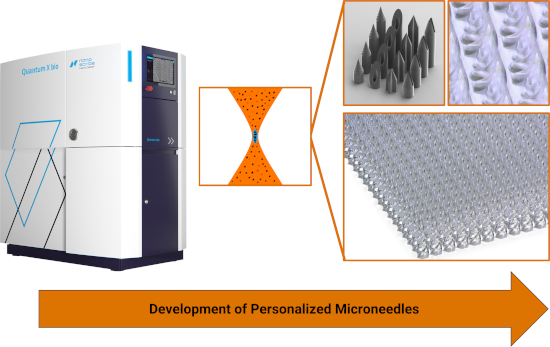
- are several subspecies of mosquitos, such as Aedes aegypti, that have evolved to specialize in human hosts [35]. An adapted design would be advantageous for painless transdermal delivery of macromolecules or biological sampling [38]. Adult ticks, as another example, live on their hosts for 7–10 days


Other Beilstein-Institut Open Science Activities



