


Search results
Search for "Ag@TiO2 nanomaterials" in Full Text gives 1 result(s) in Beilstein Journal of Nanotechnology.
Two-step laser synthesis of Ag@TiO2 nanomaterials for the photocatalytic degradation of rhodamine B
Beilstein J. Nanotechnol. 2026, 17, 622–634, doi:10.3762/bjnano.17.43
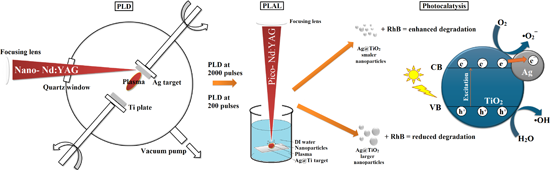
- provides an efficient and environmentally friendly route for the fabrication of Ag@TiO2 photocatalysts. Keywords: Ag@TiO2 nanomaterials; photocatalytic degradation; pulsed laser ablation in liquids; pulsed laser deposition; rhodamine B; Introduction Titanium dioxide has long been recognized as perhaps
- visible light, such as water treatment and degradation of organic contaminants [10][11][12]. Among various synthesis techniques, laser-based methods, such as pulsed laser ablation in liquids (PLAL) and laser pyrolysis, stand out as clean, efficient, and surfactant-free routes for fabricating Ag@TiO2
- nanomaterials. These physical processes enable the direct formation of highly pure and well-dispersed nanoparticles from bulk targets without the need for chemical precursors or stabilizing agents. By fine-tuning laser parameters such as wavelength, pulse energy, and ambient conditions, researchers can tailor


Other Beilstein-Institut Open Science Activities



