


Search results
Search for "BCS class-IV" in Full Text gives 4 result(s) in Beilstein Journal of Nanotechnology.
Breaking barriers: nanosystems to overcome solubility and permeability challenges of second-generation tyrosine kinase inhibitors
Beilstein J. Nanotechnol. 2026, 17, 1063–1086, doi:10.3762/bjnano.17.73
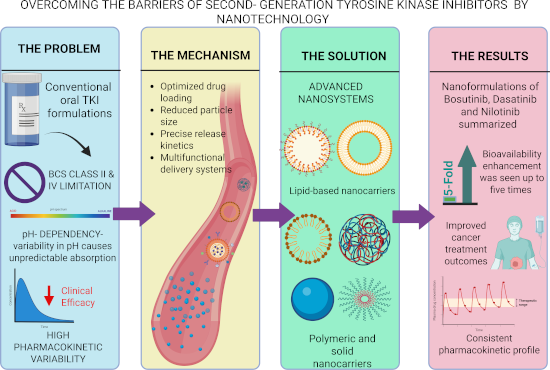
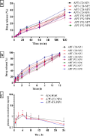
- stability, scalability, and feasibility for clinical transition. Keywords: BCS class-IV; bioavailability enhancement; biopharmaceutical limitation; bosutinib; dasatinib; drug delivery system; nanosystems; nilotinib; quality by design; second-generation TKI; Introduction Tyrosine kinases have emerged as
- -emulsification occurs due to a change in entropy [63]. Owing to their simple, scalable, and cost-effective industrial preparation, SEDDSs exhibit higher translational potential than many other novel drug delivery systems, particularly for BCS class-IV drugs [64]. DTB-loaded SEDDSs were formulated using cinnamon
- drug to about 60% over the same duration for the nanocrystal formulation, with complete drug dissolution achieved within 48 h. These findings confirm the potential of fucoidan nanocrystals to enhance the solubility of this BCS class-IV drug significantly [47]. Additionally, LNCs of BTB effectively


Aprepitant-loaded solid lipid nanoparticles: a novel approach to enhance oral bioavailability
Beilstein J. Nanotechnol. 2025, 16, 652–663, doi:10.3762/bjnano.16.50
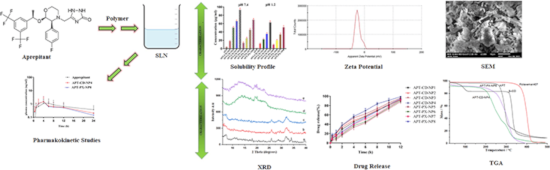
- . Therefore, the optimal SLN formulation APT-CD-NP4 is a promising tool for oral administration with sustained release to improve the bioavailability of the BCS class-IV drug APT. Keywords: aprepitant; β-cyclodextrin; pharmacokinetic study; poloxamer; solid lipid nanoparticles; Introduction Cancer is a
- class-IV drug [10]. Low solubility and poor dissolution of BCS class-IV drugs can be improved by using techniques such as incorporating the drug or prodrug into lipid or polymeric formulations, using solid lipid nanoparticles (SLNs), applying surfactants, adjusting the pH value, reducing particle size
- than the poloxamer 407-based formulations in phosphate-buffered saline (pH 7.4) and 0.1 N HCl (pH 1.2). The optimal SLN formulation APT-CD-NP4 is a promising tool for oral sustained-release dosage in order to improve the bioavailability of the BCS class-IV drug APT. Solubility analysis of APT and APT



Polymer lipid hybrid nanoparticles for phytochemical delivery: challenges, progress, and future prospects
Beilstein J. Nanotechnol. 2024, 15, 1473–1497, doi:10.3762/bjnano.15.118
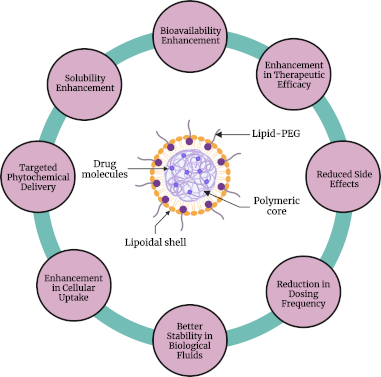
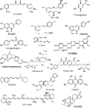
- the excellent proven therapeutic efficacy, the clinical use of CUR is limited because of its complex physicochemical characteristics. CUR belongs to the “Biopharmaceutical Classification System” (BCS) class-IV drugs, representing poor solubility and permeability [79]. CUR shows very poor solubility in
- -inflammatory, antioxidant, anticancer, antimicrobial, hepatoprotective, cardioprotective, and anti-obesity properties [134][135]. UA is categorized as a BCS class-IV compound exhibiting low solubility and low permeability. Further, it shows low GI absorption, low bioavailability, fast metabolism and clearance
- several limitations, most notably its poor water solubility and limited absorption in the GIT. It has very low bioavailability (approximately 5%) and is classified as a BCS class-IV drug. Furthermore, BRN is susceptible to the first-pass effect, which further contributes to its low bioavailability [158


Use of nanosystems to improve the anticancer effects of curcumin
Beilstein J. Nanotechnol. 2021, 12, 1047–1062, doi:10.3762/bjnano.12.78
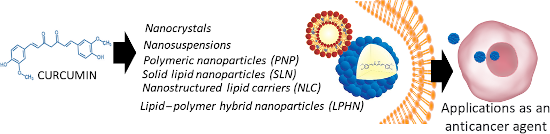
- Conventional nanosystems are particularly attractive for the biopharmaceutics classification system (BCS) class IV drugs, such as CUR, which require increases in their solubilization, pharmacokinetics, and permeation [43]. Curcumin has been targeted against carcinogenic lesions in the colon, skin, cervix


Other Beilstein-Institut Open Science Activities



