


Search results
Search for "Cu2−xTe phases" in Full Text gives 1 result(s) in Beilstein Journal of Nanotechnology.
Synthesis and characterization of RF-sputtered ZnTe/Cu2−xTe thin films for solar cell applications
Beilstein J. Nanotechnol. 2026, 17, 1016–1027, doi:10.3762/bjnano.17.69
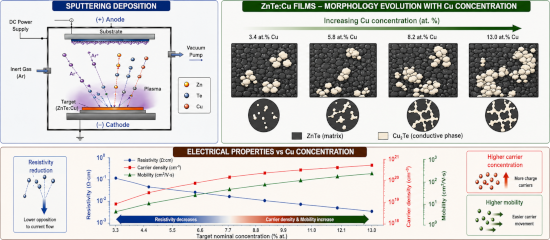
- transmittance with increasing Cu concentration, attributed to the metallic-like absorption of Cu2−xTe phases. Electrical characterization revealed a transition from semiconducting to highly conductive behavior with resistivity decreasing from approximately 102 to 10−2 Ω·cm for films grown at 300 °C and from 101
- : back contact materials; Cu2−xTe phases; phase segregation; RF magnetron sputtering; ZnTe thin films; Introduction CdTe solar cells remain one of the leading thin-film photovoltaic technologies due to the near-optimal direct bandgap of CdTe (≈1.45 eV) and its high absorption coefficient (>104 cm−1
- dopant concentrations. However, in the infrared region, a significant reduction in transmittance is observed for Cu-containing films compared to pure ZnTe. This decrease in infrared transmission is attributed to the formation of Cu2−xTe phases, which exhibit high free-carrier absorption and metallic-like



Other Beilstein-Institut Open Science Activities



