


Search results
Search for "Debye model" in Full Text gives 4 result(s) in Beilstein Journal of Nanotechnology.
Further insights into the thermodynamics of linear carbon chains for temperatures ranging from 13 to 300 K
Beilstein J. Nanotechnol. 2025, 16, 1818–1825, doi:10.3762/bjnano.16.125
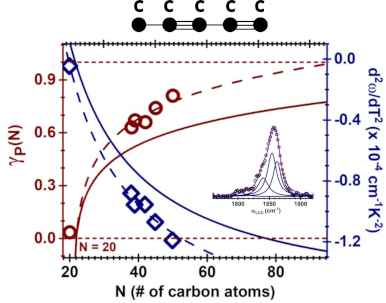
- nanotubes (LCC@DWCNT and LCC@MWCNT, respectively) behave as Debye’s materials for temperatures as high as 293 K with an estimate that such materials could still withstand such characteristics for even higher temperatures (≈700 K). Using the Debye model, thermodynamic observables (internal energy
- unchanged. Our measurements were performed in both isolated and small bundles of LCC@MWCNT, which allowed us to demonstrate that small bundles or isolated environments do not seem to influence the vibrational and thermodynamic properties measured. Keywords: carbon nanotubes; Debye model; Grüneisen
- whose thermal properties can be described by the Debye model [30]. The reason is that the responses of materials to changing temperatures usually come from two contributions: (1) the lattice thermal expansion (LTE), associated with e–ph interactions; and (2) anharmonic effects, associated with ph–ph


![[Graphic 23]](/bjnano/content/inline/2190-4286-16-125-i25.svg?max-width=637&scale=1.18182)
First-principles study of the structural, optoelectronic and thermophysical properties of the π-SnSe for thermoelectric applications
Beilstein J. Nanotechnol. 2021, 12, 1101–1114, doi:10.3762/bjnano.12.82
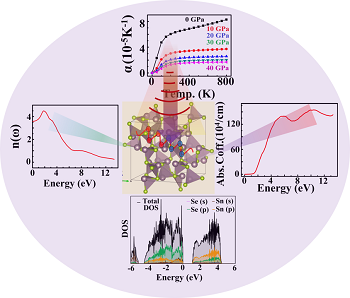
- mesh of 4 × 4 × 4 for the Brillouin zone sampling. A denser k-mesh of 27 × 27 × 27 (924 k-points) is selected to more accurately calculate the optical and thermoelectric parameters. The thermodynamic variables have been computed through the use of the quasi-harmonic Debye model carried out within the
- of temperature as well as pressure on TD parameters, such as the Grüneisen parameter (γ), Debye temperature (θD), thermal expansion coefficient (α), heat capacity (CV), and volume. We employed the quasi-harmonic Debye model [60][61] to explore the TD properties of the π-SnSe alloy. We obtained the TD


Phenalenyl-based mononuclear dysprosium complexes
Beilstein J. Nanotechnol. 2016, 7, 995–1009, doi:10.3762/bjnano.7.92
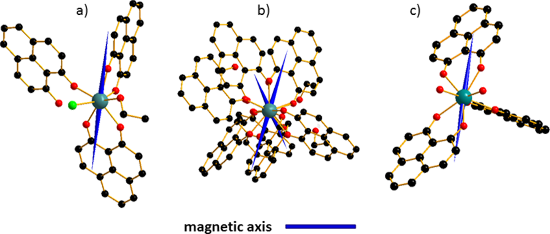
- zero. The χ″ vs χ′ data (Figure 7) under zero or dc different fields were fitted by the extended Debye Model [55]. All derived parameters are summarized in Supporting Information File 1, Tables S2–S7. For compound 1, under zero dc field, the width of distribution α varies from 0.073 to 0.279 in the
- under zero or different dc fields in the given temperature ranges. Sample codes are indicated in the graphs. The black solid lines represent the least-squares fit obtained with a generalized Debye model. The parameters are discussed in the text. In the figure for 2 under a dc field of 3000 Oe, the


Single-molecule magnet behavior in 2,2’-bipyrimidine-bridged dilanthanide complexes
Beilstein J. Nanotechnol. 2016, 7, 126–137, doi:10.3762/bjnano.7.15
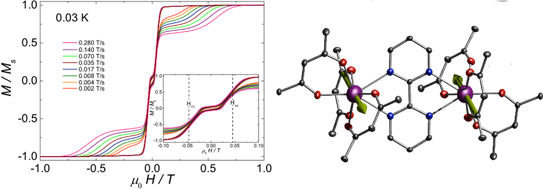
- employing a Debye model. The treatment of the relaxation times with the Arrhenius law gives an energy barrier (Ueff) of 25 ± 2 K, τ0 = (5.11 ± 7) × 10−8 s, whilst Cole–Cole fittings render a very narrow distribution of α parameters of 0.006 < α < 0.01 (from 2 to 3.3 K) (Figure 5). Magnetic studies at low


Other Beilstein-Institut Open Science Activities



