


Search results
Search for "ESR spectroscopy" in Full Text gives 4 result(s) in Beilstein Journal of Nanotechnology.
Stereodiscrimination of guests in chiral organosilica aerogels studied by ESR spectroscopy
Beilstein J. Nanotechnol. 2025, 16, 2034–2054, doi:10.3762/bjnano.16.140
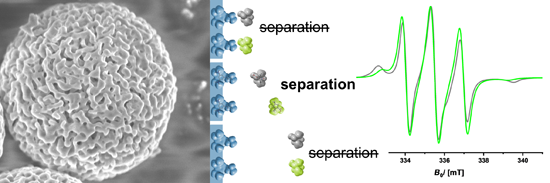
- necessary to reach separation is an important point. We have employed the two enantiomers of a chiral, nitroxide-based spin probe as guests in organo-modified macroporous host materials and applied ESR spectroscopy as a tool to investigate their rotational mobility. Using a well-established and commercially
- chemistry; ESR spectroscopy; organic inorganic hybrids; porous materials; Introduction Chiral materials represent an evolving research field that focuses on materials whose structures lack mirror symmetry [1][2][3]. The materials exhibit chirality, and a good overview of important developments was given by
- probes with surfaces [40]. Mastai and coworkers have used ESR spectroscopy to probe the chirality of crystals [41]. Our group used ESR to investigate the rotational dynamics of paramagnetic spin probes in functionalized, mesoporous organosilica materials [42][43][44][45][46]. Using 3-carboxypropyl (3CP




Tin dioxide nanomaterial-based photocatalysts for nitrogen oxide oxidation: a review
Beilstein J. Nanotechnol. 2022, 13, 96–113, doi:10.3762/bjnano.13.7
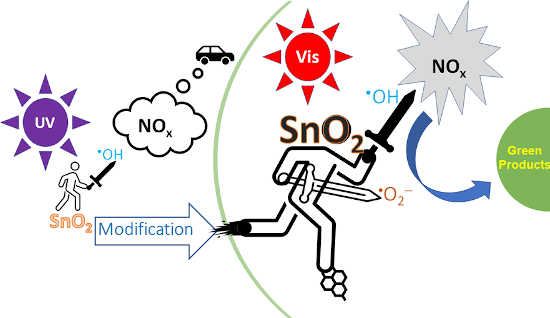
- reports still proposed its photocatalytic behaviors partly based on •O2− species via the combination of experimental physicochemical analyses, such as electron spin resonance (ESR) spectroscopy, active species trapping experiments, valence band X-ray photoelectron spectroscopy (XPS), and diffuse
- •O2− radicals played a primary role in the photocatalytic NO oxidation. Additionally, using photoluminescence (PL) spectroscopy, XPS, active species trapping tests, and ESR spectroscopy, the authors studied the photoinduced charge migration and trapping. They proposed the band structure of the SnO2


Mechanistic insights into plasmonic photocatalysts in utilizing visible light
Beilstein J. Nanotechnol. 2018, 9, 628–648, doi:10.3762/bjnano.9.59
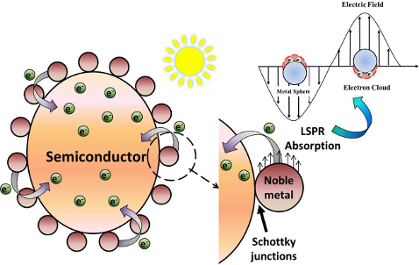
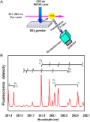
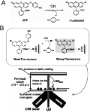
- during the photocatalysis react with DMPO to convert stable DMPO–OH radicals and are detected by ESR spectroscopy. There is a high probability that the valence-band holes might alternatively oxidize the spin-trapping reagents before the formation of •OH radicals. Figure 16 shows a three-step process for





The interplay between spin densities and magnetic superexchange interactions: case studies of mono- and trinuclear bis(oxamato)-type complexes
Beilstein J. Nanotechnol. 2017, 8, 2245–2256, doi:10.3762/bjnano.8.224
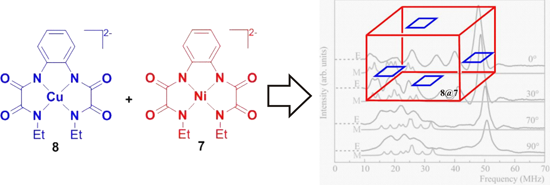
- the following we aim to review on efforts to determine the spin density distribution of mononuclear type-II and related complexes by ESR spectroscopy as a measure of the magnetic superexchange interactions of their related trinuclear type-III complexes. Review The concept The spin density of the NCO
- complexes and vice versa. Spin densities or the spin density distribution, respectively, of paramagnetic transition-metal complexes can be determined by making use of ESR spectroscopy. This method in its continuous wave [33] and, in particular, in the microwave-pulse versions [34][35][36][37][38][39][40][41


![[Graphic 15]](/bjnano/content/inline/2190-4286-8-224-i20.svg?max-width=637&scale=1.18182) molecular plan...
molecular plan...


Other Beilstein-Institut Open Science Activities



