


Search results
Search for "M cells" in Full Text gives 3 result(s) in Beilstein Journal of Nanotechnology.
Exploring the potential of polymers: advancements in oral nanocarrier technology
Beilstein J. Nanotechnol. 2025, 16, 1751–1793, doi:10.3762/bjnano.16.122
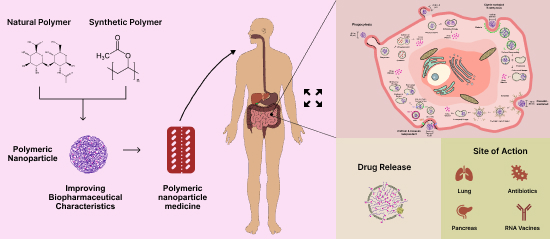
- through the epithelium occurs via the transcellular and paracellular pathways, as well as through M cells located on the surface of Peyer’s patches [8]. Positioned under the mucus layer, the intestinal epithelium plays crucial roles in defending against hostile contents, selectively absorbing nutrients
- opening of these intercellular tight junctions [75] as described in Table 2 and discussed in Section 4.1.1. M cells are characterized by invaginations in their membrane, which facilitate the selective entry of substances into the lymphatic tissue beneath the intestinal mucosa via active transport. This


Atomic force microscopy as analytical tool to study physico-mechanical properties of intestinal cells
Beilstein J. Nanotechnol. 2015, 6, 1457–1466, doi:10.3762/bjnano.6.151
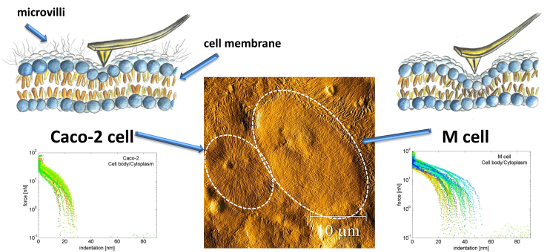
- , Austria 10.3762/bjnano.6.151 Abstract The small intestine is a complex system that carries out various functions. The main function of enterocytes is absorption of nutrients, whereas membranous cells (M cells) are responsible for delivering antigens/foreign substances to the mucosal lymphoid tissues
- topographies of Caco-2 cells and M cells. Furthermore, cell elasticity (i.e., the mechanical response of a cell on a tip indentation), was elucidated by force curve measurements. Besides elasticity, adhesion was evaluated by recording the attraction and repulsion forces between the tip and the cell surface
- cytoskeleton/microvilli arrangements and F-actin organization. Caco-2 cells displayed densely packed F-actin bundles covering the entire cell surface, indicating the formation of a well-differentiated brush border. In contrast, in M cells actins were arranged as short and/or truncated thin villi, only


The gut wall provides an effective barrier against nanoparticle uptake
Beilstein J. Nanotechnol. 2014, 5, 2092–2101, doi:10.3762/bjnano.5.218
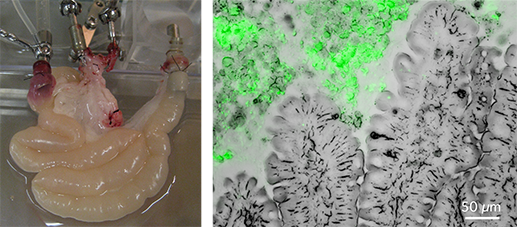
- , specialized cell types such as M cells or dendritic cells exist at certain mucosal sites [24][25]. These gateways, intended for the delivery of antigenic matter to the mucosal immune system, may be hijacked by anthropogenic NPs leading to an accumulation of NPs in gut-associated lympoid tissue as indicated by


Other Beilstein-Institut Open Science Activities



