


Search results
Search for "MIL-100(Fe)" in Full Text gives 3 result(s) in Beilstein Journal of Nanotechnology.
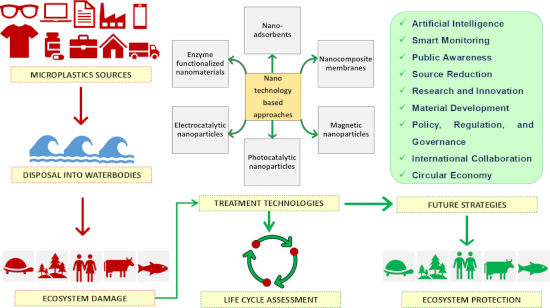
Nanotechnology-based approaches for the removal of microplastics from wastewater: a comprehensive review
Beilstein J. Nanotechnol. 2025, 16, 1607–1632, doi:10.3762/bjnano.16.114
- membrane by integrating sustainably synthesized MIL-100 (Fe) MOF nanoparticles into a polysulfone (PSF) matrix. This PSF/MIL-100 (Fe) membrane exhibited substantial improvements over the unmodified PSF membrane (M0), particularly in terms of membrane structure, surface hydrophilicity (with the water
- contact angle decreasing from 84.6° ± 1° to 64.2° ± 1.2°), work of adhesion, wetting energy, porosity, and pore dimensions. Among various loadings, the membrane with 0.5 wt % MIL-100 (Fe) (M0.5) showed the best overall performance. It delivered a pure water flux over ten times higher than M0 and achieved
- concludes that PSF/MIL-100 (Fe) composite membrane offers a promising solution for the removal of MPs [117]. Chen et al. [118] developed a series of zirconium-based MOF foam materials with interconnected pores, excellent stability, and high structural uniformity for the removal of MPs from both seawater and
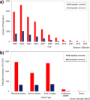


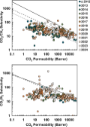
A review of metal-organic frameworks and polymers in mixed matrix membranes for CO2 capture
Beilstein J. Nanotechnol. 2025, 16, 155–186, doi:10.3762/bjnano.16.14





Facile synthesis of Fe-based metal–organic frameworks from Fe2O3 nanoparticles and their application for CO2/N2 separation
Beilstein J. Nanotechnol. 2024, 15, 897–908, doi:10.3762/bjnano.15.74
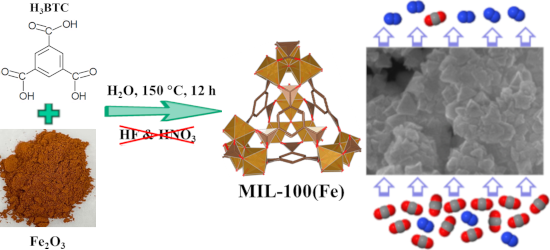
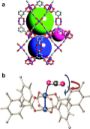
- 17104, Korea 10.3762/bjnano.15.74 Abstract A facile approach was employed to fabricate MIL-100(Fe) materials from Fe2O3 nanoparticles through a conventional hydrothermal reaction without the presence of HF and HNO3. Effects of trimesic acid content in the reaction system on the quality and CO2/N2
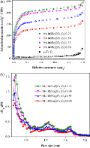
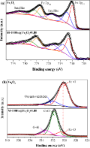
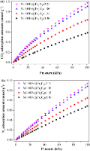
- separation performance of the as-prepared MIL-100(Fe) samples were investigated. Using 1.80 g of trimesic acid in the reaction system yielded the sample M-100Fe@Fe2O3#1.80, which proved to be the optimal sample. This choice struck a balance between the amount of required trimesic acid and the quality of the
- . Importantly, this route opens a new approach to utilizing Fe2O3-based waste materials from the iron and steel industry in manufacturing Fe-based MIL-100 materials. Keywords: CO2/N2 separation; Fe2O3 nanoparticles; hydrothermal reaction; IAST-predicted CO2/N2 selectivity; MIL-100(Fe); Introduction Metal





Other Beilstein-Institut Open Science Activities



