


Search results
Search for "MIL-101" in Full Text gives 5 result(s) in Beilstein Journal of Nanotechnology.
Electrochemical determination of ciprofloxacin using a MIL-101/reduced graphene oxide-modified electrode
Beilstein J. Nanotechnol. 2026, 17, 541–554, doi:10.3762/bjnano.17.35
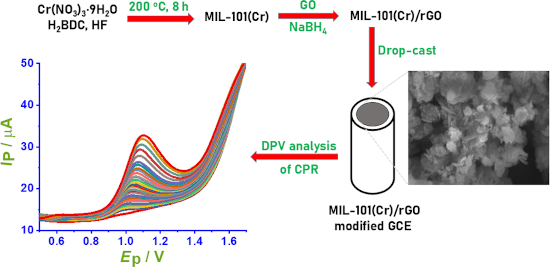
- ciprofloxacin (CPR) was developed using a glassy carbon electrode modified with MIL-101/reduced graphene oxide (MIL-101/rGO). MIL-101/rGO was synthesized via a facile ultrasonic-assisted method and characterized by various physicochemical techniques. The synergistic combination of MIL-101 with rGO significantly
- enhanced the electrocatalytic activity toward CPR oxidation. The electrochemical behavior of CPR on the MIL-101/rGO-modified electrode was systematically investigated using cyclic voltammetry and differential pulse voltammetry. Under optimized experimental conditions, the proposed sensor exhibited a linear
- , yielding acceptable recoveries. These results indicate that the MIL-101/rGO-modified electrode provides a promising and efficient platform for the electrochemical sensing of CPR in pharmaceutical and environmental analysis. Keywords: ciprofloxacin; electrochemical analysis; MIL-101; reduced graphene oxide


Current status of using adsorbent nanomaterials for removing microplastics from water supply systems: a mini review
Beilstein J. Nanotechnol. 2025, 16, 1837–1850, doi:10.3762/bjnano.16.127
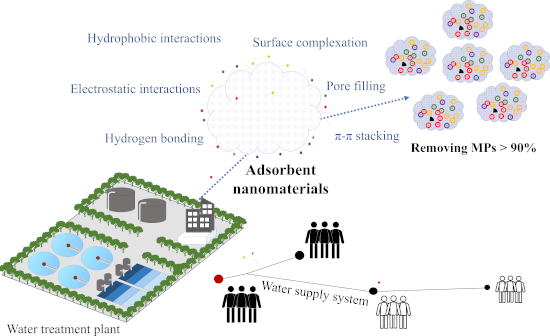
- 100% removal of MPs from suspensions with an initial concentration of 1 g·L−1 [63]. In the study of Modak et al., a chromium-based metal-organic framework (Cr-MOF/MIL-101) was synthesized and achieved a significant PSNP removal efficiency of 96% from suspensions with initial concentrations of 5 and 70


A review of metal-organic frameworks and polymers in mixed matrix membranes for CO2 capture
Beilstein J. Nanotechnol. 2025, 16, 155–186, doi:10.3762/bjnano.16.14

- enhancing CO2 capture in MOFs [55]. The formation of OMSs involves solvent removal upon activation, which establishes uncoordinated metal sites capable of adsorbing guest molecules reversibly [60]. A wide range of OMS-bearing MOFs, including NU-1000, MIL-101, and the M-MOF-74 isoreticular series (M = Mg, Ni


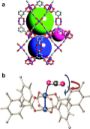



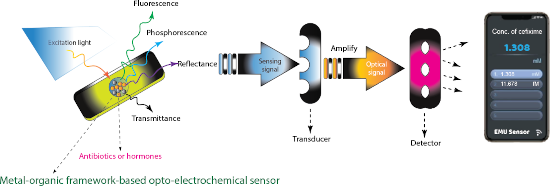
Metal-organic framework-based nanomaterials as opto-electrochemical sensors for the detection of antibiotics and hormones: A review
Beilstein J. Nanotechnol. 2023, 14, 631–673, doi:10.3762/bjnano.14.52


Ultrathin hydrophobic films based on the metal organic framework UiO-66-COOH(Zr)
Beilstein J. Nanotechnol. 2019, 10, 654–665, doi:10.3762/bjnano.10.65
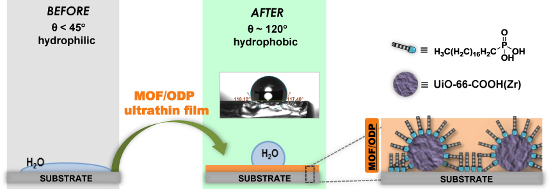
- , which is especially interesting for the development of MOF-based devices that require the use of very small MOF quantities. In some recent studies, we have reported the fabrication at the air–water interface of dense monolayers of nanoparticles of MIL-101(Cr) and MIL-96(Al) MOFs that can be transferred
- submicrometer particles, and its good CO2 adsorption capacity altogether maintaining good water stability [29][30][31]. In addition, our experience on the fabrication of MOF LB films has shown that hydrophilic MOFs can lead to LB films of good quality (e.g., MIL-101(Cr) [21] and MIL-96(Al) [26]) and UiO-66-COOH
- MOF properties. In this study, molecular surfactants were used because of solubility issues of charged surfactants in chloroform. Mixtures MOF/behenic acid (BA) have been already used with success for MIL-101(Cr) [21]. In this work, MOF suspensions with BA surfactant concentrations in the range 1–10


Other Beilstein-Institut Open Science Activities



