


Search results
Search for "PLA nanofiber" in Full Text gives 3 result(s) in Beilstein Journal of Nanotechnology.
Beyond the shell: exploring polymer–lipid interfaces in core–shell nanofibers to carry hyaluronic acid and β-caryophyllene
Beilstein J. Nanotechnol. 2025, 16, 2015–2033, doi:10.3762/bjnano.16.139
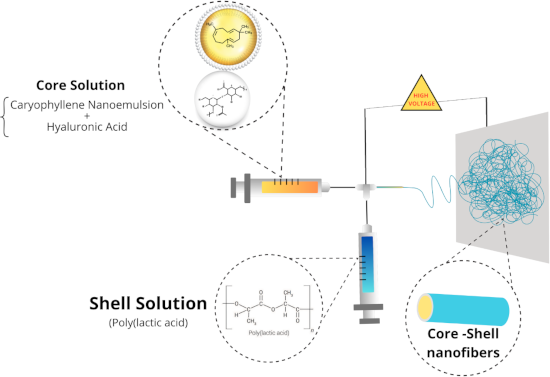
- -FTIR analysis was performed on PLA (monolithic), HA/PLA, and HA+NE2/PLA nanofiber samples, along with pure HA powder. The obtained spectra (Figure 7) confirmed effective shell coating, as only the characteristic bands of PLA were detected in the core–shell nanofibers. All three nanofiber membranes (NF
- monolithic PLA nanofiber sample showed a contact angle of 117.1° ± 11.3°. For core–shell samples, contact angles of 126.9° ± 9.8° and 129.8° ± 1.3° were observed for the samples without NE (HA/PLA) and with NE (HA+NE2/PLA), respectively. The maintenance of surface hydrophobicity with the formation of the
- software (OriginLab Corporation). Contact angle analysis Contact angle measurements were conducted to evaluate the surface wettability of PLA nanofiber samples, including monolithic PLA, HA/PLA, and HA+NE2/PLA, using an OCA 15EC optical contact angle tensiometer (Dataphysics Instruments, Germany). Samples




Berberine-loaded polylactic acid nanofiber scaffold as a drug delivery system: The relationship between chemical characteristics, drug-release behavior, and antibacterial efficiency
Beilstein J. Nanotechnol. 2024, 15, 71–82, doi:10.3762/bjnano.15.7
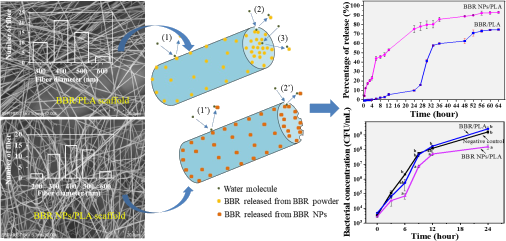
- Sciences, Phenikaa University, Hanoi 12116, Vietnam 10.3762/bjnano.15.7 Abstract Hydrophobic berberine powder (BBR) and hydrophilic BBR nanoparticles (BBR NPs) were loaded into an electrospun polylactic acid (PLA) nanofiber scaffold for modulating the release behavior of BBR in an aqueous medium. The BBR
- release from the BBR/PLA and BBR NPs/PLA nanofiber scaffolds was investigated in relation to their chemical characteristics, BBR dispersion into nanofibers, and wettability. The BBR release profiles strongly influenced the antibacterial efficiency of the scaffolds over time. When the BBR was loaded, the
- BBR/PLA nanofiber scaffold exhibited an extremely hydrophobic feature, causing a triphasic release profile in which only 9.8 wt % of the loaded BBR was released in the first 24 h. This resulted in a negligible inhibitory effect against methicillin-resistant Staphylococcus aureus bacteria. Meanwhile


Effects of drug concentration and PLGA addition on the properties of electrospun ampicillin trihydrate-loaded PLA nanofibers
Beilstein J. Nanotechnol. 2022, 13, 245–254, doi:10.3762/bjnano.13.19
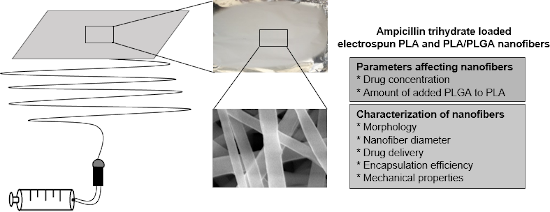
- desired properties (average nanofiber diameter, morphology, in vitro drug release, and mechanical properties) of PLA nanofibers. Keywords: ampicillin trihydrate; electrospinning; nanofiber; PLA nanofiber; PLA/PLGA nanofiber; Introduction Polymeric nanofibers have been widely used in many fields such as
- 4% to 12%) in the PLA nanofiber led to an increase in the nanofiber diameter and resulted in a higher burst effect and faster drug release. F2 coded nanofiber was chosen as the ideal PLA nanofiber with ideal drug concentration (8%) due to its favorable encapsulation efficiency, nanofiber diameter


Other Beilstein-Institut Open Science Activities



