


Search results
Search for "Tityus serrulatus" in Full Text gives 1 result(s) in Beilstein Journal of Nanotechnology.
Venom-loaded cationic-functionalized poly(lactic acid) nanoparticles for serum production against Tityus serrulatus scorpion
Beilstein J. Nanotechnol. 2025, 16, 1633–1643, doi:10.3762/bjnano.16.115
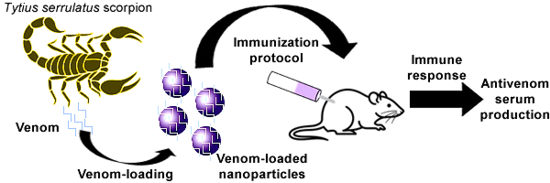
- Pharmacy, Federal University of Rio Grande do Norte (UFRN), Natal, RN, Brazil Department of Morphology, Federal University of Rio Grande do Norte-UFRN, Natal, RN, Brazil 10.3762/bjnano.16.115 Abstract Reported accidents involving scorpion poisoning by Tityus serrulatus are the most frequent in Brazil. The
- as a biotechnological approach to immunotherapy against scorpion envenomation. Keywords: cationic nanoparticles; immunoadjuvant; polyethylenimine; poly(lactic acid); Tityus serrulatus; Introduction Accidents caused by scorpion envenoming are recognized as an important public health problem in
- tropical and subtropical regions, due to the high incidence and/or severity of cases, especially for children and elders, and difficulty of management by public health services [1][2][3][4]. In Brazil, although 22 species of the scorpion genus Tityus have been described in the country, Tityus serrulatus is


Other Beilstein-Institut Open Science Activities



