


Search results
Search for "ZnO/Ti3C2Tx composites" in Full Text gives 1 result(s) in Beilstein Journal of Nanotechnology.
Room-temperature NO2 sensing performance of ZnO/Ti3C2Tx heterojunctions
Beilstein J. Nanotechnol. 2026, 17, 1159–1169, doi:10.3762/bjnano.17.79
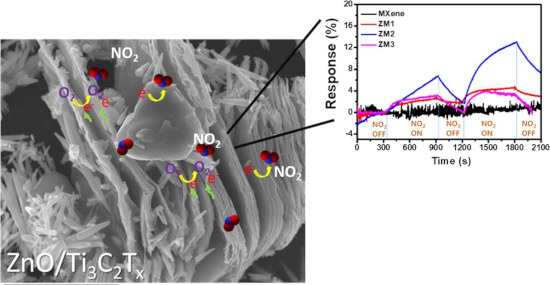
- gas sensing performance is attributed to the abundance of oxygen vacancies and surface functional groups within the ZnO/Ti3C2Tx composites, which facilitate robust interactions with NO2 molecules. These findings underscore the efficacy of ZnO/Ti3C2Tx nanocomposites as a viable strategy for enhancing
- the gas sensing properties of Ti3C2Tx-based sensors. Keywords: gas sensor; room temperature; ZnO/Ti3C2Tx composites; Introduction Nowadays, increasing attention is paid to the early detection and prevention of chemical leaks and accidental releases, highlighting the importance of identifying trace
- leading to the formation of an interfacial electron depletion layer at the ZnO/Ti3C2Tx interface. When the ZnO/Ti3C2Tx composites were exposed to synthetic air, oxygen molecules were chemisorbed on the sensor surface. As a result, O2 molecules could trap the free electrons from the ZnO/Ti3C2Tx to create a





Other Beilstein-Institut Open Science Activities



