


Search results
Search for "ZnO quantum dots" in Full Text gives 4 result(s) in Beilstein Journal of Nanotechnology.
Laser ablation in liquids for shape-tailored synthesis of nanomaterials: status and challenges
Beilstein J. Nanotechnol. 2025, 16, 1963–1997, doi:10.3762/bjnano.16.137
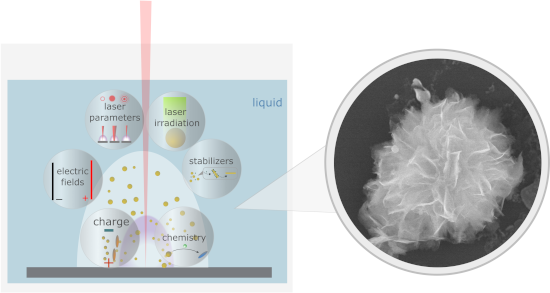
- explained by the decrease of the adhesion of NPs. The variation of the NP shape can be more significant in organic liquids. For example, Singh et al. [33] produced drop-shaped ZnO quantum dots by laser ablation of Zn in methanol, which were prone to spontaneous self-assembly after the end of the synthesis




Laser processing in liquids: insights into nanocolloid generation and thin film integration for energy, photonic, and sensing applications
Beilstein J. Nanotechnol. 2025, 16, 1428–1498, doi:10.3762/bjnano.16.104
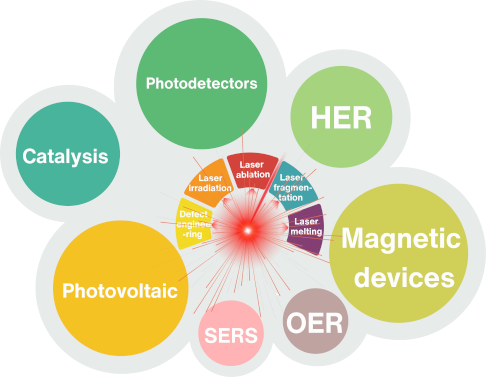
- particle size through a relatively simple process, further advancing the field of laser-based nanoparticle synthesis. The first report on the fabrication of ZnO quantum dots (QDs) through laser irradiation of ZnO hollow nanospheres in a liquid medium highlighted a rapid, simple process conducted at room






Hydrothermal synthesis of ZnO quantum dot/KNb3O8 nanosheet photocatalysts for reducing carbon dioxide to methanol
Beilstein J. Nanotechnol. 2017, 8, 2264–2270, doi:10.3762/bjnano.8.226
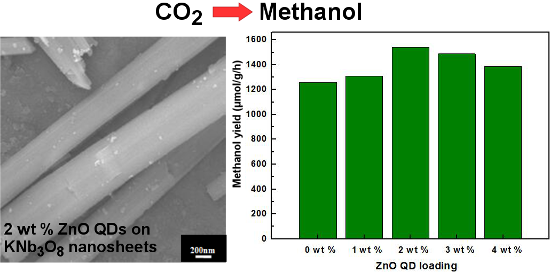
- , East China University of Science and Technology, Shanghai 200237, China 10.3762/bjnano.8.226 Abstract ZnO quantum dots and KNb3O8 nanosheets were synthesized by a two-step hydrothermal method for the photocatalytic reduction of CO2 to methanol where isopropanol is simultaneously oxidized to acetone
- materials was evaluated by formation rate of methanol under UV light irradiation at ambient temperature and pressure. The methanol formation rate of pure KNb3O8 nanosheets was found to be 1257.21 μmol/g/h, and after deposition of 2 wt % ZnO quantum dots on the surface of KNb3O8 nanosheets, the methanol
- production rate was found to increase to 1539.77 μmol/g/h. Thus, the ZnO quantum dots obviously prompted separation of charge carriers, which was explained by a proposed mechanism for this photocatalytic reaction. Keywords: CO2 reduction; KNb3O8 nanosheets; methanol production; photocatalysis; ZnO quantum




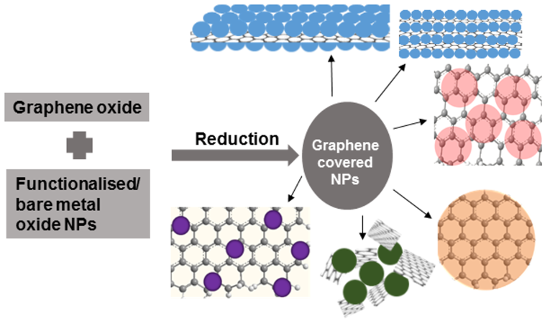
Synthesis of graphene–transition metal oxide hybrid nanoparticles and their application in various fields
Beilstein J. Nanotechnol. 2017, 8, 688–714, doi:10.3762/bjnano.8.74






Other Beilstein-Institut Open Science Activities



