


Search results
Search for "ZnTe thin films" in Full Text gives 2 result(s) in Beilstein Journal of Nanotechnology.
Synthesis and characterization of RF-sputtered ZnTe/Cu2−xTe thin films for solar cell applications
Beilstein J. Nanotechnol. 2026, 17, 1016–1027, doi:10.3762/bjnano.17.69
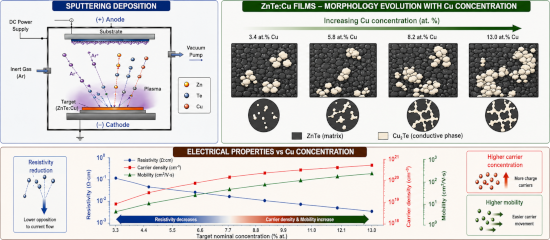
- /bjnano.17.69 Abstract The incorporation of copper and oxygen into zinc telluride (ZnTe) thin films deposited by radio-frequency magnetron sputtering from a single ZnTe–CuO composite target was investigated. The nominal Cu and O concentrations ranged from 3 to 13 atom %, and films were grown at substrate
- : back contact materials; Cu2−xTe phases; phase segregation; RF magnetron sputtering; ZnTe thin films; Introduction CdTe solar cells remain one of the leading thin-film photovoltaic technologies due to the near-optimal direct bandgap of CdTe (≈1.45 eV) and its high absorption coefficient (>104 cm−1
- in materials such as CdTe, CdSe, and ZnTe, without evidence of excessive Cu2+ formation, thereby favoring improved electrical stability. Previous studies on Cu-doped ZnTe thin films have mainly focused on the influence of Cu incorporation on crystallinity, optical bandgap, and electrical transport



Tailoring of physical properties of RF-sputtered ZnTe films: role of substrate temperature
Beilstein J. Nanotechnol. 2025, 16, 333–348, doi:10.3762/bjnano.16.25
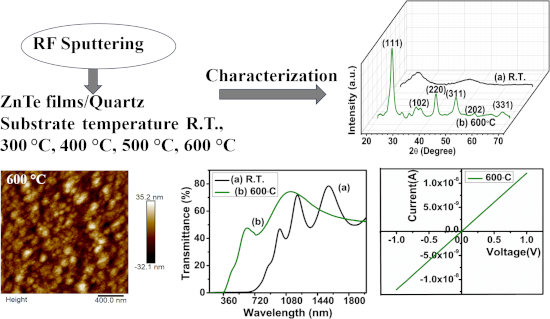
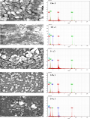
- out using EDS, and the obtained spectra are shown in Figure 4a1–e1. The existence of zinc and tellurium peaks indicates the formation of ZnTe thin films. The silicon and oxygen peaks are from the quartz substrate. The atomic percentages of Zn and Te are listed in Table 4. The film deposited at room
- thin films with varying thickness [35]. However, the changes we observed for direct bandgaps (1.47–3.11 eV) and indirect bandgaps (0.98–2.63 eV) are more significant. The existence of both direct and indirect bandgaps in a material has implications regarding the efficiency of solar cells. The
- different substrate temperatures. The linear portion of the graph was extrapolated to find the bandgap values. The indirect bandgap also increases, from 0.98 eV at R.T. to 2.63 eV at 600 °C, with the rise in substrate temperature. Pal et al. reported changes in direct and indirect bandgap values of ZnTe




Other Beilstein-Institut Open Science Activities



