


Search results
Search for "ammonia oxidation" in Full Text gives 3 result(s) in Beilstein Journal of Nanotechnology.
Light-driven ammonia electrooxidation via carbon nitride–ruthenium molecular interfaces
Beilstein J. Nanotechnol. 2026, 17, 854–862, doi:10.3762/bjnano.17.61
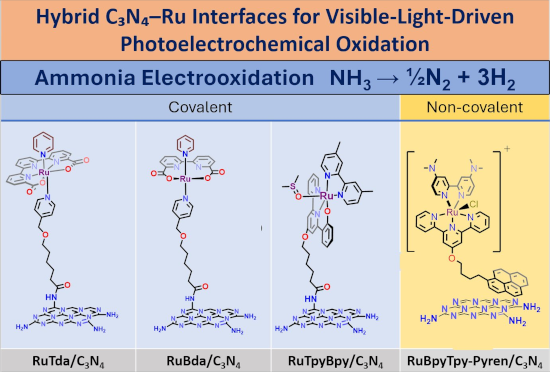
- ammonia oxidation, a reaction of growing importance as a sustainable hydrogen carrier. Inspired by natural photosynthesis, in which a light-harvesting antenna is spatially coupled to a multielectron catalytic centre, the proposed hybrid system assigns distinct and complementary roles to each component
- available materials, precedent reactions, and compelling mechanistic rationale, no study to date has reported photoelectrocatalytic ammonia oxidation at a C3N4–Ru hybrid photoelectrode, this gap is the motivation and the central argument of this perspective. Keywords: ammonia oxidation; carbon nitride
- and charge-conducting scaffold, functionally analogous to a photosensitizer, while the Ru complex serves as the molecular catalytic centre and light absorber too. Transferring this synergistic photoactive interface concept into photoelectrocatalysis for ammonia oxidation, a sustainable hydrogen


Ambient pressure XPS at MAX IV
Beilstein J. Nanotechnol. 2025, 16, 1677–1694, doi:10.3762/bjnano.16.118
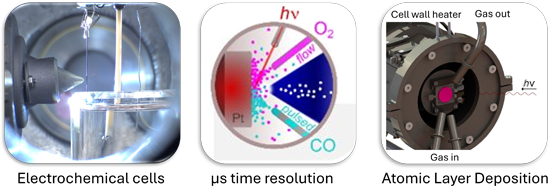
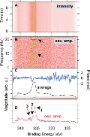
- different measurement schemes are presented below. The data are taken from two experiments performed at the SLE of the HIPPIE beamline, while exposing a catalyst to gas pulses. Ammonia oxidation (microsecond time-resolution, pump–probe mode): This experiment used 150 µs wide 170 V voltage pulses with a





Graphene functionalised by laser-ablated V2O5 for a highly sensitive NH3 sensor
Beilstein J. Nanotechnol. 2017, 8, 571–578, doi:10.3762/bjnano.8.61
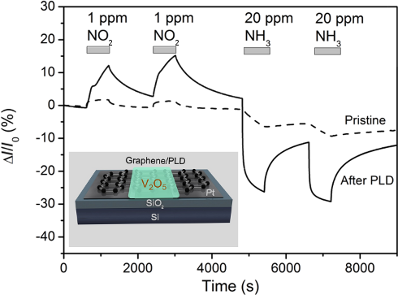
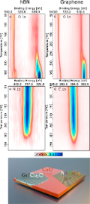
- spectra decreases, which is an indication of the reduction of V2O5 [7][9]. The corresponding ammonia oxidation reactions take place on the V2O5 catalytic surface. A variety of redox processes are possible, for example: Ambient oxygen can render the process reversible, as desired for sensor reset, for


Other Beilstein-Institut Open Science Activities



