


Search results
Search for "antioxidant effect" in Full Text gives 6 result(s) in Beilstein Journal of Nanotechnology.
Multifunctional anionic nanoemulsion with linseed oil and lecithin: a preliminary approach for dry eye disease
Beilstein J. Nanotechnol. 2025, 16, 1711–1733, doi:10.3762/bjnano.16.120
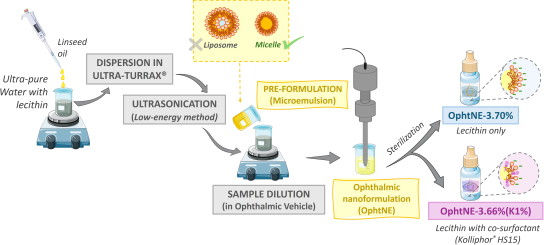
- , resulting in OphtNE-3.70% with a droplet diameter of 173 nm and a zeta potential of −44.7 mV. The addition of Kolliphor® HS15 in OphtNE-3.66%(K1%) initially reduced the droplet size to 70.8 nm and enhanced the antioxidant effect. Although the droplet size and polydispersity index increased after more than
- >75% cell viability in L929 cells and ~10% 2,2-diphenyl-1-picrylhydrazyl (DPPH) antioxidant effect. These findings support the multifunctional potential (cytocompatibility and antioxidant) of sterile OphtNE-3.66%(K1%) for the treatment of DED, emphasizing the need for in vivo studies to ensure its



Green synthesis of carbon dot structures from Rheum Ribes and Schottky diode fabrication
Beilstein J. Nanotechnol. 2024, 15, 1369–1375, doi:10.3762/bjnano.15.110
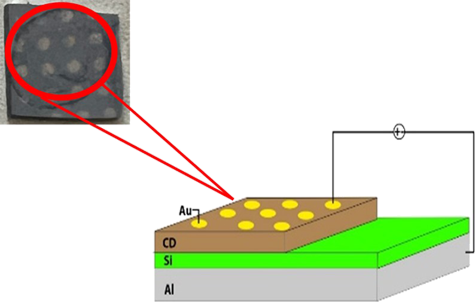
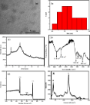
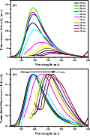
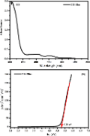
- herbaceous plant with yellowish-white flowers grows from May to June. Rheum ribes is the only Rheum species growing in Turkey. Flavonoids, stilbenes, and anthraquinones in its structure are the main phenolic components that provide a potential antioxidant effect to this plant. The young shoots and leaf stems




Ethosomal (−)-epigallocatechin-3-gallate as a novel approach to enhance antioxidant, anti-collagenase and anti-elastase effects
Beilstein J. Nanotechnol. 2022, 13, 491–502, doi:10.3762/bjnano.13.41
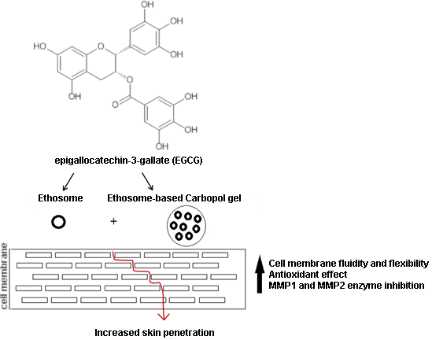
- had a long-term effect due to the stability of EGCG. The findings of the study underline the potential of antioxidant and antiaging effects of the developed ethosomal formulations for use in the cosmetic field. Keywords: antioxidant effect; antiaging effect; epigallocatechin gallate; ethosomal gel
- different plant extracts other than EGCG [15]. In this current study, we aimed to develop ethosomal formulations for the use of EGCG in cosmetics due to its widely known strong antioxidant effect, which has been emphasized in many studies. In addition, we focused on enhancing the long-term antioxidant
- dose determined based on cell viability results of 50% or more is appropriate [22][28]. In previous studies, the cytotoxic effect of EGCG, whose antioxidant effect has been proven many times, has been investigated, especially on cancer cell lines. Although there is no cytotoxicity study on the L929



Lipid nanostructures for antioxidant delivery: a comparative preformulation study
Beilstein J. Nanotechnol. 2019, 10, 1789–1801, doi:10.3762/bjnano.10.174
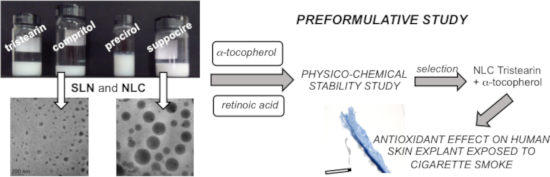
- size and the EE of TOC. Antioxidant effect of NLCs containing TOC Following the results obtained in the 2D cell model, the study of the protective effect of NLC T10-TOC was carried out on HSE. CS contains many components able to elicit oxidative stress, which can induce the cytoprotective enzyme heme

Scavenging of reactive oxygen species by phenolic compound-modified maghemite nanoparticles
Beilstein J. Nanotechnol. 2019, 10, 1073–1088, doi:10.3762/bjnano.10.108
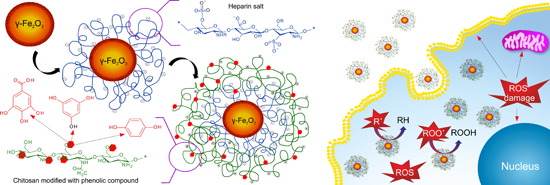
- exerted no difference on the ROS scavenging activity. The results suggested that phenolic compounds immobilized on the γ-Fe2O3 nanoparticles preserved their antioxidant effect to reduce ROS levels inside the cells. Conclusion Magnetic nanoparticles are increasingly used for biomagnetic separation





Liquid-phase exfoliated graphene: functionalization, characterization, and applications
Beilstein J. Nanotechnol. 2014, 5, 2328–2338, doi:10.3762/bjnano.5.242
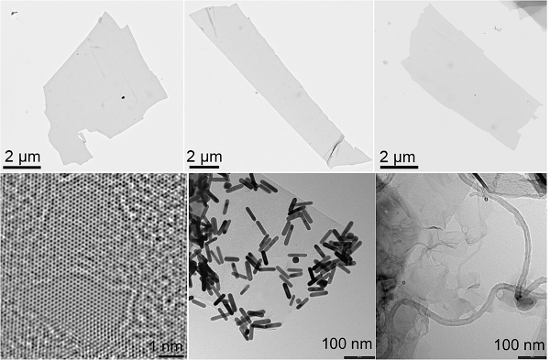
- source and catalyst. The proposed mechanism for the formation of the MWNTs from graphene is as follows [31]: (1) the production of graphene layers by ultrasonication of graphite in DMF, (2) the antioxidant effect of Fc–CHO which reduces the concentration of radical reactive species, reducing the cutting




Other Beilstein-Institut Open Science Activities



