


Search results
Search for "arboviruses" in Full Text gives 4 result(s) in Beilstein Journal of Nanotechnology.
Targeting the vector of arboviruses Aedes aegypti with nanoemulsions based on essential oils: a review with focus on larvicidal and repellent properties
Beilstein J. Nanotechnol. 2025, 16, 1894–1913, doi:10.3762/bjnano.16.132
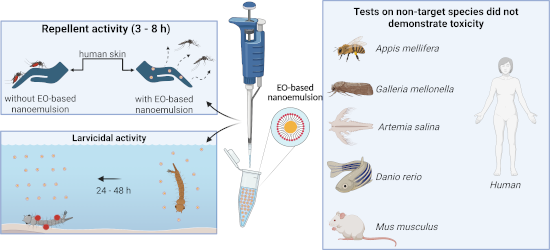
- , PE, Brazil 10.3762/bjnano.16.132 Abstract Mosquitoes of the Aedes genus are responsible for the transmission of arboviruses that seriously affect public health. Given the increasing resistance to traditional insecticides and their negative environmental impacts, the need for safer alternatives
- nanoemulsions are discussed. In addition, this review highlights challenges and perspectives on pharmaceutical nanotechnology towards nanoemulsions as safe, effective, and eco-friendly tools for controlling Ae. Aegypti. Keywords: Aedes aegypti; arboviruses; mosquito vector; nanoemulsion; nanotechnology
- ; natural products; Introduction Arboviruses (arthropod-borne viruses) are viruses transmitted by arthropods, including mosquitoes, sandflies, and ticks. Currently, more than 615 arboviruses have been recognized and reported in the literature. Their transmission cycle typically begins when a vector, such


Chitosan nanocomposite containing rotenoids: an alternative bioinsecticidal approach for the management of Aedes aegypti
Beilstein J. Nanotechnol. 2025, 16, 1197–1208, doi:10.3762/bjnano.16.88
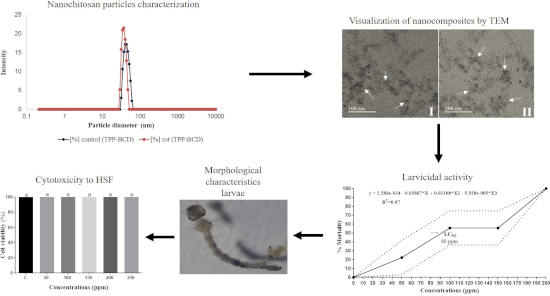
- significant advancement, vector management remains the primary strategy for preventing these urban arboviruses. In this context, the development of pesticides that offer safer alternatives for the environment and human health has become urgent. In this study, a chitosan-based nanocomposite was developed as a
- dengue prevention, Ae. aegypti vector management remains the primary strategy for controlling dengue and other urban arboviruses, such as chikungunya and zika. While most places are increasingly investing in the application of larger quantities of synthetic larvicides, such as the unprecedented



Green synthesis of silver nanoparticles derived from algae and their larvicidal properties to control Aedes aegypti
Beilstein J. Nanotechnol. 2024, 15, 1566–1575, doi:10.3762/bjnano.15.123

- , PE, Brazil Faculty of Medical Sciences, University of Pernambuco (UPE), 52171-011, Recife, PE, Brazil 10.3762/bjnano.15.123 Abstract Mosquito vectors such as Aedes spp. are responsible for the transmission of arboviruses that have a major impact on public health. Therefore, it is necessary to search
- aegypti (Stegomyia) Linnaeus (1762) (Diptera: Culicidae), known as the dengue mosquito, is a vector of important arboviroses, including Dengue, Zika, Chikungunya, and Yellow Fever [6]. Since there are no specific antiviral treatments for arboviruses and the endemicity of these diseases is determined by
- . aegypti and their potential role for the control and prevention of arboviruses are presented. Finally, ecotoxicity and environmental risk assessment of AgNPs are further discussed. Review Synthesis of silver nanoparticles AgNPs are metallic nanoparticles in a size range between 1 and 100 nm with unique


Development and characterization of potential larvicidal nanoemulsions against Aedes aegypti
Beilstein J. Nanotechnol. 2024, 15, 104–114, doi:10.3762/bjnano.15.10
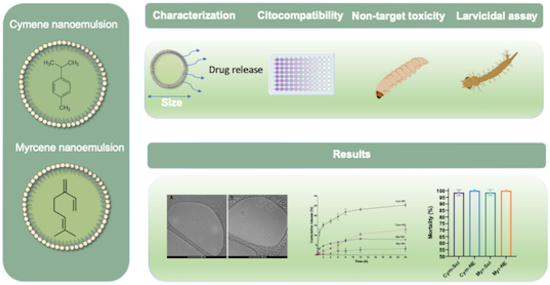
- ; drug delivery system; hydrophile–lipophile balance; monoterpenes; Introduction Aedes aegypti (Linnaeus, 1762) is a mosquito species that is cosmopolitan and well adapted to anthropized and peridomestic environments. It is an important vector of arboviruses, including dengue, chikungunya fever, zika


Other Beilstein-Institut Open Science Activities



