


Search results
Search for "azides" in Full Text gives 7 result(s) in Beilstein Journal of Nanotechnology.
Cross-reactivities in conjugation reactions involving iron oxide nanoparticles
Beilstein J. Nanotechnol. 2025, 16, 1504–1521, doi:10.3762/bjnano.16.106
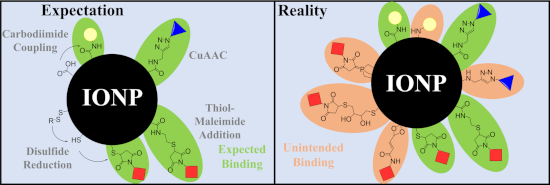
- commonly used click reactions and shows high specificity [15][16]. The Cu(I) catalyst increases the coupling rate of azides and alkynes by up to seven orders of magnitude, forming triazole rings, which possess exceptional chemical stability [16]. For these reasons, the CuAAC has been utilized extensively
- for the preparation of functional IONPs capped with either alkynes or azides [8][13][17][18][19][20][21][22][23][24][25][26][27]. The thiol–maleimide Michael addition reaction is another commonly employed click reaction [28][29][30][31], which can be performed at room temperature by simply mixing
- IONPs, which can be coupled to azides through the CuAAC, with no detectable cross-reactivity. At this point, it may be tempting to label the conjugation reaction as a success. However, an important step in the synthesis has been neglected: We have not provided evidence that the binding of PPA is through







Antibody-conjugated nanoparticles for target-specific drug delivery of chemotherapeutics
Beilstein J. Nanotechnol. 2023, 14, 912–926, doi:10.3762/bjnano.14.75
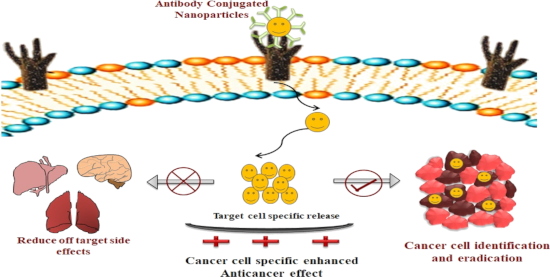
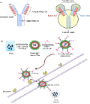
- byproducts. Click chemistry involves a copper-catalyzed cycloaddition between an organic azide and a terminal alkyne to form a stable 1,4-disubstituted 1,2,3-triazole ring (Figure 4c) [58][59]. Azides and alkynes are inert towards most functional groups and biomolecules. Hence, the NPs are functionalized



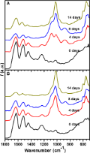
Recombinant DNA technology and click chemistry: a powerful combination for generating a hybrid elastin-like-statherin hydrogel to control calcium phosphate mineralization
Beilstein J. Nanotechnol. 2017, 8, 772–783, doi:10.3762/bjnano.8.80
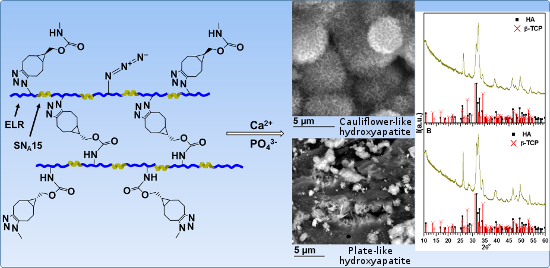
- required for cycloaddition – azides and terminal alkynes – are easily introduced [24][25][26][38]. The reaction conditions for biomedical and pharmaceutical applications are preferably mild and typically performed in water to ensure that the biological structures do not lose their function. Hydrogels can



Nanostructured carbon materials decorated with organophosphorus moieties: synthesis and application
Beilstein J. Nanotechnol. 2017, 8, 485–493, doi:10.3762/bjnano.8.52
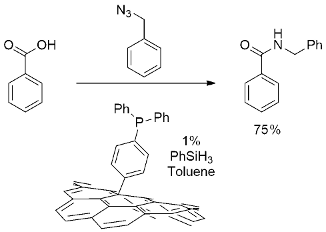
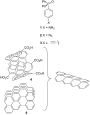
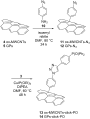
- corresponding phosphine derivatives and applied one of the materials produced as heterogeneous organocatalyst in a Staudinger ligation reaction. Keywords: azides; click chemistry; heterogeneous catalysis; organocatalysis; phosphorus; Introduction The term of carbon nanomaterial (CNMs) comprises many different
- organocatalyst in a Staudinger ligation of carboxylic acids and azides being inspired by work of Ashfeld and co-workers [24]. In this work the reaction between a carboxylic acid and an organic azide, to afford the corresponding amide is catalyzed by PPh3 (10 mol %). The process is general and affords high yields





Antitumor magnetic hyperthermia induced by RGD-functionalized Fe3O4 nanoparticles, in an experimental model of colorectal liver metastases
Beilstein J. Nanotechnol. 2016, 7, 1532–1542, doi:10.3762/bjnano.7.147
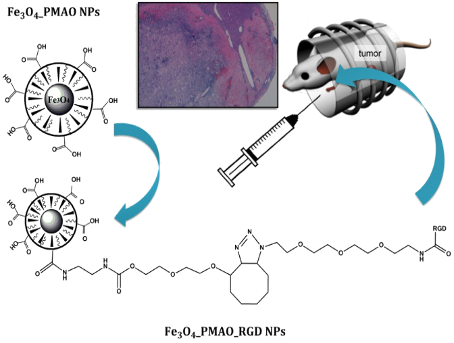
- motifs. These molecules could also be easily modified with functional groups, from azides or amines to other amino acids and fluorophores that give them different specificities [28]. One of the procedures to bind RGD peptides due to its unique features such as high aqueous competency, efficiency and
- intermediate which could fulfill the “click criteria” to add RGD by means of 1,3-dipolar cycloaddition of azides with the terminal alkynes. The preparation, together with both structural and magnetic characterization of RGD-functionalized nanoparticles, are also presented in this paper. The ultimate goal would


Donor–acceptor graphene-based hybrid materials facilitating photo-induced electron-transfer reactions
Beilstein J. Nanotechnol. 2014, 5, 1580–1589, doi:10.3762/bjnano.5.170
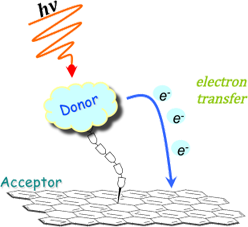
- reaction mechanism involves an electron transfer from graphene to the diazonium salt, resulting in the formation of a radical aryl unit, which subsequently adds to the sp2-carbon lattice of graphene; Addition of azides forming aziridine adducts onto graphene [41][42][43]. The particular functionalization
- proceeds via nitrenes as generated upon the thermal (or photochemical) decomposition of azides and the liberation of dinitrogen. Characterization, charge-separation and incident-photon-to-current efficiency Raman spectroscopy is an extremely useful tool for characterizing graphene-based materials. Pristine


Inorganic–organic hybrid materials through post-synthesis modification: Impact of the treatment with azides on the mesopore structure
Beilstein J. Nanotechnol. 2011, 2, 486–498, doi:10.3762/bjnano.2.52
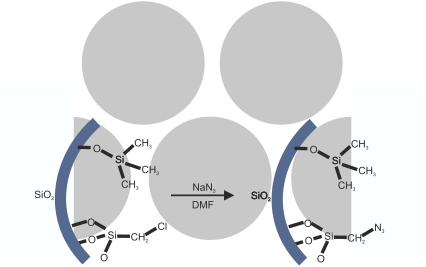
- precursor materials are of type IV with H2 hysteresis loops according to the classification of Sing et al. [31], whereas the same samples after conversion of the chlorides into azides display hysteresis loops of H1 type indicating a narrow distribution of pores. In addition, the isotherms for SiO2–(CH2)1,3
- 2.7 to 3.7 nm for methyl-spacer samples and in the range of 1.5 to 1.9 nm for propyl-spacer samples was observed. For instance, the chloromethyl-modified sample (3.0 mmol CMTMS) showed a pore diameter DBJH,Ads of 5.54 nm prior to nucleophilic substitution and after conversion into the azides an
- coverage of the silica surface with organic groups. For nitrogen sorption on non-modified silica materials, the CBET values are typically in the range 80–150 [34]. Figure 2 also shows the SAXS patterns for the modified silica gels before and after nucleophilic substitution of the chlorides into azides


Other Beilstein-Institut Open Science Activities



