


Search results
Search for "back contact materials" in Full Text gives 1 result(s) in Beilstein Journal of Nanotechnology.
Synthesis and characterization of RF-sputtered ZnTe/Cu2−xTe thin films for solar cell applications
Beilstein J. Nanotechnol. 2026, 17, 1016–1027, doi:10.3762/bjnano.17.69
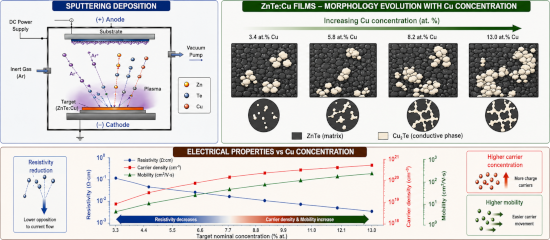
- incorporation and the formation of conductive Cu-rich secondary phases, yielding a biphasic system composed of semiconducting ZnTe and conductive Cu-rich telluride phases. These material properties suggest potential relevance for future studies of back-contact materials in CdTe-based solar cells. Keywords
- : back contact materials; Cu2−xTe phases; phase segregation; RF magnetron sputtering; ZnTe thin films; Introduction CdTe solar cells remain one of the leading thin-film photovoltaic technologies due to the near-optimal direct bandgap of CdTe (≈1.45 eV) and its high absorption coefficient (>104 cm−1
- investigated as alternative back contact materials. Although ZnTe exhibits intrinsic p-type conductivity and a wide bandgap (2.24 eV), its relatively low conductivity and the diffusion of Cu during growth remain limiting factors for device performance [6][7][8]. ZnTe has attracted considerable attention not



Other Beilstein-Institut Open Science Activities



