


Search results
Search for "cancer chemotherapy" in Full Text gives 8 result(s) in Beilstein Journal of Nanotechnology.
Nanocarrier strategies to overcome P-glycoprotein-mediated drug resistance in cancer therapy
Beilstein J. Nanotechnol. 2026, 17, 882–921, doi:10.3762/bjnano.17.64
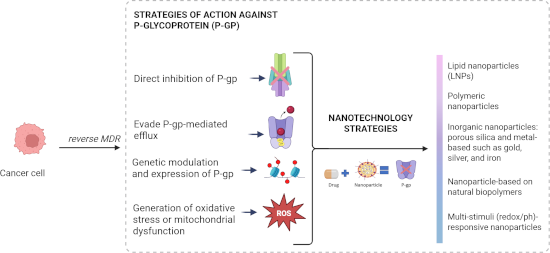
- City of Buenos Aires, Argentina 10.3762/bjnano.17.64 Abstract Multidrug resistance (MDR) remains a major barrier to successful cancer chemotherapy, frequently resulting in therapeutic failure, tumor relapses, and poor clinical outcomes. Among the diverse mechanisms underlying MDR, the overexpression
- . Keywords: cancer chemotherapy; efflux transporters; multidrug resistance (MDR); nanoparticles; siRNA nanocarriers; tumor-targeted therapy; Review 1 Introduction 1.1 Cancer and current challenges in chemotherapy Cancer remains one of the leading causes of mortality worldwide, with millions of new cases


Probing the potential of rare earth elements in the development of new anticancer drugs: single molecule studies
Beilstein J. Nanotechnol. 2025, 16, 187–194, doi:10.3762/bjnano.16.15

- interdisciplinary research to find, produce, and test drug candidates until they can reach the market [1][2]. Cancer chemotherapy, for instance, is a type of treatment that deserves improvements not only in the efficacy of the drugs employed to kill tumor cells, but also in reducing the occurrence of the well-known


AI-assisted models to predict chemotherapy drugs modified with C60 fullerene derivatives
Beilstein J. Nanotechnol. 2024, 15, 1170–1188, doi:10.3762/bjnano.15.95
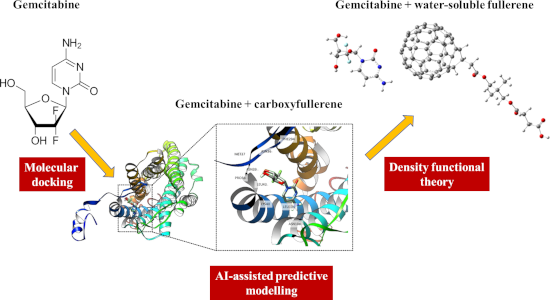
- relationship (QSAR)/ quantitative structure–property relationship (QSPR) models, this study explores the application of fullerene derivatives as nanocarriers for breast cancer chemotherapy drugs. Isolated drugs and two drug–fullerene complexes (i.e., drug–pristine C60 fullerene and drug–carboxyfullerene C60
- to compare results obtained by DFTB3 with a conventional density functional theory approach. These findings promise to enhance breast cancer chemotherapy by leveraging fullerene-based drug nanocarriers. Keywords: breast cancer; CXCR7; drug nanocarriers; QSAR; Introduction Breast cancer is the most
- commonly used for breast cancer chemotherapy modified with fullerene derivatives as drug nanocarriers was carried out. The CXCR7 protein was selected as a target for molecular docking calculations; the drugs were studied in the isolated form and modified with C60 fullerene and with the water-soluble C60


Antibody-conjugated nanoparticles for target-specific drug delivery of chemotherapeutics
Beilstein J. Nanotechnol. 2023, 14, 912–926, doi:10.3762/bjnano.14.75
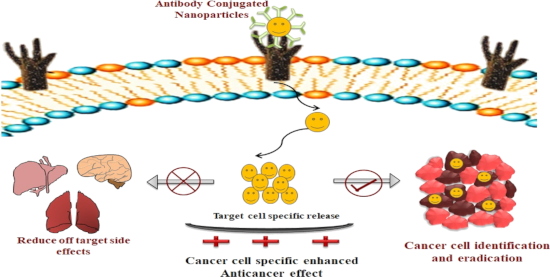
- antibodies, such as increased surface to volume-ratio, surface modification and functionalization, and improved cellular uptake and intracellular stability. In cancer chemotherapy, ACNPs have shown immense potential to achieve targeted drug delivery and combination therapy, to overcome drug resistance, to



Orally administered docetaxel-loaded chitosan-decorated cationic PLGA nanoparticles for intestinal tumors: formulation, comprehensive in vitro characterization, and release kinetics
Beilstein J. Nanotechnol. 2022, 13, 1393–1407, doi:10.3762/bjnano.13.115
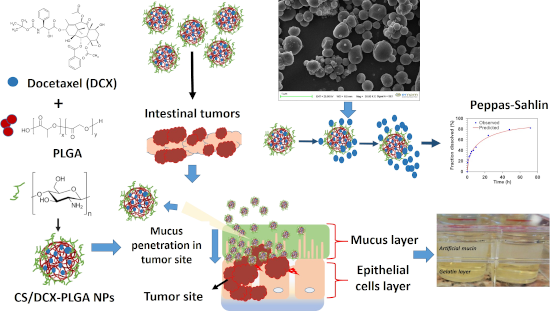
- approaches in the treatment of colon carcinomas as well as of many other diseases [10][11][12][13]. Cancer chemotherapy is still mostly administered parenterally, which is a negative factor in terms of patient comfort. Also, non-specific wide biodistribution of the drug after parenteral administration can
- is no need for a medical facility or health professional for each dose. It is less stressful and more affordable for the patient [16]. Considering that cancer is a chronic disease and that the person needs long-term treatment, oral formulations for cancer chemotherapy are still an issue of interest


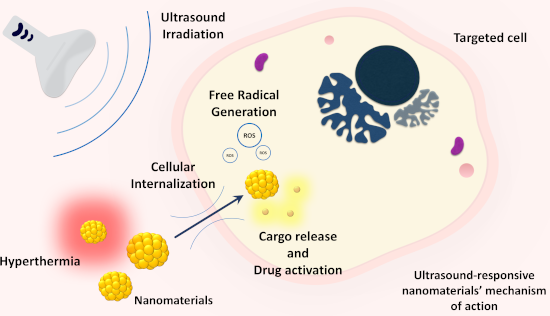
Comprehensive review on ultrasound-responsive theranostic nanomaterials: mechanisms, structures and medical applications
Beilstein J. Nanotechnol. 2021, 12, 808–862, doi:10.3762/bjnano.12.64


Tight junction between endothelial cells: the interaction between nanoparticles and blood vessels
Beilstein J. Nanotechnol. 2016, 7, 675–684, doi:10.3762/bjnano.7.60
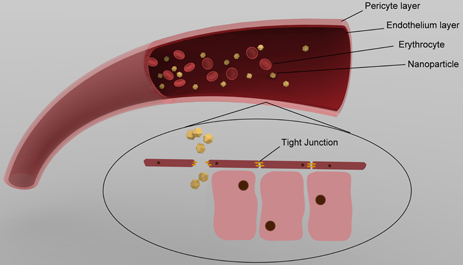
- defeat some of the drawbacks in traditional cancer chemotherapy (such as multidrug resistance (MDR) in tumors [6]). They can be modified to enhance the specificity of tumor therapy. Admittedly, no scientist could ignore its prominent latent prospect, but meanwhile numerous researches show their concerns

Release behaviour and toxicity evaluation of levodopa from carboxylated single-walled carbon nanotubes
Beilstein J. Nanotechnol. 2015, 6, 243–253, doi:10.3762/bjnano.6.23
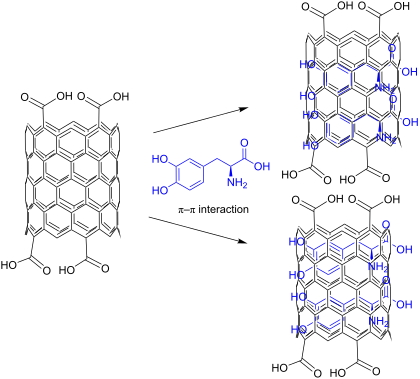
- intense research for theranostic delivery systems, especially in the field of cancer chemotherapy [7][8][9]. Their attractive properties such as good biocompatibility and excellent chemical and thermal stability ensure the stability and solubility of drugs in aqueous environments. Furthermore, their




Other Beilstein-Institut Open Science Activities



