


Search results
Search for "carbon nanoparticles (CNPs)" in Full Text gives 2 result(s) in Beilstein Journal of Nanotechnology.
Toward clinical translation of carbon nanomaterials in anticancer drug delivery: the need for standardisation
Beilstein J. Nanotechnol. 2025, 16, 2092–2104, doi:10.3762/bjnano.16.144

- enhancing therapeutic delivery, particularly in areas such as cancer treatment. This perspective highlights critical considerations in the development of CNM-based nanocarriers, spanning from initial design to clinical implementation. Keywords: carbon nanomaterials (CNMs); carbon nanoparticles (CNPs); drug
- instance, small carbon nanoparticles (CNPs) are readily cleared through renal pathways, whereas larger or irregularly shaped CNPs tend to accumulate in organs such as the liver and spleen. Characterisation of these properties is typically performed using dynamic light scattering, electron microscopy, or



Identification of physicochemical properties that modulate nanoparticle aggregation in blood
Beilstein J. Nanotechnol. 2020, 11, 550–567, doi:10.3762/bjnano.11.44
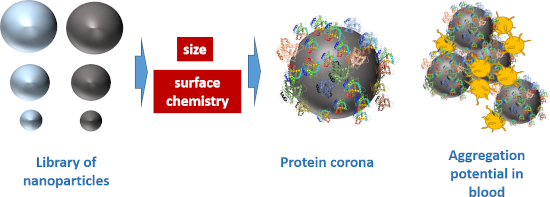
- other hand, contrasting data have been reported on the potential of isometric carbon nanoparticles (CNPs) like carbon black, fullerenes and diesel exhaust particles to induce platelet activation and NP aggregation [10][11][13]. Systemic administration of carbon black in mice resulted in fibrinogen and
- (Germany). 5,5-dimethyl-1-pyrroline N-oxide (DMPO) was obtained from Cayman Chemicals (USA). Ultrapure water was obtained from a Milli-Q Plus system (Millipore, Bedford, MA, USA). All other chemicals and solvents used were at least of analytical grade. Synthesis of carbon nanoparticles Carbon nanoparticles
- (CNPs) were produced starting from glucose using a one-step hydrothermal process as previously described by Kokalari et al. 2019 [24]. Briefly, glucose was dissolved in 50 mL of ultrapure water followed by the addition of 15 mg of sodium polyacrilate. The solution was introduced in a pressure reactor




Other Beilstein-Institut Open Science Activities



