


Search results
Search for "carbon nanotube sponge" in Full Text gives 2 result(s) in Beilstein Journal of Nanotechnology.
Interconnection morphology effects on the radio frequency response of carbon nanotube sponges
Beilstein J. Nanotechnol. 2026, 17, 343–351, doi:10.3762/bjnano.17.23
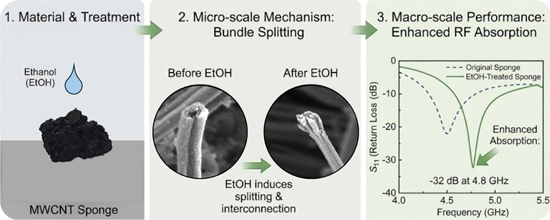
- applied for these tests, and an increase in the response up to 45% was found for the two studied positions. Keywords: carbon nanotube film; carbon nanotube sponge; chemical vapour deposition; monopole RF antenna; Introduction Most radio frequency (RF) applications rely on the use of conductors with low
- increased from 0.5 to 5.0 μm, the gain changed from 14% up to 70% [19]. MWCNTs were also mixed with conductive polymers [20][21] or with metals [22], showing sizeable improvements in the response. More recently, a novel material based on a 3D self-standing CNT assembly, often denoted as carbon nanotube
- sponge (CNS) [23], was applied as active medium for the fabrication of antennas [24]. The material consists of highly interconnected MWCNTs that are assembled during the synthesis process and confer the material its 3D shape. In addition, the assembly has interesting macroscopical properties like high



Applications of three-dimensional carbon nanotube networks
Beilstein J. Nanotechnol. 2015, 6, 792–798, doi:10.3762/bjnano.6.82

- respond to incident light in the visible and near-ultraviolet region and to generate a photocurrent. Keywords: carbon nanotube sponge; electrochemical; hydrophobicity; lipophilicity; Introduction In the last years, there has been growing interest in developing natural and synthetic three-dimensional


Other Beilstein-Institut Open Science Activities



