


Search results
Search for "cell–material interactions" in Full Text gives 4 result(s) in Beilstein Journal of Nanotechnology.
Polycatecholamine nanocoatings on stainless steel: the effect on attachment of human fibroblasts and platelets
Beilstein J. Nanotechnol. 2026, 17, 365–380, doi:10.3762/bjnano.17.25
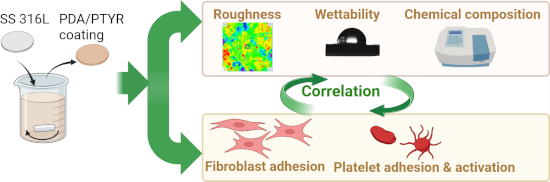
- : cell–material interactions; Fenton oxidation; hemocompatibility; nanocoatings; polycatechols; Introduction Stainless steel 316L (SS 316L) is an iron-based alloy containing chromium and molybdenum, which promote passivation and corrosion resistance [1]. Owing to its mechanical robustness
- stability. Consequently, a variety of surface modifications have been developed to improve cell–material interactions, including anodized nanopit arrays, hydroxyapatite–collagen layers on polydopamine-modified steel, nanoporous coatings influencing integrin/ERK signaling, and bilayers comprising graphene
- with native cells promotes their integration and mitigates inflammatory processes, the coatings on long-term metallic implants must fulfil some essential requirements. Such coatings must (i) provide corrosion protection, (ii) maintain mechanical integrity, (iii) support cell–material interactions, and




Bioselectivity of silk protein-based materials and their bio-inspired applications
Beilstein J. Nanotechnol. 2022, 13, 902–921, doi:10.3762/bjnano.13.81
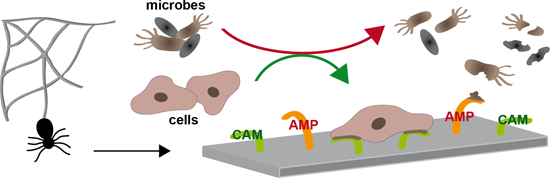
- foam walls, while cellular aggregates were formed in and on unmodified eADF4(C16) foams, because the cells preferred cell-cell-contacts over cell-material-interactions (Figure 3C) [169]. Additionally, it could be shown that osteoblasts, fibroblasts, keratinocytes, and myoblasts adhere to eADF4(C16)-RGD


The nanomorphology of cell surfaces of adhered osteoblasts
Beilstein J. Nanotechnol. 2021, 12, 242–256, doi:10.3762/bjnano.12.20
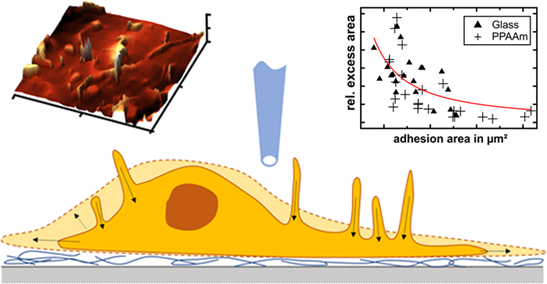
- applied for studying cell–material interactions [63] with similar characteristics to those of primary human osteoblasts [64][65]. Cells were cultured in Dulbecco’s modified Eagle’s medium (DMEM, 31966-021, Life Technologies Limited, Paisley, UK), with 10% fetal calf serum (FCS, Biochrom FCS Superior


Oxygen-plasma-modified biomimetic nanofibrous scaffolds for enhanced compatibility of cardiovascular implants
Beilstein J. Nanotechnol. 2015, 6, 254–262, doi:10.3762/bjnano.6.24
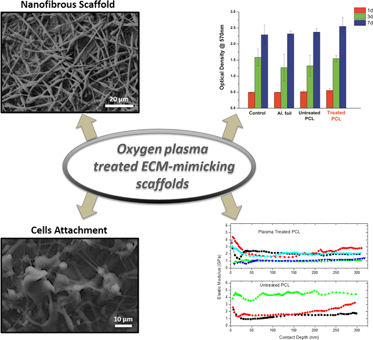
- control and favor cell activity. Thus, the ultimate aim of the present work was to modify the hydrophobic surface of electrospun nanofibrous PCL scaffolds, in order to improve the surface chemistry and favor the cell-material interactions without dramatically affecting the morphological features of the


Other Beilstein-Institut Open Science Activities



