


Search results
Search for "chemosensor" in Full Text gives 2 result(s) in Beilstein Journal of Nanotechnology.
Cross-scale design of chemosensor arrays: from molecular self-assembly in water to paper-based devices for metal ion detection
Beilstein J. Nanotechnol. 2026, 17, 828–838, doi:10.3762/bjnano.17.59
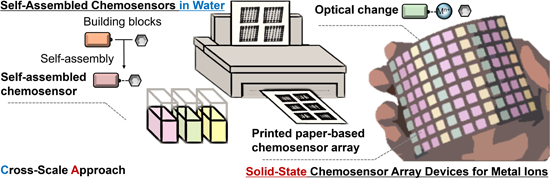
- optical signals. In particular, coordination with metal ions enables cross-reactive sensing, allowing for simultaneous detection of multiple analytes based on pattern recognition. This perspective summarizes advances in self-assembled chemosensor systems for metal ion detection and further developments to
- solid-state chemosensor array devices based on nanotechnologies. In practical chemosensor designs, dynamic covalent bonds between catechol and phenylboronic acid derivatives have been employed to provide a versatile strategy for the spontaneous preparation of chemosensor elements without extensive
- ions in various water environments across microscopic and macroscopic scales. Keywords: chemosensor; metal ion; paper device; pattern recognition; self-assembly; Introduction Metal ions are essential species in biological systems; however, heavy metal ions act as pollutants and can damage organs and


Optical bio/chemical sensors for vitamin B12 analysis in food and pharmaceuticals: state of the art, challenges, and future outlooks
Beilstein J. Nanotechnol. 2025, 16, 2207–2244, doi:10.3762/bjnano.16.153
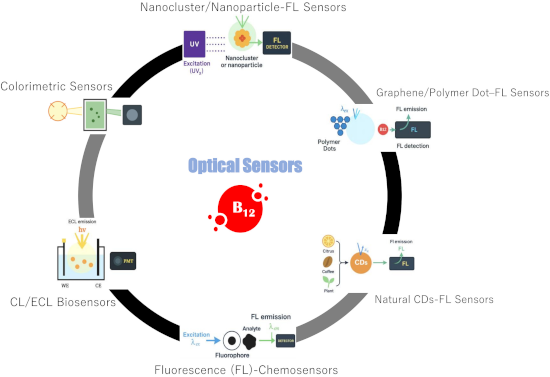
- significant difference in the detected amounts of MeCbl among the utilized diagnostic assays [78]. Small-molecule-based colorimetric chemosensors for cobalt/VB12 detection In this class, the recognition material is a small-molecule receptor (chemosensor), the indicator material is its intrinsic chromophore or
- hemoglobin. Conversely, excessive absorption of Co2+ causes some negative impacts on health, including asthma, reduced cardiac output, and heart and lung diseases [79]. A new colorimetric chemosensor fabricated from a pyridyl moiety and a 2-chloro-N-(2-((3-nitro-2-oxo-2H-chromen-4-yl)amino)phenyl)acetamide
- sensor could effectively oxidize Co2+ to Co3+ in almost entirely aqueous environment. Na et al. also showed that this chemosensor had a superb capacity to be an optical solid sensor [80]. Maity and Govindaraju earlier reported a colorimetric coumarin-conjugated thiocarbanohydrazone-based chemosensor


Other Beilstein-Institut Open Science Activities



