


Search results
Search for "chloropicrin (CP)" in Full Text gives 1 result(s) in Beilstein Journal of Nanotechnology.
Electronic and optical properties of chloropicrin adsorbed ZnS nanotubes: first principle analysis
Beilstein J. Nanotechnol. 2025, 16, 1184–1196, doi:10.3762/bjnano.16.87
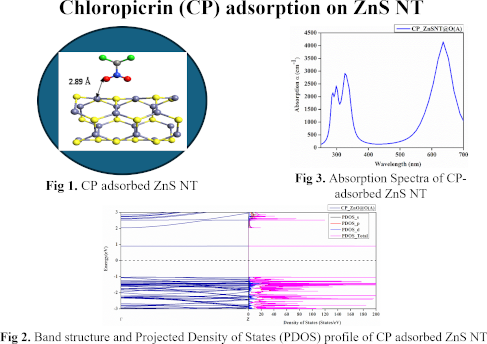
- functional theory (DFT) to explore the sensing capabilities of a ZnS (3,3) nanotube (ZnS NT) for detecting chloropicrin (CP, CCl3NO2), a highly toxic gas. To elucidate the sensing mechanism, we systematically analyze the adsorption configurations, Mulliken charge transfer, band structure, density of states
- spectra and optical conductivity peaks, highlight the potential of ZnS NT for designing sensitive and reusable CP gas sensors. Keywords: chemical sensor; chloropicrin (CP); density functional theory; zinc sulfide nanotubes (ZnS NTs); Introduction Chloropicrin (CP), also known as trichloronitromethane
- ZnO@ZnS heterostructures and ZnS NTs exhibited superior amperometric cholesterol sensing performance, with ZnS NTs achieving the highest sensitivity (598 mA/m2) and low detection limits among the configurations studied. Despite these advances, the use of ZnS NT for detecting chloropicrin (CP), a


Other Beilstein-Institut Open Science Activities



