


Search results
Search for "copper-catalyzed azide–alkyne cycloaddition" in Full Text gives 2 result(s) in Beilstein Journal of Nanotechnology.
Cross-reactivities in conjugation reactions involving iron oxide nanoparticles
Beilstein J. Nanotechnol. 2025, 16, 1504–1521, doi:10.3762/bjnano.16.106
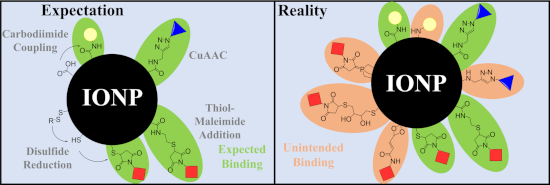
- IONPs (IONP-3,4-DHBA) as a platform upon which carbodiimide coupling can be used to conjugate clickable small molecules for further functionalization using two common click reactions, namely, the copper-catalyzed azide–alkyne cycloaddition (CuAAC), and the thiol–maleimide Michael addition reactions
- erroneous conclusions about the efficacy of conjugation reactions, which can have detrimental impacts on the functionality and safety of IONPs in biomedical applications. Keywords: click chemistry; copper-catalyzed azide–alkyne cycloaddition; disulfide reduction; iron oxide nanoparticles; thiol–maleimide
- thermodynamic driving force, use simple reaction conditions, produce no interfering byproducts, produce products that are stable under physiological conditions, and can be purified easily using non-chromatographic means. The copper-catalyzed azide–alkyne cycloaddition (CuAAC) reaction is one of the most







Tailoring the ligand shell for the control of cellular uptake and optical properties of nanocrystals
Beilstein J. Nanotechnol. 2015, 6, 232–242, doi:10.3762/bjnano.6.22
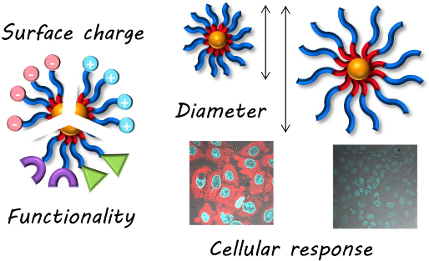
- system fulfills all stated requirements for biomedical applications such as no toxicity and no unspecific interaction in vitro and in vivo. The vast functionalization properties prior to and after the encapsulation of nanoparticles, even including copper catalyzed azide–alkyne cycloaddition make the PI-b






Other Beilstein-Institut Open Science Activities



