


Search results
Search for "core-hole clock" in Full Text gives 2 result(s) in Beilstein Journal of Nanotechnology.
Probing internal continua and atomic ultrafast charge transfer within size-controlled nanoparticles by post-collision interaction in core-hole clock spectroscopy
Beilstein J. Nanotechnol. 2026, 17, 505–514, doi:10.3762/bjnano.17.33
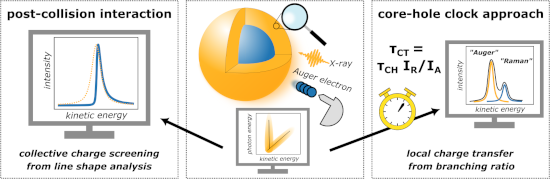
- -Liebknecht-Straße 24/25, 14476 Potsdam-Golm, Germany 10.3762/bjnano.17.33 Abstract This study investigates size-controlled, quantum-confined CdSe/ZnS core–shell quantum dots using core-hole clock spectroscopy in combination with post-collision interaction (PCI) line shape analysis, providing insights into
- experimental approach enables the simultaneous observation of collective electronic properties and atom-specific dynamics within in a single measurement under identical sample conditions, an advance particularly valuable for complex, sensitive materials. Keywords: core-hole clock; nanoparticles; post
- surface ligands [14]. In this work, we obtain charge transfer on the atomic scale for size-dependent quantum-confined systems using core-hole clock (CHC) spectroscopy. We further expand the well-established CHC approach by the aspect of detecting the internal continuum states within the size-controlled



The influence of an interfacial hBN layer on the fluorescence of an organic molecule
Beilstein J. Nanotechnol. 2020, 11, 1663–1684, doi:10.3762/bjnano.11.149
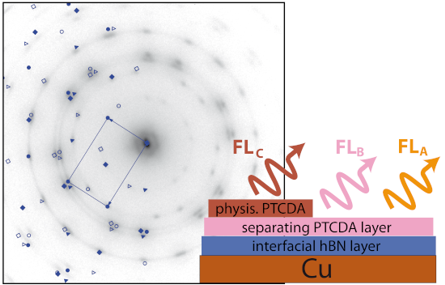
- states and the dynamical CT in the excited state can be probed by photoemission spectroscopy (PES). In particular, core hole clock spectroscopy has been used to measure the time constant of dynamical CT in the valence band states as a function of the lifetime of the core hole, which is typically of the





Other Beilstein-Institut Open Science Activities



