


Search results
Search for "dasatinib" in Full Text gives 3 result(s) in Beilstein Journal of Nanotechnology.
Breaking barriers: nanosystems to overcome solubility and permeability challenges of second-generation tyrosine kinase inhibitors
Beilstein J. Nanotechnol. 2026, 17, 1063–1086, doi:10.3762/bjnano.17.73
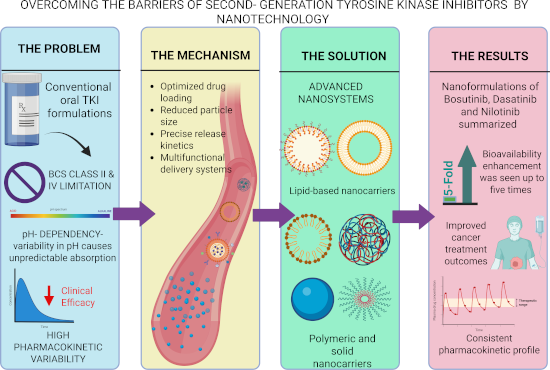
- , Cadila Pharmaceuticals Limited, Survey No. 1389, Trasad Road, Dholka, Ahmedabad, Gujarat, 382225, India 10.3762/bjnano.17.73 Abstract Second-generation tyrosine kinase inhibitors (TKIs) – bosutinib, nilotinib, and dasatinib – demonstrate therapeutic efficacy across various chronic malignancies
- stability, scalability, and feasibility for clinical transition. Keywords: BCS class-IV; bioavailability enhancement; biopharmaceutical limitation; bosutinib; dasatinib; drug delivery system; nanosystems; nilotinib; quality by design; second-generation TKI; Introduction Tyrosine kinases have emerged as
- epithelial transition factor, epidermal growth factor receptor, Janus kinase, platelet-derived growth factor receptor, receptor tyrosine kinase, Sarcoma (Src), and vascular endothelial growth factor receptor [1]. The three main second-generation TKIs are bosutinib (BTB), nilotinib (NTB), and dasatinib (DTB


Nanocarrier strategies to overcome P-glycoprotein-mediated drug resistance in cancer therapy
Beilstein J. Nanotechnol. 2026, 17, 882–921, doi:10.3762/bjnano.17.64
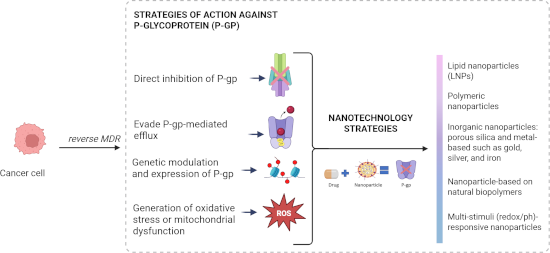
- , docetaxel), and several tyrosine kinase inhibitors (dasatinib, gefitinib), among others [18][21]. The consequence in each case is a reduction in intracellular drug concentration sufficient to prevent the cytotoxic threshold from being reached. Understanding P-gp’s functional regulation and structural


The impact of molecular tumor profiling on the design strategies for targeting myeloid leukemia and EGFR/CD44-positive solid tumors
Beilstein J. Nanotechnol. 2021, 12, 375–401, doi:10.3762/bjnano.12.31
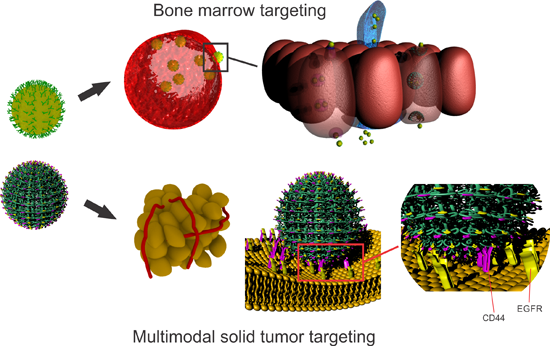
- %, from 50% in the pre-imatinib era [7]. However, imatinib and related TKIs (the second-generation TKIs dasatinib, bosutinib, nilotinib, and the third-generation ponatinib) are not exclusively specific for the BCR-ABL fusion protein, and may also affect normal c-ABL and other kinases such as c-KIT. This
- all currently available TKIs, except for ponatinib, a third-generation TKI. In addition, second-generation TKIs also display similar resistance mechanisms as imatinib, but the mutation spectra are different: T315I, F317L or V299L for dasatinib, E255K/V, T315I, F359C/V or Y253H for nilotinib, and V299L
- the synergistic effect of the combinational chemotherapy regimen. Clinical observations have revealed that co-administration of imatinib mesylate (IM) and other TKIs, such as nilotinib or dasatinib, may yield additive/synergistic anti-leukemia effects in CML [59][60]. Considering this, the development


Other Beilstein-Institut Open Science Activities



