


Search results
Search for "differentiation marker" in Full Text gives 3 result(s) in Beilstein Journal of Nanotechnology.
Piezoelectricity of hexagonal boron nitrides improves bone tissue generation as tested on osteoblasts
Beilstein J. Nanotechnol. 2025, 16, 1068–1081, doi:10.3762/bjnano.16.78
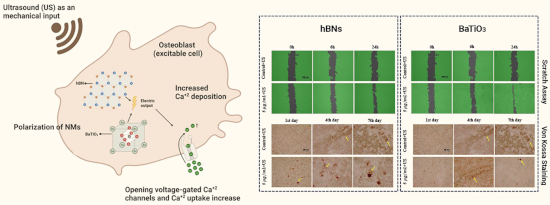
- stimulation on osteoblastic differentiation, calcium depositions as an osteoblastic end differentiation marker was detected via the von Kossa staining procedure. Coloring is based on the conversion of calcium salts into silver salts. The calcium ions bound to the phosphates are replaced by the silver ions in


Effect of silver nanoparticles on human mesenchymal stem cell differentiation
Beilstein J. Nanotechnol. 2014, 5, 2058–2069, doi:10.3762/bjnano.5.214
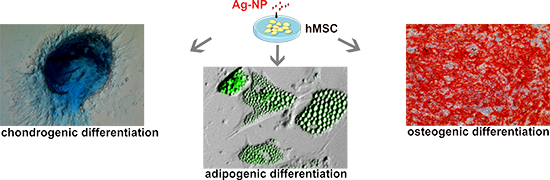
- -toxic concentrations. Therefore, more studies are needed to investigate the effects of silver species on cells at low concentrations during long-term treatment. Keywords: differentiation; differentiation marker; mesenchymal stem cells; nanoparticles; silver; Introduction Novel nanomaterials are being
- absence of silver. The asterisks (*) indicate significant differences in comparison to the control (*p < 0.05;**p < 0.005). Release of the adipogenic differentiation marker adiponectin after hMSCs were incubated with Ag-NP/Ag+ ions. After incubation with different concentrations of Ag-NP/Ag+ ions for 24 h
- respect to to the control (*p < 0.05; **p < 0.005). Release of the osteogenic differentiation marker osteocalcin after incubation of hMSCs with Ag-NP/Ag+ ions. The data are expressed as the mean ± SD (n = 7 independent experiments), given as the percent of the control (osteocalcin 15.6 ± 6 ng·mL−1; cells


Carbon-based smart nanomaterials in biomedicine and neuroengineering
Beilstein J. Nanotechnol. 2014, 5, 1849–1863, doi:10.3762/bjnano.5.196
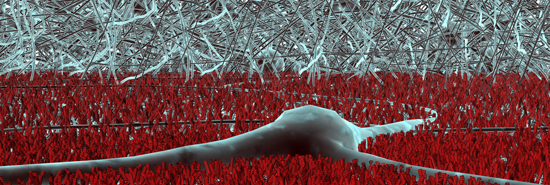
- transformation into myofibroblasts. Their results showed an up-regulated expression of a specific differentiation marker, accompanied, however, by an increased generation of the most biologically significant free radicals, the reactive oxygen species (ROS). NDs: Among the applications of NDs, the most important


Other Beilstein-Institut Open Science Activities



