


Search results
Search for "electrode modifier" in Full Text gives 2 result(s) in Beilstein Journal of Nanotechnology.
Electrochemical sensing of sildenafil in pharmaceutical formulations using an (S,N)-doped reduced graphene oxide-modified electrode
Beilstein J. Nanotechnol. 2026, 17, 1087–1102, doi:10.3762/bjnano.17.74
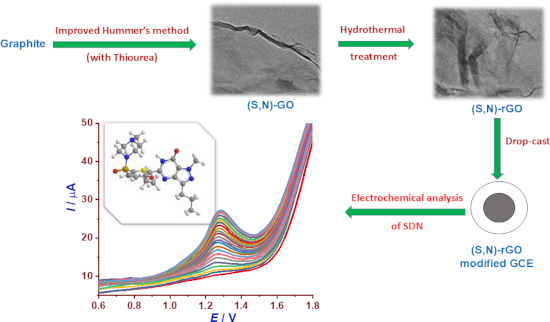
- samples. The results were in good agreement with those from high-performance liquid chromatography, indicating that the proposed electrochemical method is reliable and suitable for practical analysis. Keywords: differential pulse voltammetry; electrode modifier; rGO; (S,N)-rGO; sildenafil; Introduction
- demonstrated to significantly improve electrochemical performance by introducing defects, redistributing charge density, and facilitating electron transfer processes [20][21]. In our previous study [22], nitrogen- and sulfur-doped reduced graphene oxide ((S,N)-rGO) was explored as a potential electrode
- modifier for the electrochemical detection of SDN, showing promising electrocatalytic behavior. However, that work was mainly limited to a proof-of-concept study and lacked a systematic investigation of the sensing mechanism, optimization of experimental conditions, and a comprehensive evaluation of



Simultaneous electrochemical determination of uric acid and hypoxanthine at a TiO2/graphene quantum dot-modified electrode
Beilstein J. Nanotechnol. 2024, 15, 719–732, doi:10.3762/bjnano.15.60
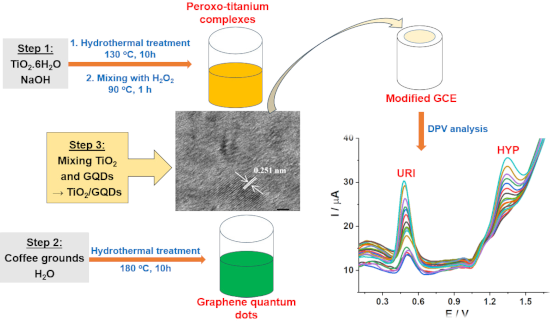
- composite (TiO2/GQDs) obtained by in situ synthesis of GQDs, derived from coffee grounds, and peroxo titanium complexes was used as electrode modifier in the simultaneous electrochemical determination of uric acid and hypoxanthine. The TiO2/GQDs material was characterized by photoluminescence, X-ray


Other Beilstein-Institut Open Science Activities



