


Search results
Search for "glass–glass interfaces" in Full Text gives 3 result(s) in Beilstein Journal of Nanotechnology.
Nanoglasses: a trail towards uncharted regions of vitreous materials and their properties?
Beilstein J. Nanotechnol. 2026, 17, 1047–1062, doi:10.3762/bjnano.17.72

- Way Tucson, AZ 85719, United States Institute of Nanotechnology, Karlsruhe Institute of Technology, Kaiserstr. 12, 76131 Karlsruhe, Germany 10.3762/bjnano.17.72 Abstract Nanoglasses are a class of non-crystalline materials composed of nanoscale glass regions separated by glass–glass interfaces that
- compared with conventional homogeneous glasses, giving rise to unique structural and functional properties. Additionally, the interfaces between the glass cores and the glass–glass interfaces need to be considered, as the specific interface areas are large. In this perspective paper, we discuss the
- structure, thermodynamics, and stability of glass–glass interfaces and examine their implications for the design and properties of nanoglasses, highlighting that this approach represents a novel pathway for modifying amorphous materials more broadly. Particular attention is given to columnar thin-film


Influence of grain size and composition, topology and excess free volume on the deformation behavior of Cu–Zr nanoglasses
Beilstein J. Nanotechnol. 2015, 6, 537–545, doi:10.3762/bjnano.6.56
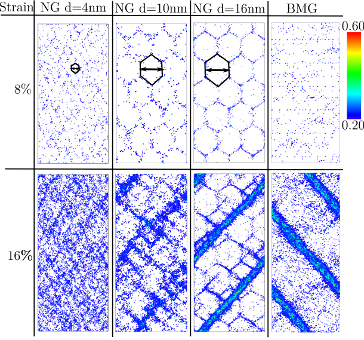
- interfaces are very different from the bulk phase. After thermal treatment the redistribution of free volume leads to a more homogenous deformation behavior. The deformation behavior of the softer Zr-rich nanoglass, in contrast, is only weakly affected by the presence of glass–glass interfaces, since the
- ; Introduction A nanoglass (NG) is a nanostructured material produced via cold compaction of glassy nanoparticles [1]. It consists of glassy grains separated by glass–glass interfaces. Indirect experimental evidence for the existence of interfaces in NGs have been provided by Gleiter et al. [2][3][4][5][6][7
- ]. The recent work of Chen et al. [8], supports Gleiter’s results on the structural model of a NG. The microstructure of a metallic nanoglass consisting of glassy grains and glass–glass interfaces has been experimentally revealed by electron microscopy, small-angle X-ray scattering and positron



Nanoglasses: a new kind of noncrystalline materials
Beilstein J. Nanotechnol. 2013, 4, 517–533, doi:10.3762/bjnano.4.61
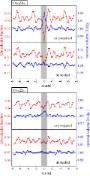
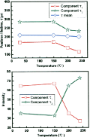
- have a similar chemical composition. Thus, this component is considered to originate from the interior of the consolidated glassy clusters. The second (τ2 = 285 ps) was seen exclusively in nanoglasses. Hence, it is supposed to originate from the glass–glass interfaces, which are characterized by an
- enhanced free volume. As seen in Figure 8 (lower figure), in the as-prepared Fe25Sc75 nanoglass the volume fraction of the glass–glass interfaces was about 65%. Upon annealing of the Fe25Sc75 nanoglass, the initial intensity of 65% of the τ1 component decreased to about 25% when the temperature was
- consisting of regions of high density and regions of lower density. By using the volume fractions of the glassy regions and of the glass–glass interfaces deduced from PAS (Figure 8), one obtains a difference in the electron density of about 17% between the density of the glass–glass interfaces and the






Other Beilstein-Institut Open Science Activities



