


Search results
Search for "hemotoxicity" in Full Text gives 3 result(s) in Beilstein Journal of Nanotechnology.
Ultrasonic irradiation in the synthesis of nanohydroxyapatite: a chemically friendly technique for improving hemocompatibility and antibiofilm applications
Beilstein J. Nanotechnol. 2026, 17, 991–1015, doi:10.3762/bjnano.17.68
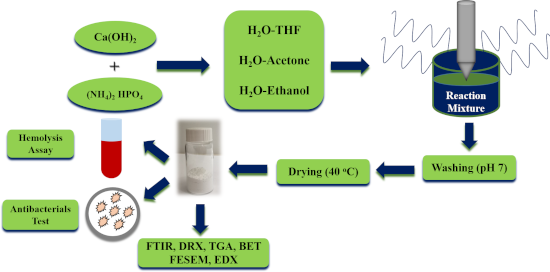
- hemotoxicity (hemolysis < 2%), and did not affect platelet ADP aggregation processes. Microbiological assays showed a significant reduction in Pseudomonas aeruginosa biomass production (p < 0.05) after 24 h, particularly for nHA synthesized with the W/ETOH mixture. There was also a less bacterial colonization
- ]. Nanohydroxyapatite is distinguished by its remarkable osteoinduction and osteoconduction capabilities, making it a bioceramic with great potential in biomedical engineering. Its low hemotoxicity [27][28] and antibacterial properties [29][30] further expand its applicability in the field of biomaterials. It is also
- previously, supports the highly promising and non-disruptive preliminary profile of the synthesized nanostructures. When assessing the hemotoxicity of a biomaterial, platelet aggregation must also be studied. This process is crucial for preventing many circulation-related diseases and pathologies, such as




Doxorubicin-loaded gold nanorods: a multifunctional chemo-photothermal nanoplatform for cancer management
Beilstein J. Nanotechnol. 2021, 12, 295–303, doi:10.3762/bjnano.12.24
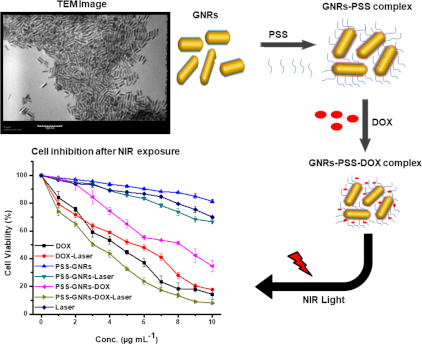
- hemoglobin in the supernatant of GNPs-RBCs mixture by monitoring absorbance intensity at 570 nm. The absence of a marked hemotoxicity of this sample is mainly related to the presence of the polymer. The GNR surface had no direct contact with the RBCs because it was completely passivated by the PSS coating
- -GNRs for 24 h. (b) A hemotoxicity assay on PSS-GNRs shows that PSS-GNRs are hemo-compatible. No significant difference was seen in the range of 5–500 µg/mL (<20% hemolysis). A low significant (***) of a high significant difference (****) were seen for 1000 and 2000 µg/mL compared with 100 µg/mL. Each


Nanoconjugates of a calixresorcinarene derivative with methoxy poly(ethylene glycol) fragments for drug encapsulation
Beilstein J. Nanotechnol. 2018, 9, 2057–2070, doi:10.3762/bjnano.9.195
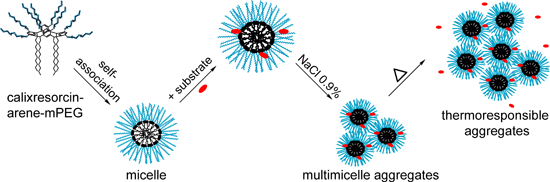
- a non-toxic amphiphilic calixresorcinarene capable to form nanoconjugates for drug encapsulation, tetraundecylcalixresorcinarene functionalized by methoxy poly(ethylene glycol) chains has been synthesized. The macrocycle obtained is characterized by low hemotoxicity. In aqueous solution it forms
- use as a supramolecular drug-delivery system. Keywords: calixresorcinarene; drug encapsulation; hemotoxicity; methoxy poly(ethylene glycol); temperature-controlled release; Introduction One of the acute problems of modern medicinal therapy is the development of novel drug-delivery systems with low
- calixarene and calixresorcinarene polylactide star polymers [19]. Self-association and hemotoxicity of 3 First, the self-association of macrocycle 3 in the aqueous solution was studied by using small-angle X-ray scattering (SAXS). The obtained data are typical for core–shell particles that practically do not


Other Beilstein-Institut Open Science Activities



