


Search results
Search for "hollow nanospheres" in Full Text gives 5 result(s) in Beilstein Journal of Nanotechnology.
Laser ablation in liquids for shape-tailored synthesis of nanomaterials: status and challenges
Beilstein J. Nanotechnol. 2025, 16, 1963–1997, doi:10.3762/bjnano.16.137
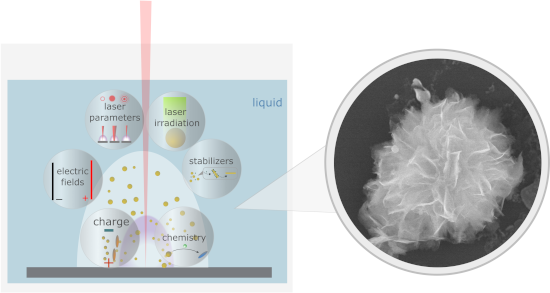
- –water mixtures provides a higher yield of gaseous products which favours the formation of hollow nanospheres. This effect observed in water–ethanol mixtures is explained by a longer cavitation bubble lifetime as compared to that of pure water [56][57]. Similarly, saturation of a liquid with gases also
- provides a route to synthesize hollow nanospheres, as shown in [58]. The reactive gases, such as H2, O2, and CO2 can also direct the growth of nonspherical NPs by adsorption on the seed NP surface and block the growth along specific directions [59][60]. The ambient gases can also induce exfoliation of






Laser processing in liquids: insights into nanocolloid generation and thin film integration for energy, photonic, and sensing applications
Beilstein J. Nanotechnol. 2025, 16, 1428–1498, doi:10.3762/bjnano.16.104
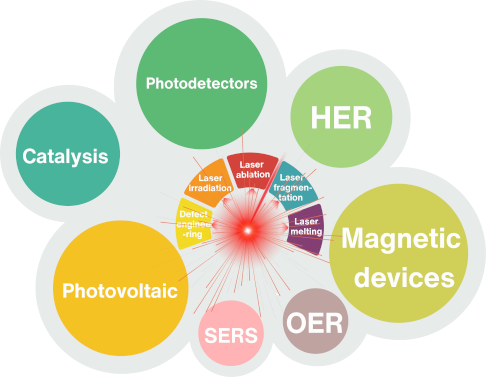
- particle size through a relatively simple process, further advancing the field of laser-based nanoparticle synthesis. The first report on the fabrication of ZnO quantum dots (QDs) through laser irradiation of ZnO hollow nanospheres in a liquid medium highlighted a rapid, simple process conducted at room






Novel hollow titanium dioxide nanospheres with antimicrobial activity against resistant bacteria
Beilstein J. Nanotechnol. 2019, 10, 1716–1725, doi:10.3762/bjnano.10.167
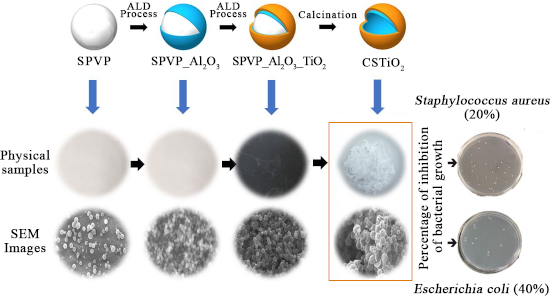
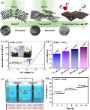
- and titanium dioxide, and after a calcination process, hollow nanospheres were obtained with a radius of approximately 345 nm and shell thickness of 17 nm. The structural characterization was performed using electron microscopy, and X-ray diffraction and small-angle X-ray diffraction evidenced an
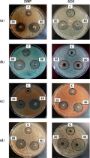
- anatase titanium dioxide crystalline structure. Thermogravimetric analysis and Fourier-transform infrared spectroscopy studies demonstrated the absence of polymer residue after the calcination process. The antimicrobial properties of the developed CSTiO2 hollow nanospheres were evaluated against different
- ; atomic layer deposition; electrospinning; hollow nanospheres; titanium dioxide; Introduction Microbial contamination and the increase of multidrug bacterial resistance have become two major current concerns for food safety and human health due to the number of food-borne diseases and nosocomial


Near-infrared-responsive, superparamagnetic Au@Co nanochains
Beilstein J. Nanotechnol. 2017, 8, 1680–1687, doi:10.3762/bjnano.8.168
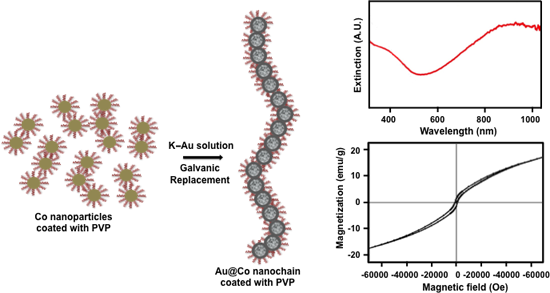
- of K–gold solution, a plasmon resonance appeared as a strong peak at ca. 900 nm; importantly, the nanochains possess no extinction bands characteristic of either bare gold nanoparticles or pure gold nanochains [68][69][70]. As mentioned above, Au-coated hollow nanospheres using Co nanoparticles as a


The Kirkendall effect and nanoscience: hollow nanospheres and nanotubes
Beilstein J. Nanotechnol. 2015, 6, 1348–1361, doi:10.3762/bjnano.6.139
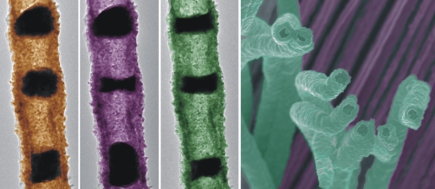
- the conversion chemistry of nanostructures from solid to hollow has reached a very advanced maturity, there is still much to be discovered and learned on this effect. Here, the recent progress on the use of the Kirkendall effect to synthesize hollow nanospheres and nanotubes is reviewed with a special
- conclude with a summary, where the prospective future direction of this research field is discussed. Keywords: hollow nanospheres; Kirkendall effect; metals; nanotubes; oxides; Review Introduction In the years following the discovery of the diffusion of gold in solid lead by Roberts-Austen in 1896 [1][2
- Kirkendall effect was reviewed by Fan et al. [23]. In this first review, they summarized and discussed the achievements from both the experimental and theoretical point of view. In 2012, a review focusing mainly on the synthesis of hollow nanospheres using the Kirkendall effect was reported by Wang et al



Other Beilstein-Institut Open Science Activities



